

On this page
Biology makes up half of the NEET paper. For years, students relied on rote memorisation of facts to score well. However, the pattern has changed. Recent papers feature a heavy load of complex formats like Statement-based questions in NEET, multi-statement selection, and assertion-reason questions.
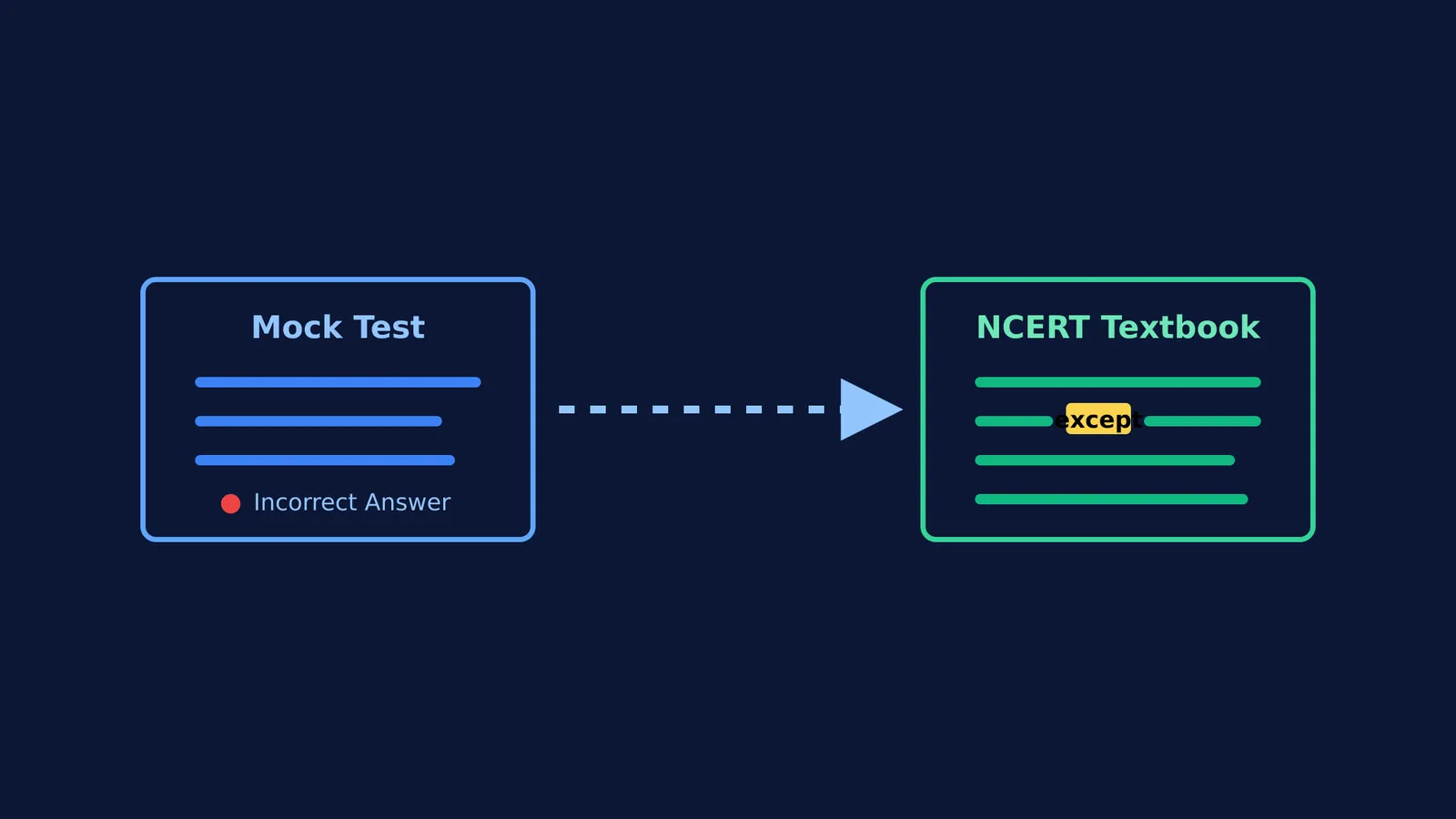
These questions take more time to read and are designed to trap you if you are fuzzy on the details. The vast majority of these questions are derived directly from the exact lines of the NCERT textbooks. If you get a question wrong, it is rarely because the concept is outside the syllabus; it is usually because you missed a crucial word like "not", "except", or "always" when reading the textbook.
How can you trace errors to the exact NCERT line?
When reviewing a mock test, reading the provided answer key is not enough. You need to build a system that connects every mistake back to the source material. Using NCERT lines for NEET biology means treating the textbook as a map.
Find the exact sentence: For every incorrect or unattempted question, open your NCERT textbook and locate the exact page and paragraph where the fact is mentioned.
Read the context: Read the entire paragraph surrounding the fact. Question setters often pick the very next line for the subsequent mock test.
Mark the trap: Use a brightly coloured highlighter or a sticky note to mark the specific word or diagram label that confused you. This highlights your weak zones for final revision.
Log the error: Write down why you made the mistake in a dedicated logbook. Was it a conceptual gap (not understanding how a mechanism works), a factual slip (forgetting an example), or a reading error (missing a keyword)?
What are the common biology traps in NEET?
When you analyse your mock tests, you will likely notice patterns in your mistakes. Exam setters frequently lay traps using these common methods:
Similar terms: Mixing up words that look alike but mean different things, such as *glucagon* versus *glycogen*, or *apoenzyme* versus *coenzyme*.
Skipped examples: Forgetting the specific plant or animal examples given in chapters like Plant Morphology or Animal Kingdom.
The summary and boxes: Many students skip the chapter summary or the scientist biographies at the start of each unit. Examiners frequently pull statement-based questions from these exact sections.
When you log these specific traps, you will know exactly what to look for the next time you open your textbook.
Why does testing improve memory?
Why is a detailed review more effective than just re-reading the textbook? A landmark 2006 study on test-enhanced learning by psychologists Henry Roediger and Jeffrey Karpicke proved that testing actively strengthens memory.
In the study, college students were divided into groups. One group read science passages multiple times. Another group read the passage once and then took three recall tests. After one week, the group that simply re-read the material retained far less of the information. The group that practiced active retrieval showed substantially greater retention.
Re-reading creates an "illusion of competence" because the words feel familiar when they are right in front of you. Taking a test forces your brain to work harder, and that mental effort is what locks the information into long-term memory. Knowing how to analyse a mock test effectively means using it as a learning tool, not just a score.
How do you fix conceptual gaps in biology?
Sometimes a mistake happens because you genuinely do not understand the underlying biology. If you are struggling with a complex process like the counter-current mechanism or the Calvin cycle, re-reading the same confusing paragraph will not help.
This is where an AI tutor steps in. If you bring a confusing mock test question to Fermi's AI tutor, it will not just give you the answer. Fermi works out what you already know, builds a plan for the session, and teaches through it—drawing the figure and checking your understanding as it goes. If you need a comprehensive refresher on a topic, the Concept Library contains a mapped lesson for every concept in biology, physics, and chemistry.
Your mistakes are the most valuable part of a mock test. By systematically tracing them to their source and testing yourself on the weak spots, you stop losing marks to the same traps.


