

On this page
Rough work is not the problem in a board exam; messy rough work is. A calculation scribbled between two answers makes the examiner stop and work out what counts. The fix takes seconds: a ruled-off column, a label and one clean line through it.
What do the boards actually say about rough work?
The clearest official rule we found is from CISCE. Instruction 12 on the ISC 2026 Mathematics specimen question paper says: "All workings, including rough work, should be done on the same page as, and adjacent to, the rest of the answer." So for ISC maths, a separate rough page at the back is not what the paper asks for.
For CBSE, we could not find a published rule naming an exact spot for rough work. Many websites say "right margin"; we did not find that on a CBSE page, so treat it as advice. What CBSE does publish helps:
In its pre-exam FAQ for students, CBSE says no separate marks are given for presentation, but answers can be neat, well organised and have important points underlined.
The same FAQ says whitener is not permitted, so strike rough work through with a line rather than trying to cover it up.
The CBSE 2025 marking scheme instructions to examiners tell them to write marks in the left-hand margin and encircle them, so that margin is not yours to fill. For questions with parts, the same instructions have marks for each part awarded on the right-hand side.
Your own paper has the final word: read the answer book cover and question paper instructions, listen to the invigilator, and follow them where they differ from this article.
Where should I do rough work in the board exam answer sheet?
The safest default for any board is a narrow column on the right of the same page as the answer. It keeps your working beside the answer, as ISC asks, and leaves the left-hand margin clear for the examiner's marks, as CBSE's examiner instructions need. Because part marks go on the right-hand side, keep the column tidy and leave a little blank space at the page edge.
Set it up like this:
Before you start a calculation answer, draw a vertical line about a quarter of the page width from the right edge, top to bottom, with your pencil or pen.
Write "Rough work" at the top of the column.
Do every side calculation in that column, at the same height as the step it belongs to.
When the answer is finished, draw one diagonal line through the column. Do not scribble it out.
Write the question number in the left margin, beside the answer, never inside the rough column.
If your paper does not ask for working beside the answer, a back page headed "Rough work" is a fallback: write the question number beside each calculation and strike it through. The cost is that your working sits far from your answer. For ISC maths, the instruction above rules it out.
What does a neat rough column look like?
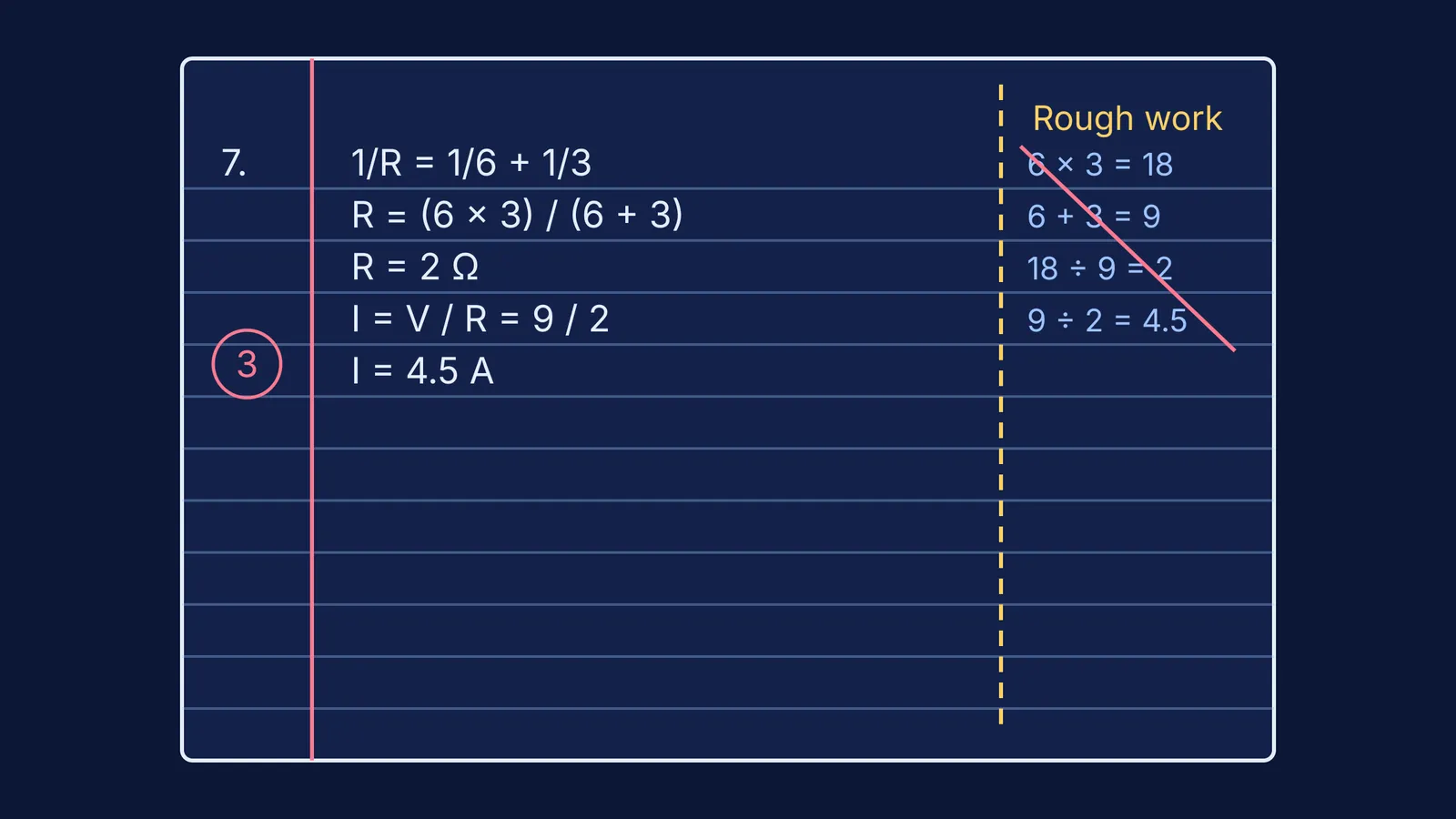
Take a Class 12 physics numerical: resistors of 6 ohms and 3 ohms are in parallel across a 9 V battery. Find the current drawn.
In the answer column you write:
Q 7 in the left margin
1/R = 1/6 + 1/3, so R = (6 × 3) / (6 + 3)
R = 2 ohms
I = V / R = 9 / 2
I = 4.5 A
In the rough column, level with those lines, you write 6 × 3 = 18, 6 + 3 = 9, 18 ÷ 9 = 2 and 9 ÷ 2 = 4.5. Then you strike the column once. The examiner never wonders whether "18" is your final answer.
Rehearse this layout on your next few practice numericals. The Fermi Problem Library has worked problems with a step-by-step solver that explains the reasoning rather than printing an answer, so you can check that every step you put in the answer column is a real step and only the arithmetic went into the rough column.
What mistakes with rough work cost students marks?
Doing rough work on the question paper. Your paper's instructions decide this; assume it is not allowed unless they say so.
Leaving two versions of an answer. CBSE's examiner instructions say that if a student attempts an extra question, the answer deserving more marks is kept and the other scored out, and its FAQ says attempting both options confuses the examiner. Strike out what you do not want marked.
Hiding a key step in the rough column. If a step could earn marks, such as a formula or a substitution, it belongs in the answer.
For more on laying out your answer, read our guide on how to write maths steps in board exams, check what CBSE allows in your stationery kit, and plan how to use the 15 minutes of reading time before you write a line.


