

On this page
If you are preparing for JEE, the exercises at the end of each NCERT chapter are the cheapest good practice you own: every book can be downloaded as a PDF from NCERT's textbook site. The real question is which ones deserve a full written solution, and when to move on.
Should I solve NCERT exercise questions for JEE?
Yes, for two reasons you can check yourself.
The first is the syllabus. The unit names in NTA's JEE Main 2027 syllabus (Units and Measurements, Kinematics, Laws of Motion, Work, Energy and Power, Rotational Motion, Gravitation and so on) closely follow the chapter list of your Class 11 NCERT Physics book. The exercises test exactly those ideas.
The second is how memory works. In a 2008 study in Science, Karpicke and Roediger found that, for students learning foreign-language vocabulary, repeated studying after an item had been learned had no effect on delayed recall, while repeated testing produced a large positive effect. A review of ten study techniques by Dunlosky and colleagues rated practice testing as high utility, and rereading and highlighting as low. Solving an exercise is practice testing. Reading the chapter a third time is rereading.
Which NCERT questions should you solve fully?
Not every question needs a page of working. Sort each one into three bins before you start.
Solve fully, on paper, without the solution: every numerical in physics and physical chemistry, every maths question where you cannot see the whole path at a glance, the miscellaneous exercise at the end of each maths chapter, and any chemistry question that asks you to write a reaction, a mechanism or a structure.
Answer aloud, then check the text: the “define”, “state” and “explain why” questions. If you can say it clearly from memory, tick it. If you stumble, reread that paragraph and try again tomorrow.
Skim: long descriptive questions that repeat a paragraph of the chapter almost word for word.
In inorganic chemistry, bin 2 matters more than it looks: answering those questions aloud is a quick way to find the NCERT lines you have not learned yet. Our guide on how deep to study chemistry for JEE Advanced goes further.
How fast should you move through NCERT exercises?
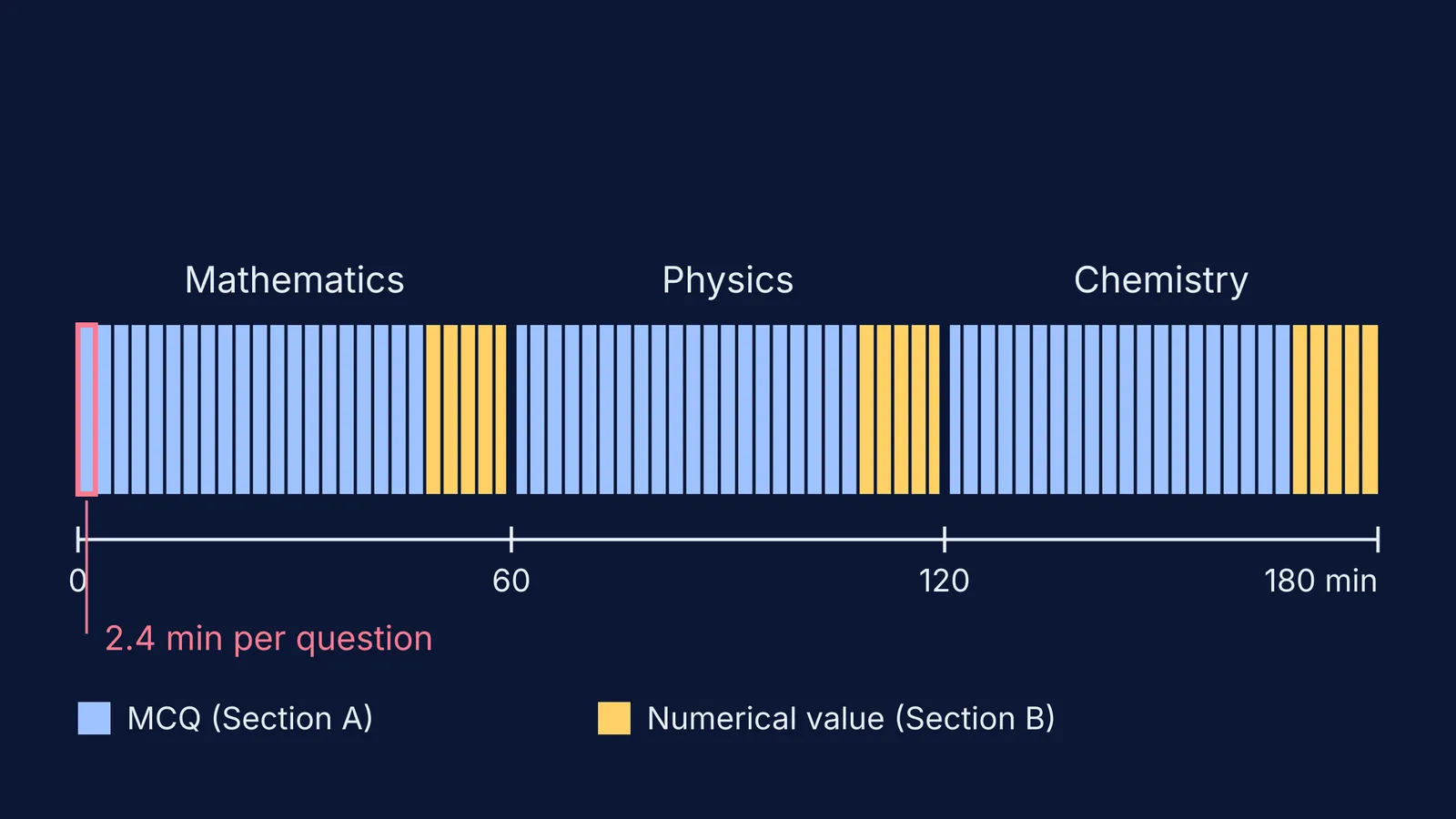
Use the exam as your clock. According to the JEE Main 2027 Information Bulletin, Paper 1 has 75 questions in 3 hours: 25 each in mathematics, physics and chemistry, of which 20 are multiple choice and 5 need a numerical answer, with +4 for a correct answer and −1 for a wrong one in both sections. That works out to 2.4 minutes per question on average.
NCERT exercise questions are usually more direct than JEE questions, so they should not take longer. Run this test on each exercise:
Pick five bin-1 questions from across the exercise, not just the first five.
Set a timer for 12 minutes, which is five questions at the JEE Main pace.
Solve without notes, then check every answer.
All five right in time: finish the rest of bin 1 quickly, then open the Exemplar chapter.
Three or four right, or over time: solve every bin-1 question, and redo the misses later in the week.
Two or fewer right: go back to the chapter text and its solved examples before touching the exercise again.
For example, say you finish the Laws of Motion chapter on Monday. That evening you take the five-question test, get four right but run over time, and the miss is a pulley problem where your free-body diagram was wrong. Verdict: solve all the numericals this week, drawing the free-body diagram before writing any equation. On Thursday, redo the pulley question cold. If it comes out clean, start the Exemplar chapter at the weekend.
When a miss is about method (you knew the physics but set the equations up wrongly), the Fermi Problem Library has worked problems with a step-by-step solver that explains the reasoning rather than printing an answer, so you can find the step where your setup went off. When the miss is a concept gap, the Fermi Concept Library gives each concept its own lesson and its place in the map.
Before you tick a question as done, check your answer properly. Our guide to checking your NCERT exercise answers with AI shows how to do that without copying.
What comes after NCERT exercises?
NCERT publishes Exemplar Problems for Class 11 and 12 physics, chemistry and mathematics as downloadable PDFs, with answers. They follow the same chapters at a harder level, so they are the natural next step. After that come previous papers and timed tests; our plan for when to start full mock tests shows how to phase them in.
Tonight, pick one chapter you have finished, set a 12-minute timer, and let five questions tell you where you stand.


