On this page
Modern physics is a compact part of the JEE Main physics syllabus. In NTA's JEE Main 2027 syllabus, it sits in three of the 20 physics units: Unit 17 (Dual Nature of Matter and Radiation), Unit 18 (Atoms and Nuclei) and Unit 19 (Electronic Devices). The unit text is short and largely formula-based, so secure these chapters early.
What is in modern physics for JEE Main 2027?
NTA's 2027 syllabus PDF names these topics:
Unit 17: dual nature of radiation, photoelectric effect, Hertz and Lenard's observations, Einstein's photoelectric equation, matter waves and the de Broglie relation.
Unit 18: alpha-particle scattering, Rutherford and Bohr models, energy levels, hydrogen spectrum, nuclear composition and size, mass defect, binding energy per nucleon, fission and fusion.
Unit 19: semiconductors, diode I-V characteristics and rectifiers, LED, photodiode, solar cell, Zener regulator, and the OR, AND, NOT, NAND and NOR gates.
Notice that the 2027 text for Unit 18 does not name radioactive decay or half-life. Put your time into the listed topics; if an old book covers more, read it once and move on.
The JEE Main 2027 Information Bulletin gives physics 20 multiple-choice questions and 5 numerical-value questions, worth 100 marks in total. Each correct answer earns +4 and each wrong one costs 1, in both sections. The bulletin does not give marks by chapter, so treat any weightage table as an estimate; our guide to using chapter weightage in JEE Main preparation explains how to read them.
How do you build a modern physics concept sheet?
Keep it to one page. Write each formula beside its meaning and units; a formula you cannot explain is one you will misuse under time pressure, as our post on why memorising physics formulas fails explains.
Photon energy: E = hc/λ, with hc ≈ 1240 eV nm, from NIST's values for Planck's constant in eV and the speed of light.
Einstein's equation: K_max = hν − φ = eV₀, where V₀ is the stopping potential.
de Broglie wavelength: λ = h/p.
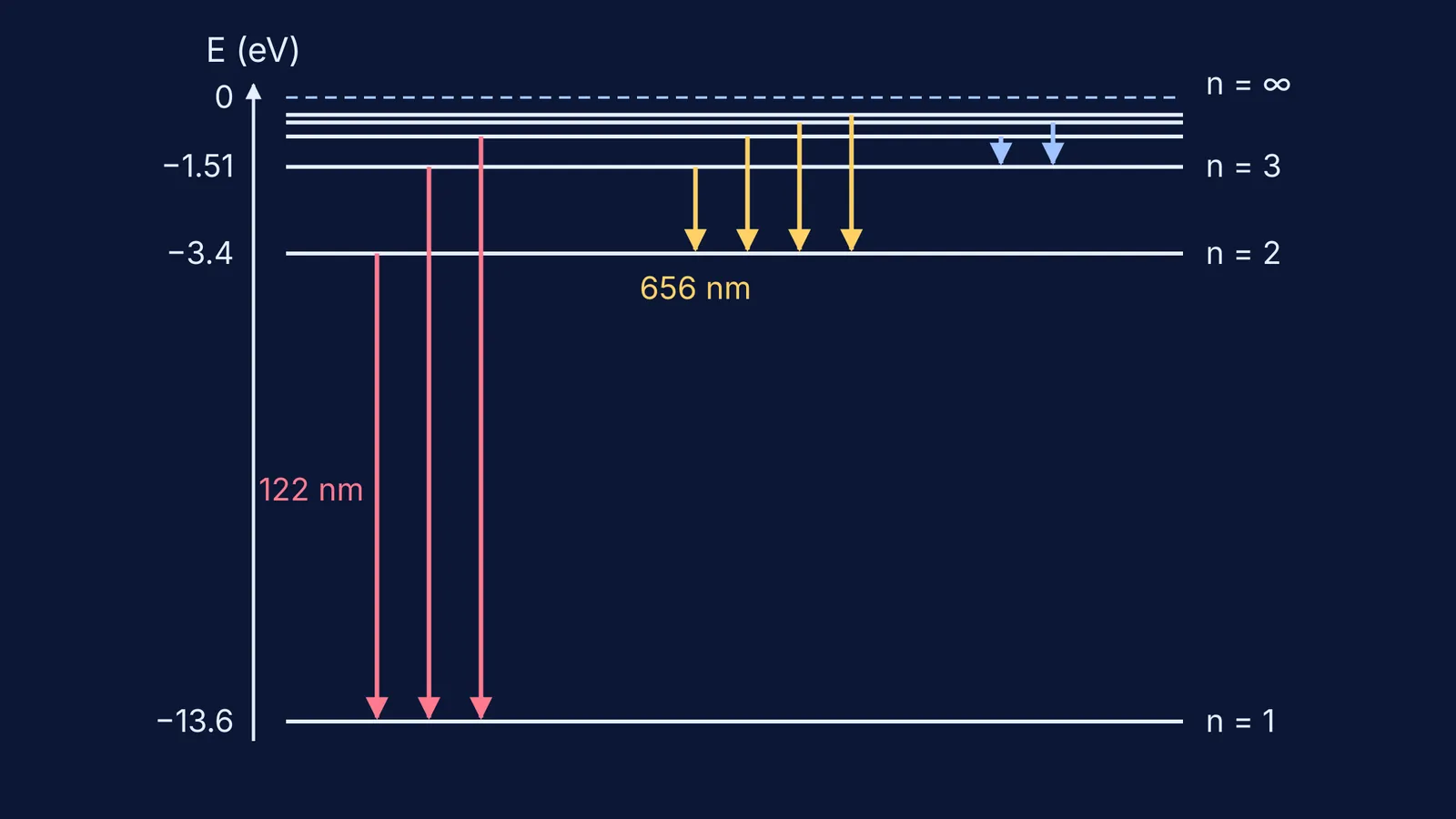
Bohr energy levels: E_n = −13.6 Z²/n² eV, using NIST's Rydberg energy of 13.6057 eV.
Bohr radius and speed: r is proportional to n²/Z, and v to Z/n.
Spectral lines: 1/λ = R Z²(1/n₁² − 1/n₂²), with n₂ greater than n₁.
Binding energy: Δm × 931.5 MeV per atomic mass unit, from NIST's mass-energy equivalent of 931.494 MeV.
Devices: the five gate truth tables, and that a Zener in breakdown holds its voltage while its current changes.
A one-minute worked example: Light of wavelength 300 nm falls on a metal with work function 2.3 eV. Find the stopping potential.
Photon energy: 1240/300 = 4.13 eV.
Maximum kinetic energy: 4.13 − 2.3 = 1.83 eV.
Stopping potential: 1.83 V, because K_max = eV₀.
For hydrogen's n = 3 to n = 2 jump, 13.6(1/4 − 1/9) = 1.89 eV, and 1240/1.89 gives about 656 nm, the red Balmer line. Many photoelectric and hydrogen-spectrum questions reduce to an energy in eV and the 1240 shortcut.
Why are past papers so useful for modern physics?
Modern physics questions tend to come back in a few familiar types: photoelectric graphs, de Broglie comparisons, Bohr ratios between levels or ions, binding-energy curves, diode circuits and gate combinations. In a study by Roediger and Karpicke (2006), students who practised recalling prose passages remembered more two days and one week later than students who restudied them instead, even though restudying made students more confident.
NTA publishes recent question papers on the JEE Main website, including the April 2026 shifts. Pull out the modern physics questions and tag each one with its type; our guide to tagging previous year questions by concept with AI shows a quick way to do it.
What does a 10-day modern physics plan look like?
Days 1 to 2: NCERT for Unit 17; start the concept sheet.
Days 3 to 4: Unit 18; finish the sheet and practise Bohr ratios for hydrogen-like ions.
Day 5: Unit 19; draw each diode circuit and truth table from memory.
Days 6 to 8: 15 to 20 past-paper questions a day, timed, no notes.
Day 9: redo every wrong question without looking at the old working.
Day 10: rewrite the concept sheet from memory and compare.
When a wrong answer comes from the wrong method rather than arithmetic, the Fermi Problem Library has worked problems with a step-by-step solver that explains the reasoning rather than printing an answer. If the gap is the idea itself, such as why intensity does not change stopping potential, the Fermi Concept Library gives each concept its own lesson.
Start today: print the syllabus page for Units 17 to 19 and write the first line of your concept sheet.