

On this page
When you sit down with a book of previous year questions, it is tempting to just work through them in order. But if you sort them by what they look like on the page, you might be missing the point of the exam.
A foundational 1981 study in *Cognitive Science* by Michelene Chi, Paul Feltovich and Robert Glaser found that novices and experts see physics problems completely differently. Across four experiments on problem sorting, they found that novices base their understanding on a problem's literal, surface features — such as whether a question involves a block or a spring. Experts, on the other hand, abstract the underlying physics principles required to solve the problem, grouping them by concepts like energy conservation.
The researchers gave participants cards with mechanics problems and asked them to sort them into groups. Novices placed a block sliding down a ramp into one group and a block dangling on a spring into another. To them, the physical objects were the most important part of the question.
Experts saw right past the objects. They placed both the sliding block and the spring problem into a single group because both are solved using the conservation of energy. To succeed in exams like JEE Main or NEET-UG, you need this mental map of an expert. A highly effective way to build this map is to ask an AI to tag your previous year questions by concept.
Why tag previous year questions by concept?
Most students treat past papers as a test of their memory, checking their final answers against the marking scheme. While this tells you if you got a question right, it does not explain why you got it right.
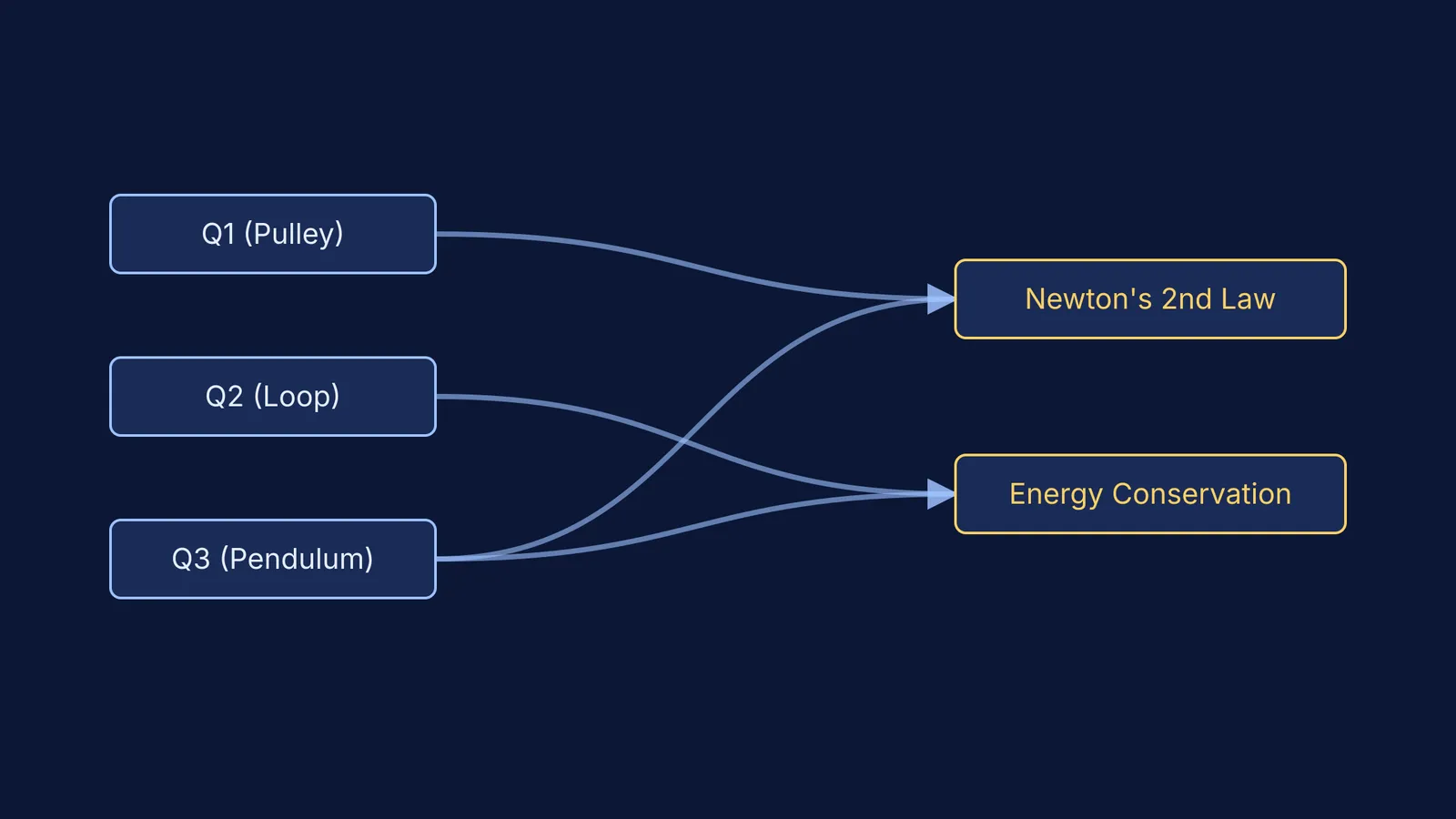
When you tag questions by concept, you are forced to think about the underlying structure of the problem. This helps you see that the examiner is not endlessly inventing new questions; they are simply dressing up the same concepts in different scenarios. You begin to notice that a pendulum problem and a rollercoaster loop problem are testing the same energy principles. Once you know which concepts repeat, you can focus your revision where it matters most, reducing the overwhelming volume of an exam syllabus into a manageable set of core rules.
How do you prompt an AI for concept tags?
Instead of asking an AI for the solution, you can use it as a classification tool. A good prompt sets boundaries so the AI acts as a guide rather than an answer key. Here is a script you can use to prompt an AI model to tag your questions:
"Here are five previous year questions from my physics exam. Do not solve them or give me the answers. Instead, read each question and tell me the single deepest underlying concept or principle required to solve it. Give me a one-sentence explanation of why that concept applies."
By holding back the answers, the AI gives you a framework for your revision rather than doing the work for you. You can group your past papers according to these tags and practice all the "conservation of momentum" questions together. If you are preparing a study schedule, you might also read our guide on Using an AI tutor in the week before an exam: a day-by-day plan to see how to integrate this tagging exercise into your final days of preparation.
Can checking AI tags improve your active learning?
AI models are capable, but they can still misinterpret a nuanced question. Rather than trusting the tags blindly, checking the AI's logic is an excellent way to study.
Read the AI's chosen concept and its one-sentence justification. Do you agree? Can you see how the principle applies to the scenario? Perhaps the AI tagged a problem as "kinematics", but you see that it actually requires the "work-energy theorem" to solve efficiently. This critical review pushes you to think carefully about the material. For more on testing these systems, see our guide on How to evaluate an AI tutor: 8 tests you can run in 20 minutes.
If the AI tags a concept that you do not fully grasp, you have found a gap in your knowledge. The Fermi Concept Library contains every concept in physics, chemistry, biology, mathematics and computing, each with its own lesson and its place in the map.
When you sit down to tackle the hard questions, Fermi's AI tutor can work out what you already know and build a plan for the session. Rather than just printing an answer, it holds a line of reasoning, checks your understanding as it goes, and teaches you how to spot the underlying principles for yourself.


