On this page
When you buy a kilogram of apples, you expect exactly a kilogram. When a factory machines an engine part, it must be accurate to the micrometre. Metrology is the science of measurement, and it is the hidden foundation of modern manufacturing, research and trade.
For engineers and physicists, a career in metrology means designing new ways to measure physical quantities, calibrating precision equipment, and ensuring that measurements trace back to international standards. Without metrologists, GPS systems would fail, medical dosages would be unsafe, and assembly lines would grind to a halt.
What does a metrologist do?
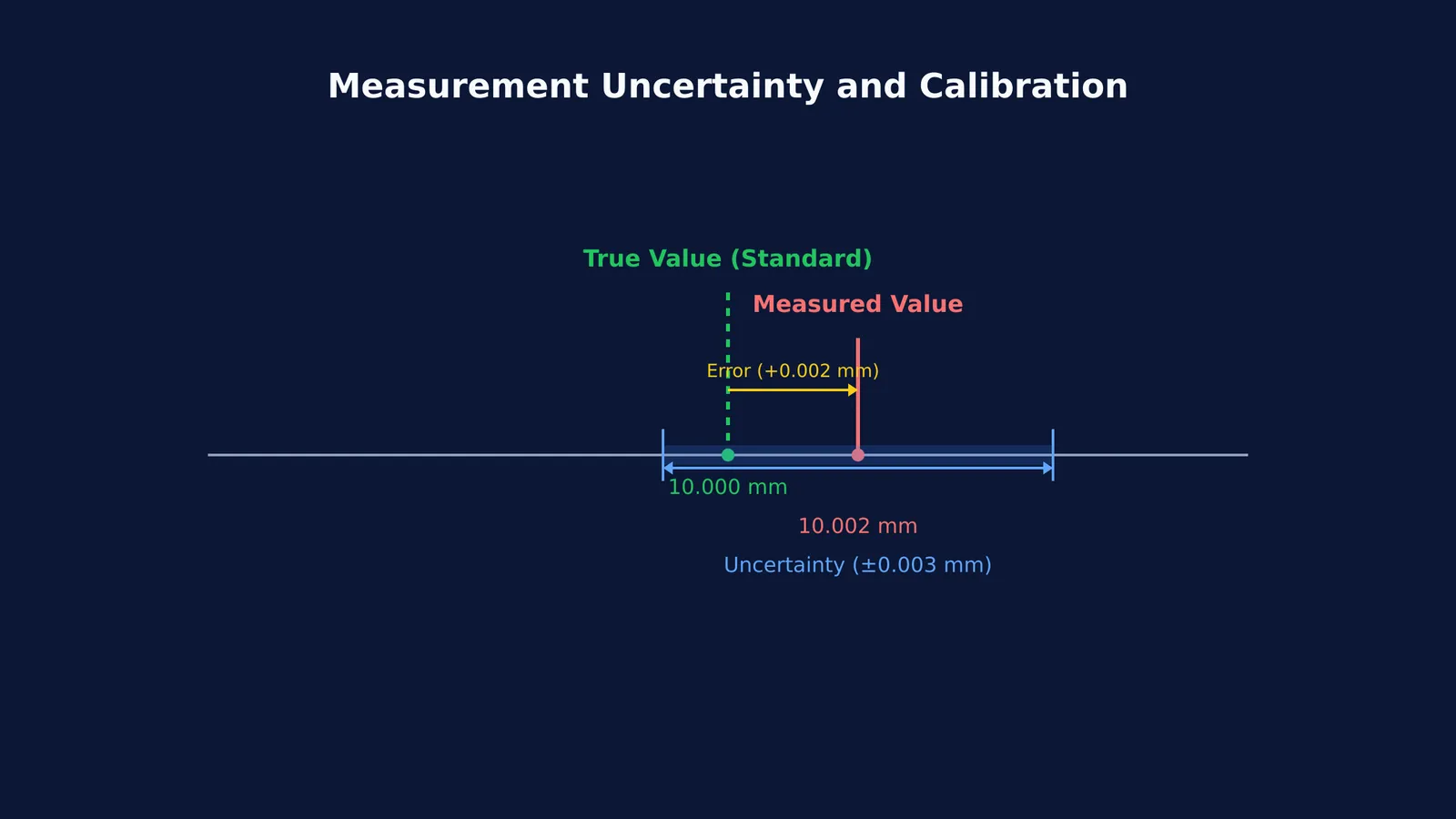
A metrologist works out how to measure things accurately and how to prove that those measurements are correct. They deal with the concepts of uncertainty and traceability. Every measuring instrument, from a classroom thermometer to an aircraft coordinate measuring machine (CMM), has some inherent error.
A metrologist's job is to quantify that error by comparing the instrument against a more accurate standard, a process called calibration. They also calculate the measurement uncertainty—the range of values within which the true value of the measured quantity is expected to lie.
For example, if a thermometer reads 20.0 °C, a metrologist determines not only whether the true temperature is 19.8 °C or 20.1 °C, but also mathematically models how much confidence we can have in that reading. They build a chain of comparisons, known as traceability, linking that individual thermometer all the way back to the primary national standard for the kelvin. This meticulous record-keeping and mathematical analysis ensure that a part manufactured in Bengaluru perfectly fits an assembly built in Germany.
Where do metrologists work in India?
The ultimate authority for measurement in India is the National Physical Laboratory (CSIR-NPL), founded in 1947 in New Delhi. CSIR-NPL maintains the national standards for the International System of Units (SI), such as the metre, kilogram and second.
Beyond the national institutes, metrologists and calibration engineers work in:
Accredited laboratories: There are approximately 1,200 NABL-accredited calibration laboratories in India. These independent labs test and certify instruments for private companies across sectors, providing the essential paperwork that proves a factory's tools are accurate.
Aerospace and defence: Organisations like ISRO and DRDO rely on extreme precision for satellite parts, rockets and navigation systems. A tiny measurement error in a thruster component can cause a mission to fail in orbit.
Manufacturing: Automotive and semiconductor plants employ metrology engineers to check parts on assembly lines using 3D scanners and CMMs from makers like Zeiss and Mitutoyo. They ensure that every piston and microchip meets its strict design tolerances.
Healthcare: Calibrating medical imaging machines, pacemakers and surgical equipment requires specialist metrologists. Accurate radiation dosages and precise diagnostic imaging depend directly on the calibration of hospital equipment.
Much like mechatronics and robotics engineering, metrology involves working across mechanical and electronic disciplines to solve complex real-world problems.
How do you become a metrology engineer or scientist?
If you want to work in metrology, your educational path depends on whether you approach it as an engineer or a physicist.
For physicists: A BSc in physics followed by an MSc in physics, applied physics or instrumentation is the standard route. For high-level research roles at national laboratories like CSIR-NPL or the Bhabha Atomic Research Centre (BARC), a PhD is usually required.
For engineers: A BTech or BE in mechanical, electrical, or instrumentation engineering is the usual starting point. Many engineers who enter this field learn calibration on the job or complete a postgraduate degree or certification in precision engineering or geometric dimensioning and tolerancing (GD&T).
Whichever path you take, you will need a strong grasp of the fundamentals of physics. Topics such as units and dimensions, error analysis (you can learn how to use dimensions to check your physics answers), and the properties of materials are central to the job. You will also need to understand thermodynamics and electromagnetism, as temperature and electrical noise often introduce errors into sensitive measurements. If you want to build a deep understanding, see how to learn physics from first principles, not formulas.
If you are a student exploring these concepts, the Fermi Concept Library contains every concept in physics, chemistry, biology, mathematics and computing, each with its own lesson and its place in the map, helping you trace how ideas like measurement error connect to advanced topics.
Is metrology a good career choice for you?
Metrology is often described as a recession-proof career. As long as factories build things, aeroplanes fly, and trade happens across borders, someone must calibrate the instruments.
Here is a quick checklist to see if this career suits you:
You like finding errors: You enjoy figuring out why a result is slightly off rather than just accepting it.
You prefer lab work: You would rather work in a quiet, climate-controlled laboratory with highly precise tools than on a noisy factory floor.
You are strong in fundamentals: You enjoy the core concepts of physics, such as units, dimensions and material properties, more than abstract theoretical physics.
If you enjoy solving problems and finding the sources of small errors, metrology offers a stable and intellectually rewarding career path.