

On this page
You open the module for a second round, read question 14, and the answer arrives before you have drawn the diagram. It feels like progress. Usually it is memory of the answer, not the method, and the exam will not give you the same numbers.
Why do I remember module answers instead of solving them?
A question you have seen before becomes a cue for the stored answer, and that shortcut feels like understanding.
Psychologists Asher Koriat and Robert Bjork described this in a 2005 paper on illusions of competence: judging your learning while the answer is in view "can instill a sense of competence during learning that proves unwarranted during testing."
A 2009 survey of 177 college students by Karpicke, Butler and Roediger found that most students repeatedly reread their notes or textbook, and relatively few tested themselves. Re-solving a question whose answer you remember is rereading in disguise: nothing is pulled out of memory.
Does re-solving the same questions actually help?
Not much, once the answers stick.
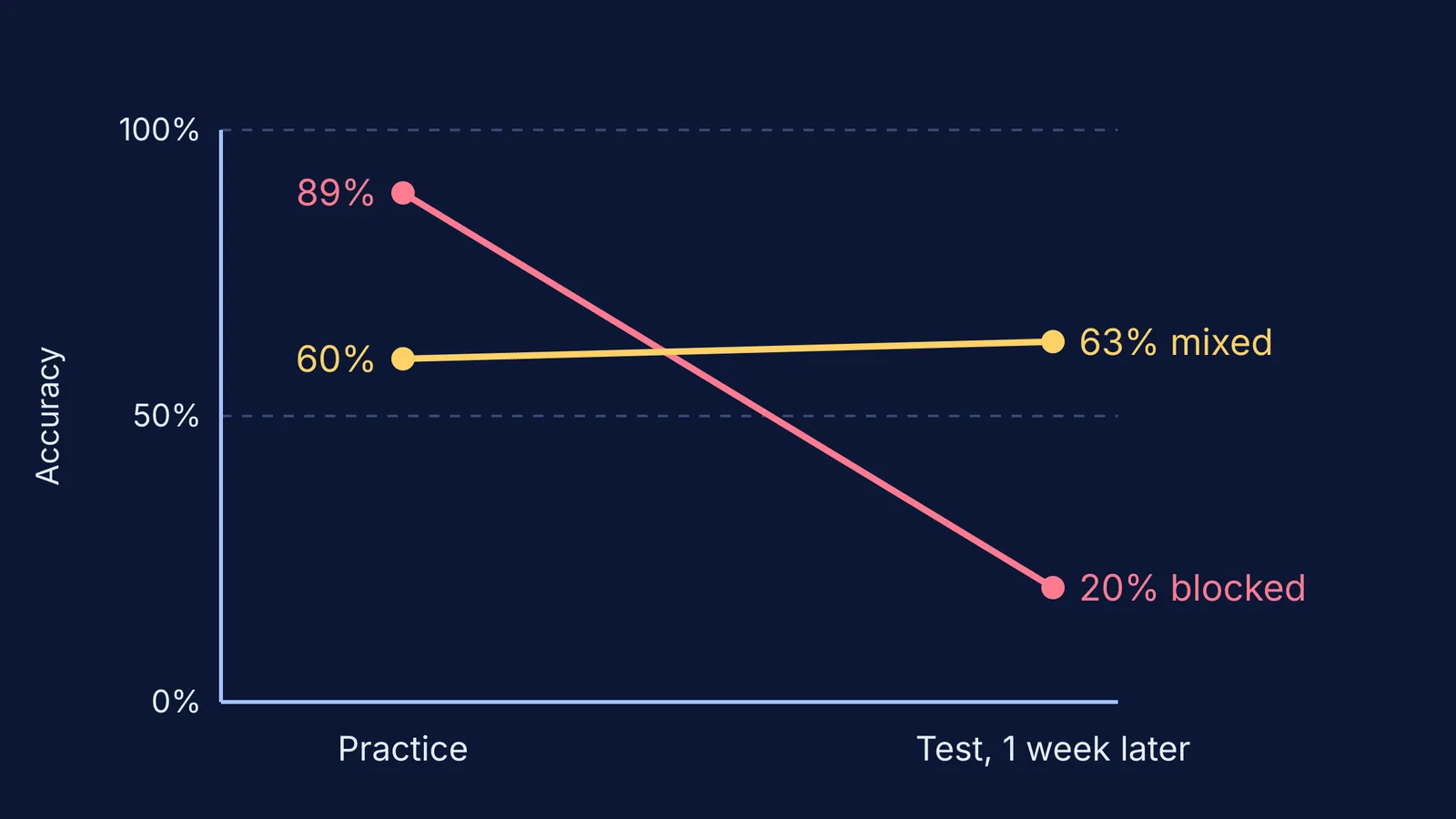
In Rohrer and Taylor's 2007 study in Instructional Science, college students learned to find the volumes of four unusual solids. One group practised in blocks (all the problems on one solid, then all the problems on the next, like a module exercise). The other group did the same problems shuffled.
During practice, the blocked group averaged 89% and the mixed group 60%.
On a test one week later, the mixed group scored 63% and the blocked group 20%.
Shuffled problems make you choose the right formula before you use it. Blocked practice makes that choice for you, and that is the trap of a familiar module: the exercise heading has already chosen the method.
A similar pattern shows up in memory research. In Roediger and Karpicke's 2006 study, restudying a passage beat taking a recall test on it when students were tested 5 minutes later, but on tests 2 days and 1 week later, students who had practised recall remembered substantially more, even though restudying made students more confident. A 2013 review by Dunlosky and colleagues rated practice testing and spaced-out practice as high-utility techniques and rereading as low utility.
How do I practise when I already know the answers?
Each of these swaps removes the cue your memory relies on.
Change the numbers, then change the question. Take a module question you remember: a block slides down a smooth 30 degree incline; find its acceleration (g = 10 m/s squared). You remember '5'. Now make the incline rough with a friction coefficient of 0.2 and an angle of 37 degrees: a = 10(sin 37 - 0.2 cos 37) = 10(0.6 - 0.16) = 4.4 m/s squared. Then turn it around: on a smooth incline, what angle gives an acceleration of 3 m/s squared? Now sin of the angle = 0.3. The remembered '5' is useless in both, so you have to rebuild the method. More ideas: practising the same question with new numbers.
Bring in questions you have never seen. Take questions on the same concept from a different book or previous papers, and mix them with two older chapters so you have to decide the method yourself. This interleaved practice plan shows how.
Reattempt from a blank page. Close the module and the solutions. Write the question down, solve it fully, and only then compare. The same idea works for theory with the blurting method.
When a changed-number version stops you cold, the Fermi Problem Library has worked problems with a step-by-step solver that explains the reasoning rather than printing an answer, so you can see exactly which step your memory was covering for.
A one-week plan for a module you have already done once
Day 1: go through the module and mark R next to every question where the answer comes before the method.
Days 2 and 3: rewrite four R questions per session with changed numbers or a changed unknown, and solve them.
Day 4: solve 10 new questions on the same chapter, shuffled with questions from two older chapters.
Day 5: blank-page reattempt of the five hardest R questions, no notes, timed.
Day 6: for every mistake, write one line on which step failed: choosing the idea, setting up, or calculation.
Day 7: a short mixed test, then cross off the R marks you have earned back.
If you are not sure which chapter to start with, Fermi's AI tutor can work out what you already know and build a plan for the session, so you sit down to a clear next step.
What can parents say instead of 'Have you finished the module?'
A finished module can hide remembered answers. Try these instead:
'Pick one question you did today and change the numbers. Can you show me how you would start?'
'Which question surprised you this week?'
'Which step do you get stuck on most?'
These ask about method, not pages done.
Tonight, pick three questions you can answer from memory, change one number in each, and solve them on a blank sheet.


