

On this page
If you like engines, electricity and working with your hands, marine engineering can turn Class 12 physics into a job. Know what it involves first: years of rotations at sea, a strict medical, and a career ladder climbed one certificate at a time.
In India, "marine engineer" usually means a merchant navy officer who runs a ship's machinery. The US Bureau of Labor Statistics separates the two jobs: marine engineers and naval architects design vessels and machinery, while ship engineers keep it running at sea.
What does a marine engineer do on a ship and in a shipyard?
On board, ship engineers "operate and maintain a vessel's propulsion system, which includes the engine, boilers, generators, pumps, and other machinery", according to the BLS guide to water transportation jobs. That means engine-room watches and repairs far from any workshop.
Shore-side, design engineers work "in offices, on manufacturing shop floors, or at sea". Shipyards also run their own training. Cochin Shipyard's Marine Engineering Training Institute offers a 12-month residential course for mechanical and naval architecture graduates who want to go to sea.
What is the marine engineering course after 12th?
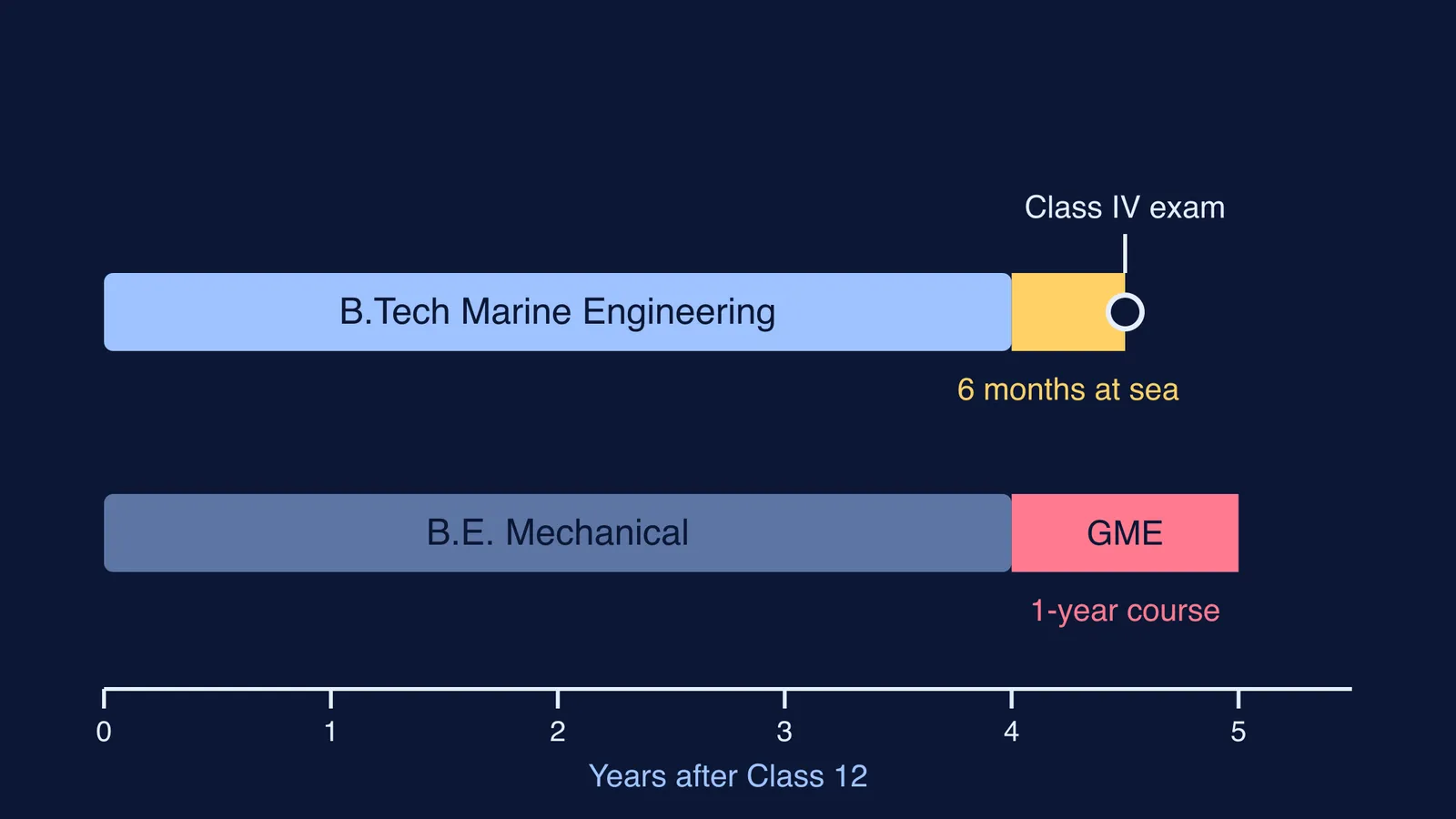
The main route is the B.Tech in Marine Engineering. Indian Maritime University describes it as a residential 4-year programme designed in line with the STCW convention for seafarers. IMU admits students through its own Common Entrance Test, the IMU CET.
IMU's eligibility rules are: 60% aggregate in physics, chemistry and maths, and 50% in English in Class 12. SC/ST candidates get a 5% relaxation in the PCM requirement but not in English. Upper age limits also apply.
The syllabus on the IMU programme page moves from workshop technology in the first year to marine diesel engines, auxiliary machinery, and shipboard power generation and distribution. Thermodynamics and electrical circuits underpin all of it.
If you already have a mechanical engineering degree, the other route is a one-year Graduate Marine Engineering (GME) course, like the one at Cochin Shipyard's METI, which asks for 50% in your final engineering year, 50% in English in Class 10 or 12, and a maximum age of 28 at the start of the course.
How much sea time do you need before you become an officer?
The degree alone does not make you a ship's officer. Tolani Maritime Institute, which runs a B.Tech in marine engineering, says six months of shipboard training after graduation is mandatory for a seagoing career. Its graduates are exempt from Part A of the DG Shipping Class IV exam, but they need at least six months at sea and three advanced modular courses before they can sit Part B.
Passing Class IV makes you a certified watchkeeping engineer. From there you build more sea time and clear higher certificates of competency on the way to second engineer and chief engineer. Check each step against current Directorate General of Shipping rules.
What is life at sea really like?
The BLS says some crews, such as those on deep-sea ships, "may spend weeks or months away from home and work on board for long periods 7 days a week".
There are legal limits. Under the ILO's Maritime Labour Convention, countries cap either working hours or rest hours; on the rest standard, seafarers must get at least 10 hours of rest in any 24-hour period and 77 hours in any seven-day period. The convention came into force on 20 August 2013 and also covers repatriation and on-board medical care for the world's 1.5 million seafarers.
The hard parts are real: missed festivals, patchy internet and the same small crew for months. If isolation ever starts to affect your sleep or mood, talk to someone early. In India, Tele MANAS is a free government helpline on 14416.
Is marine engineering right for you? A five-question check
Work through these with a parent before you fill in any form:
Am I likely to score 60% across PCM and 50% in English?
Have I had a DGS-approved medical, including eyesight?
Can I picture being away for several months at a time, more than once?
Do I enjoy fixing things, not just understanding them?
Have I asked a working seafarer what a hard day on board looks like?
If you answer no to question 2 or 3, slow down. You could look at shore-side naval architecture or mechanical engineering instead.
The engine room runs on the heat-engine and electricity physics you are learning now. If entropy or the Carnot cycle still feels hazy, the Fermi Concept Library has a lesson for every physics concept, and Fermi Simulation Lab has interactive simulations for ideas that are easier to see than to read.
Next step: open the IMU programme page, read the eligibility and medical rules in full, and book that medical.


