On this page
The first weeks in a hostel feel loud and lonely at the same time. Everyone is new, everyone is a little nervous, and it can seem as if friend groups formed overnight without you. They did not. Friendships in a hostel grow out of ordinary, repeated time with the same people, and you can plan for that.
How long does it take to make a friend in college?
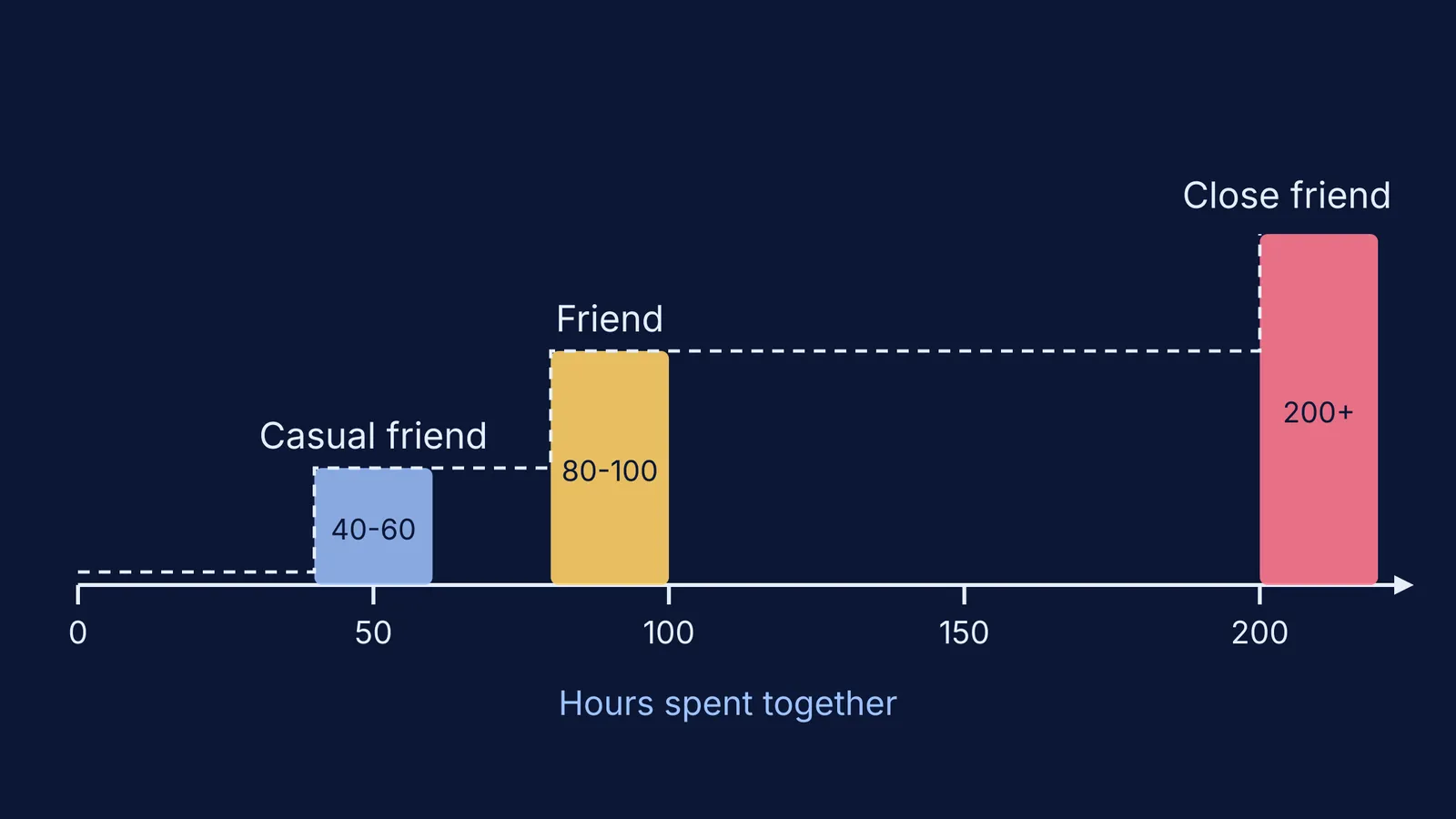
Communication researcher Jeffrey Hall followed 112 first-year students over 9 weeks after they moved to a new university, and found that more hours spent together went with growing closeness (Hall, Journal of Social and Personal Relationships).
Combining that with a survey of 355 adults who had recently moved, Hall estimated, according to the University of Kansas summary of the study, that moving from acquaintance to casual friend took about 40 to 60 hours, becoming a friend took about 80 to 100 hours, and a close friend took more than 200 hours. The same summary notes that time spent working together did not count as much as hanging out and joking around.
Nearness matters too. In a German study, 54 first-year students were given random seat numbers at a one-off introductory session, and those who happened to sit next to each other rated their friendship as stronger a year later (Back, Schmukle and Egloff, Psychological Science; summary on ScienceDaily).
In a hostel, you are surrounded by "neighbouring seats": your wing, your mess table, your lab batch. The trick is to turn chance meetings into repeated ones.
How do you meet people in the hostel common room and mess?
Pick a regular mess slot. Eat dinner at roughly the same time each day. You will keep seeing the same faces, and a nod soon becomes a conversation.
Sit at a table that already has people. Ask "Is this seat free?" and then one easy question: "Which branch are you in?" or "Where are you from?"
Use the common room at busy times. Cricket matches, a carrom board or a shared newspaper give you something to talk about that is not you.
Keep your door open when you are in. On many wings, an open door is a quiet invitation.
Offer small things. Extra Maggi, a phone charger, an iron. Small favours start many hostel friendships.
If sharing a room is part of the adjustment, our guide on getting along with your college roommate from week one has practical first conversations.
Should you join clubs in the first month?
Yes, but not ten of them. Clubs give you a reason to meet the same people every week, which is exactly the repeated time Hall's study describes. Go to several orientation sessions, then commit to one or two you will actually attend. Our post on how many clubs to join in first year, and which walks through the choice.
Can a study group for the first tests help you make friends?
It can, if you add time that is not only work. The first quizzes and mid-semester tests arrive within weeks, and nearly everyone in your batch is worried about them. That shared worry is a natural opening.
Ask three or four people from your wing or lab batch: "Want to do the maths tutorial sheet together on Thursday?"
Meet in the common room at a fixed time each week.
Each person brings one problem they could not solve.
End with tea at the canteen. That is the hanging-out time that builds friendship.
When the whole group is stuck on the same question, the Fermi Problem Library has worked problems with a step-by-step solver that explains the reasoning, so you can talk through why a method works instead of copying an answer.
What if you still feel alone after a month?
You are probably liked more than you think. A study of first-year college students getting to know their dorm mates found that people consistently underestimated how much their new conversation partners liked them, a gap that lasted for months (Boothby and colleagues, Psychological Science). So send the message, suggest the chai, ask the second question.
A slow start is normal, and our piece on feeling lonely in your first year of college has more ideas. If loneliness turns into sadness that will not lift, trouble sleeping or eating, or you feel unsafe, talk to your college counsellor or warden. You can also call Tele MANAS, India's free, 24x7 mental health helpline, on 14416 or 1800-891-4416 (details via IIT Kanpur counselling service).
Pick one thing from this list and do it at dinner tonight.