On this page
Why is rote chanting ineffective for mental maths?
Every morning in many primary and middle-school classrooms across India, students recite multiplication tables, or pahade, in unison. While group chanting makes the room noisy and active, it fails when a student sits alone before a multi-step problem. Repeating lines out loud builds auditory familiarity rather than direct recall. When a child chants "seven eights are fifty-six", their brain relies on rhythm. Asked for 7 × 8 in isolation, they must recite from 7 × 1 to retrieve the product.
Cognitive science explains why this happens. In a 2023 study in Applied Cognitive Psychology, Fieke Ophuis-Cox, Leen Catrysse and Gino Camp tested 48 second-grade pupils across spaced sessions. Retrieval practice with flashcards produced significantly stronger multiplication fact fluency than oral restudy chanting on both five-minute and one-week delayed tests.
Retrieval practice strengthens memory traces needed in problem solving. John Sweller's Cognitive Load Theory in Cognitive Science shows that working memory is strictly limited. Calculating 8 × 7 or 14² manually in the middle of an algebra equation fills working memory with intermediate arithmetic. As David Geary showed in a 5-year longitudinal study in Developmental Psychology, shifting from counting to memory retrieval predicts long-term mathematics achievement. Fact automaticity frees mental capacity for problem strategy.
When students get stuck on multi-step maths, Fermi's AI tutor works out what they know, notices where a calculation or concept stalls, and decides whether to explain the pattern, ask a question, or guide the next step.
What patterns make squares up to 30 easy to calculate?
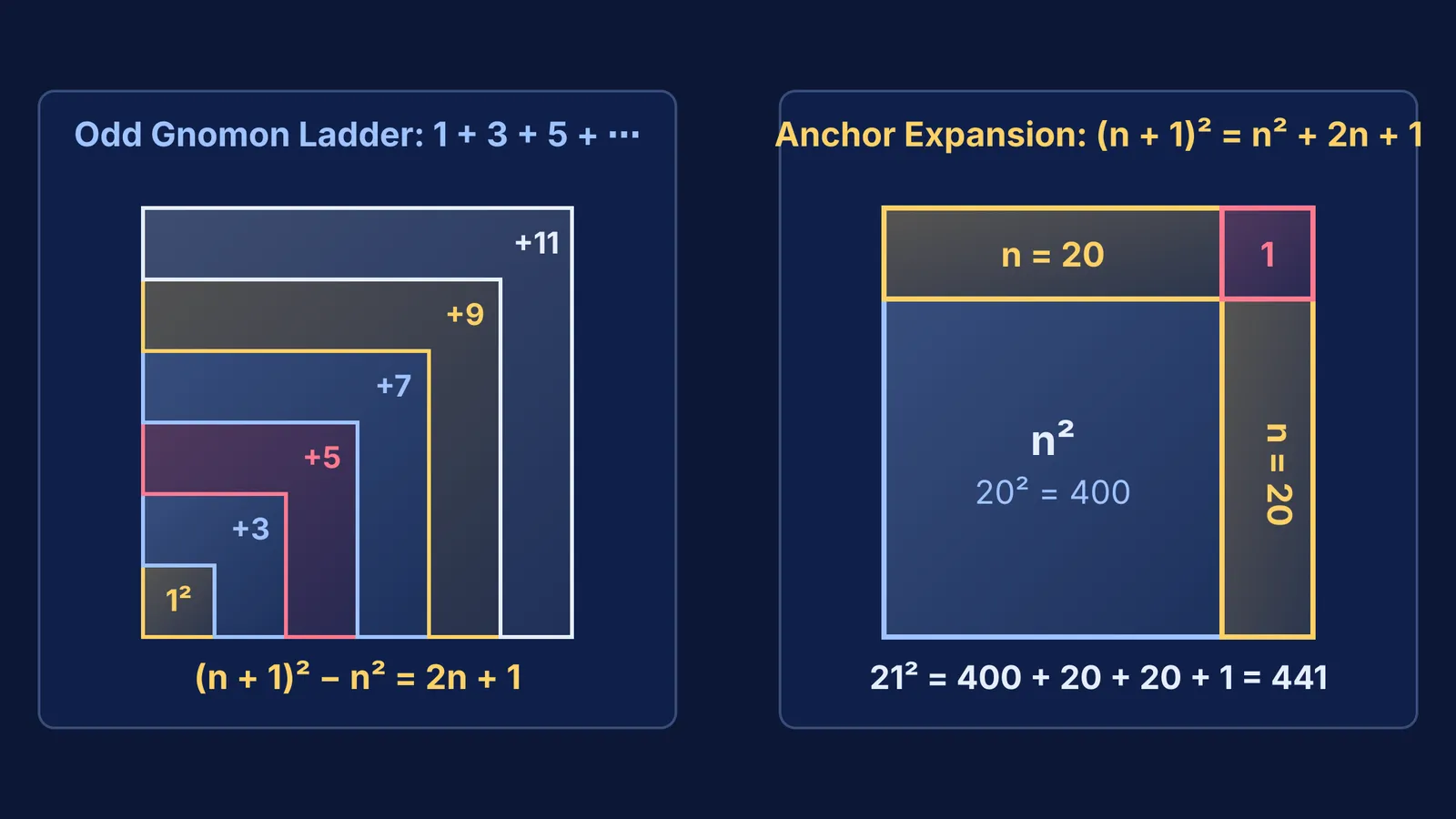
Memorising thirty squares is simple once you connect them through algebraic patterns. In patterns in mathematics, students see that every square number is the sum of consecutive odd integers: 1 = 1², 1 + 3 = 4 = 2², and 1 + 3 + 5 = 9 = 3².
As covered in squares and square roots in Class 8, the difference between consecutive squares is (n + 1)² − n² = 2n + 1. Each square is the previous square plus the next odd number. Landmark squares act as mental anchors:
Anchor from 20² = 400: To find 21², add 2(20) + 1 = 41 to get 441. For 19², subtract 39 to get 361.
Anchor from 25² = 625: To find 26², add 51 to get 676. For 24², subtract 49 to get 576.
Anchor from 30² = 900: For 29², subtract 59 to get 841.
For numbers ending in 5, the identity (10a + 5)² = 100a(a + 1) + 25 squares numbers in seconds. Multiply the tens digit a by (a + 1) and suffix 25. For 35², compute 3 × 4 = 12 to get 1225. For 75², 7 × 8 = 56 gives 5625.
For squares near 50, use (50 − d)² = 100(25 − d) + d². For 47², the deficit d is 3. Subtract 3 from 25 to get 22, then append 3² (09) to reach 2209. For 46², 25 − 4 = 21 with 4² = 16 gives 2116.
How do last-digit symmetries help you recall cubes?
Cubes grow fast, but their units digits follow a predictable symmetry explained in cubes and cube roots in Class 8. Six digits preserve their ending digit when cubed:
0³ ends in 0 (10³ = 1000)
1³ ends in 1 (11³ = 1331)
4³ ends in 4 (4³ = 64, 14³ = 2744)
5³ ends in 5 (5³ = 125, 15³ = 3375)
6³ ends in 6 (6³ = 216, 16³ = 4096)
9³ ends in 9 (9³ = 729, 19³ = 6859)
The remaining four digits swap with their ten-complements:
2³ ends in 8 (2³ = 8, 12³ = 1728) and 8³ ends in 2 (8³ = 512).
3³ ends in 7 (3³ = 27, 13³ = 2197) and 7³ ends in 3 (7³ = 343).
Because every cube from 1 to 10 ends in a distinct digit, you can verify mental calculations instantly. For multi-step problems where calculations become tangled, the Fermi Problem Library provides worked problems with a step-by-step solver that explains the reasoning rather than printing an answer.
How should you structure a 5-minute daily recall drill?
Short, distributed recall sessions build durable memory. A 2006 study by Henry Roediger and Jeffrey Karpicke in Psychological Science showed that testing memory produces substantially greater delayed retention than repeated study. You can build automaticity with a daily five-minute drill:
Two minutes of mixed flashcards: Test 15 to 20 flashcards with tables, squares up to 30, and cubes up to 15. Speak or write the answer before flipping, setting aside any card taking over two seconds.
Two minutes of anchor reconstruction: For hesitated or missed cards, calculate the answer using consecutive differences or the base-50 identity instead of reading the back.
One minute of error logging: Place missed cards at the front of the next day's deck.
Combining algebraic patterns with active retrieval turns mechanical memorisation into fluent reasoning, giving students confidence in middle-school mathematics.