

On this page
You open YouTube to understand one idea, say rolling motion for Class 11 physics. Forty minutes later you have watched a topper's timetable and half a podcast. The app is built to keep you watching; your session can be built to finish.
Why does one study video turn into an hour of YouTube?
In January 2018, YouTube's then chief product officer Neal Mohan said at CES that its recommendations drive about 70% of watch time on the platform, as Tubefilter reported from CNET's coverage. Autoplay adds to the pull: when one video ends, the next starts unless you have switched it off, which YouTube's help page shows how to do.
Many good explanations live on YouTube, so quitting is not the answer. Give each session a job, a finish line and a check instead.
What should you write down before you press play?
Write one question the video must answer, and your best guess at the answer. Guessing wrong is fine.
Psychologists call these prequestions. In a 2017 study by Shana Carpenter and Alexander Toftness, students who tried to answer two questions before each segment of a short history video did better on the final test than students who did not, including on questions they had never seen, as the British Psychological Society's Research Digest summarised. With real course lectures over 20 minutes long, a follow-up by Toftness and colleagues found the benefit was mostly for the information the prequestions asked about. So make your question about the thing you actually need.
A weak pre-set question names a topic: "rolling motion". A strong one names a result you can check: "Why does a solid ball rolling down a ramp reach the bottom later than a block sliding down a frictionless one?"
How long should you watch before testing yourself?
Set a time box of 20 to 25 minutes, and pause about every five minutes to write, from memory, what you just heard.
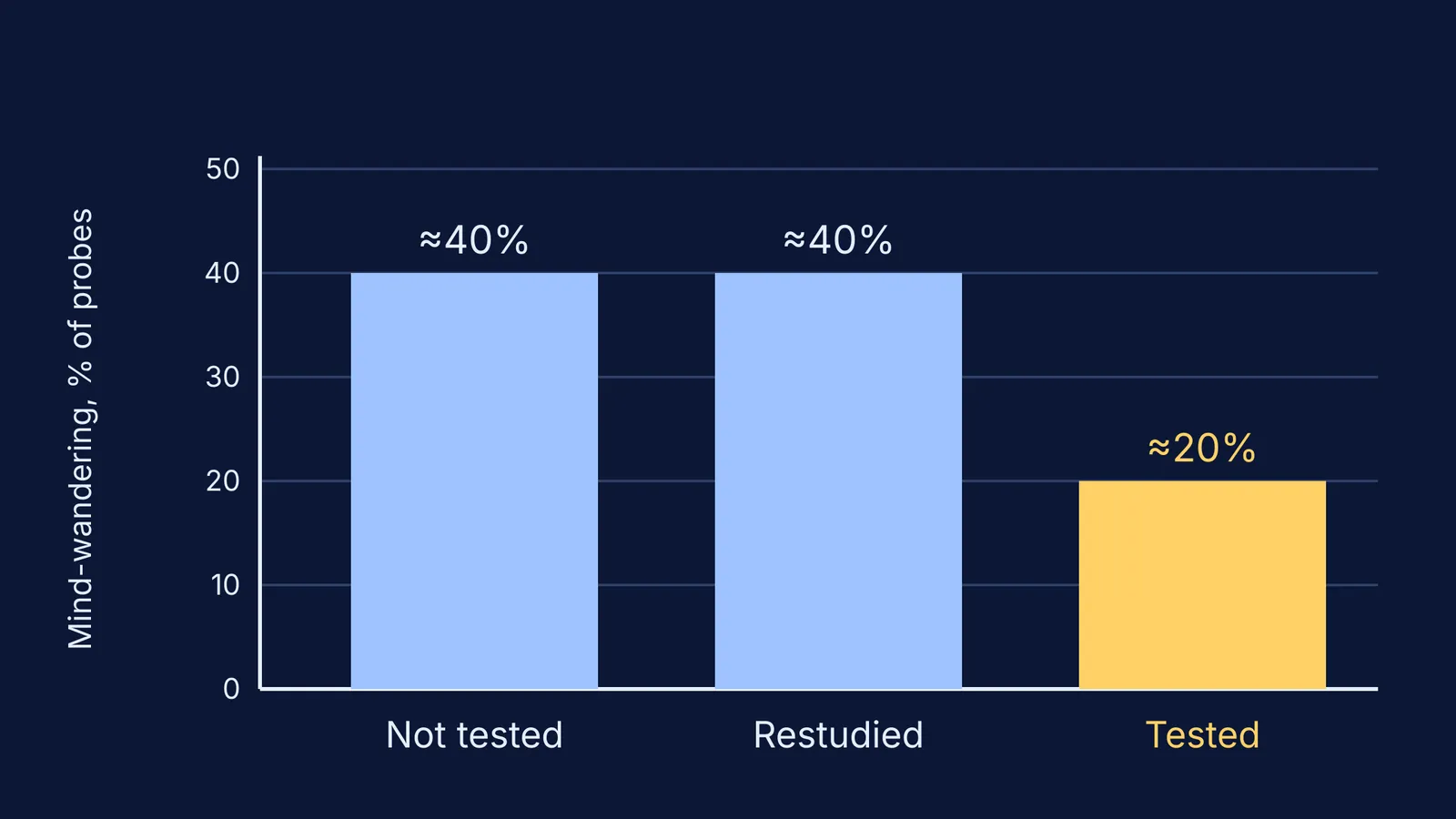
The case for pauses comes from a Harvard experiment. In Szpunar, Moulton and Schacter's 2013 study in PNAS, students watched a 21-minute recorded statistics lecture in four segments. Students quizzed after each segment reported mind-wandering in response to about 20% of attention probes, against about 40% for students who were not tested or who restudied instead. The tested group also took about three times as many notes and did better on the final test.
The time box matters because drifting starts when a video ends and the next thumbnail appears. If the session stops at minute 25 by plan, that moment is your cue to close the tab.
If a video is too slow, read whether 2x lecture speed hurts learning. If stray thoughts pull you away, try a parking-lot sheet for random thoughts.
How do you test yourself after a YouTube lecture?
Close the video, take a blank page and answer your pre-set question in your own words. Then try one problem without looking anything up.
This is retrieval practice. The testing effect is the finding that taking a memory test improves later retention, not just measures it, as Henry Roediger and Jeffrey Karpicke showed in 2006. In their experiments, students who restudied a passage did better on a test 5 minutes later, but students who had been tested remembered substantially more 2 days and 1 week later. Restudying also made students more confident, which is why rewatching a video can feel like learning when it is not.
Mark what you could not explain. That gap, not the next recommended video, decides what you open next. If the gap is a concept, the Fermi Concept Library gives each concept in physics, chemistry, biology, mathematics and computing its own lesson. If it is a method, the Fermi Problem Library has worked problems with a step-by-step solver that explains the reasoning rather than printing an answer.
What does a 30-minute YouTube study session look like?
Here is the whole plan, using the rolling-ball question.
Minutes 0 to 3: switch off autoplay, open the one video you chose in advance, and write your question and your guess on paper.
Minutes 3 to 25: watch, with no other tabs open. Roughly every five minutes, pause and write two lines from memory.
Minute 25: close the video, even if it has not finished. Note the timestamp so you can resume another day.
Minutes 25 to 30: answer your question on a blank page. Here, some of the ball's energy goes into spinning, so for a solid sphere the acceleration is 5/7 of g sin θ, against g sin θ for the frictionless block, as this LibreTexts derivation for rolling bodies shows. Then try one textbook problem.
Write one line: what you still cannot explain. That is where the next session starts.
Next time you open YouTube to study, write the question first. The rest of the session follows from it.


