On this page
If you want a seat at Guru Gobind Singh Indraprastha University (GGSIPU, usually called IPU) in Delhi, start with one question: which test does your course count? The 2026-27 bachelor's admission brochure says IPU admits students through national tests run by other bodies, through its own Common Entrance Tests (CET), through CUET, or on qualifying-exam marks. Each course has its own list of tests, in order of priority.
Which IPU courses use CET, JEE Main or CUET?
The brochure's at-a-glance table lists the tests for each programme code "in order of priority" (Chapter 1, GGSIPU). For 2026-27 it reads:
B.Tech (code 131): JEE Main Paper I first, then CUET.
B.Sc.-M.Sc. dual degree in physics, chemistry or maths (code 137): JEE Main Paper I, then CET, then CUET, then Class 12 marks.
MBBS, BDS, BAMS and BHMS: NEET UG only.
B.Sc. (Hons) Nursing: NEET UG, then CET. BPT/BOT: NEET UG, then CET, then CUET.
Integrated BA LL.B and BBA LL.B: CLAT UG, then CUET. B.Arch: NATA.
CET first, CUET second: BCA, BBA, BMS, B.Com (Hons), B.Pharm, BA (Journalism and Mass Communication), hotel management, B.Tech Biotechnology, paramedical courses and B.Ed, among others.
CET only: lateral entry to B.Tech and B.Pharm, and the three-year LLB, among others.
If CUET is your back-up for several Delhi universities, our guide to how CUET works for science students explains the subject choices.
What is the IPU CET exam pattern?
Every IPU CET has 100 multiple-choice questions, 4 marks each, with 1 mark deducted for each wrong answer, in a 150-minute paper worth 400 marks (Chapter 4, GGSIPU). The same chapter set the 2026 CET as an offline OMR test, tentatively between 25 April and 17 May 2026, in English except for B.Ed. There is no retest, answer-key objections cost Rs 200 per question within three days, and on equal marks the older candidate usually ranks higher.
Here is what that marking means. Torn between two options, a guess is worth 0.5 × 4 − 0.5 × 1 = 1.5 marks on average; a blind guess among four is worth 0.25 × 4 − 0.75 × 1 = 0.25 marks. A blank costs nothing, and the brochure advises not attempting questions you are unsure of.
If your lost marks come from using the wrong method rather than slips, the Fermi Problem Library has worked problems with a step-by-step solver that explains the reasoning rather than printing an answer.
How does IPU counselling work, round by round?
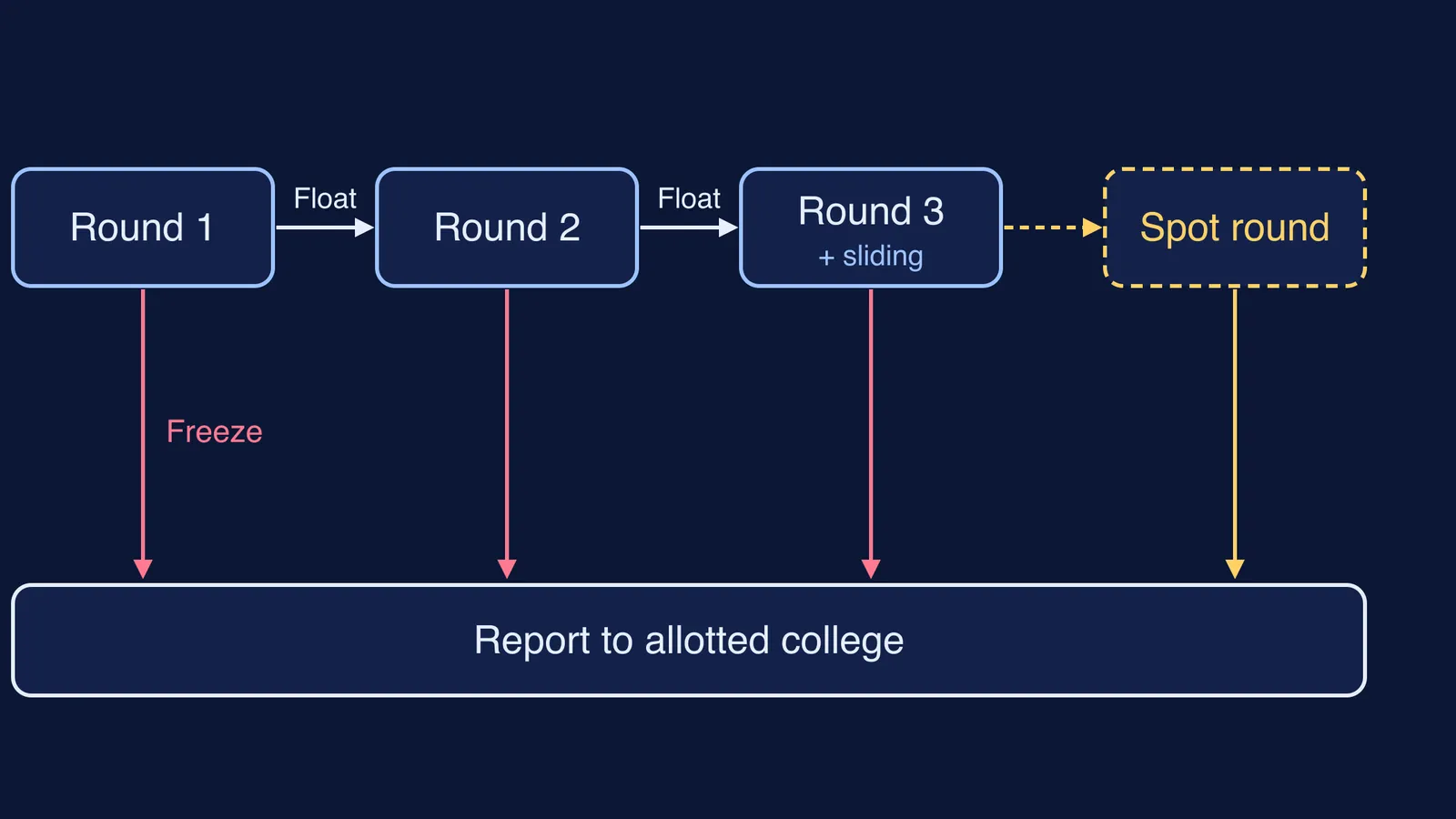
The brochure's flow chart sets out four stages: Round 1, Round 2, Round 3 with a sliding round, and spot rounds (Chapter 1, GGSIPU). The first time you get a seat, you must pay the Part Academic Fee; skip it and you are out, though you can enter the spot round as a fresh candidate. Next come online document checks, the allotment letter, and a choice: Freeze (keep this seat) or Float (stay in for an upgrade). Spot rounds need fresh registration. Finally, you report to the college and pay the balance fee, or lose the seat.
Where you finished school changes your odds. In non-minority affiliated colleges, 85% of seats go to Delhi Region candidates, who passed their qualifying exam from a school or institute in Delhi or a GGSIPU-affiliated college, and 15% go to everyone else, even if they live in Delhi (Chapter 5, GGSIPU). Self-financing colleges also keep a 10% management quota unless they give it up. Category rules are in Chapter 6. If you need to explain them at home, see how reservation categories work in counselling.
What is the step-by-step checklist for Delhi admissions?
Find your course's programme code and its tests in Chapter 1 of the brochure.
Register on the official portal, ipu.admissions.nic.in, even for JEE Main, NEET or CLAT courses; the flow chart puts registration first.
Choose your Region carefully. Chapter 4 warns that a wrong Region can lead to cancellation.
Get category certificates in your own name; Chapter 6 rejects a parent's. Delhi OBC candidates need a non-creamy-layer certificate issued after 31 March 2026.
For the CET, list three test centres in order. Centres cannot be changed later.
Enrol for counselling and fill more choices than you think you need.
Pay the Part Academic Fee as soon as you are first allotted a seat.
Freeze if this is the seat you want; float only if a higher choice is realistic.
Report to the college with original documents and pay the balance fee.
The GGSIPU 2026 admissions page carries current notices, including one saying there is no counselling participation fee. Rules change yearly, so check it before each round.
If someone offers you a seat for money, read what to do when an agent promises a college seat.