

On this page
Class 9 is the first year of the two-year ICSE course, and the subject list is wide. Under the CISCE regulations for the 2028 ICSE examination, the exam that students now in Class 9 will sit, Group I is compulsory: English, a second language, and History, Civics and Geography. Group II adds two or three subjects such as Mathematics and Science, and Group III adds one more, such as Computer Applications. That makes six or seven subjects at once. In the same regulations, Group I subjects are 80% written examination and 20% internal assessment, and Group III subjects are split 50% and 50%, so projects and lab work need slots too.
How do you study for ICSE Class 9 with so many subjects?
The trouble is rarely one hard subject. It is six subjects competing for the same evening, where the nearest test wins and the rest drift. Four rules stop the drift:
Every subject gets at least one fixed slot a week, even when no test is near.
Maths and Science get three slots each, because each chapter builds on the last.
A slot is 40 minutes with one task written in advance, such as "Exercise 9B, questions 1 to 10", never just "study chemistry".
English Literature gets short, frequent slots from the first week of term.
What does a weekly ICSE Class 9 study plan look like?
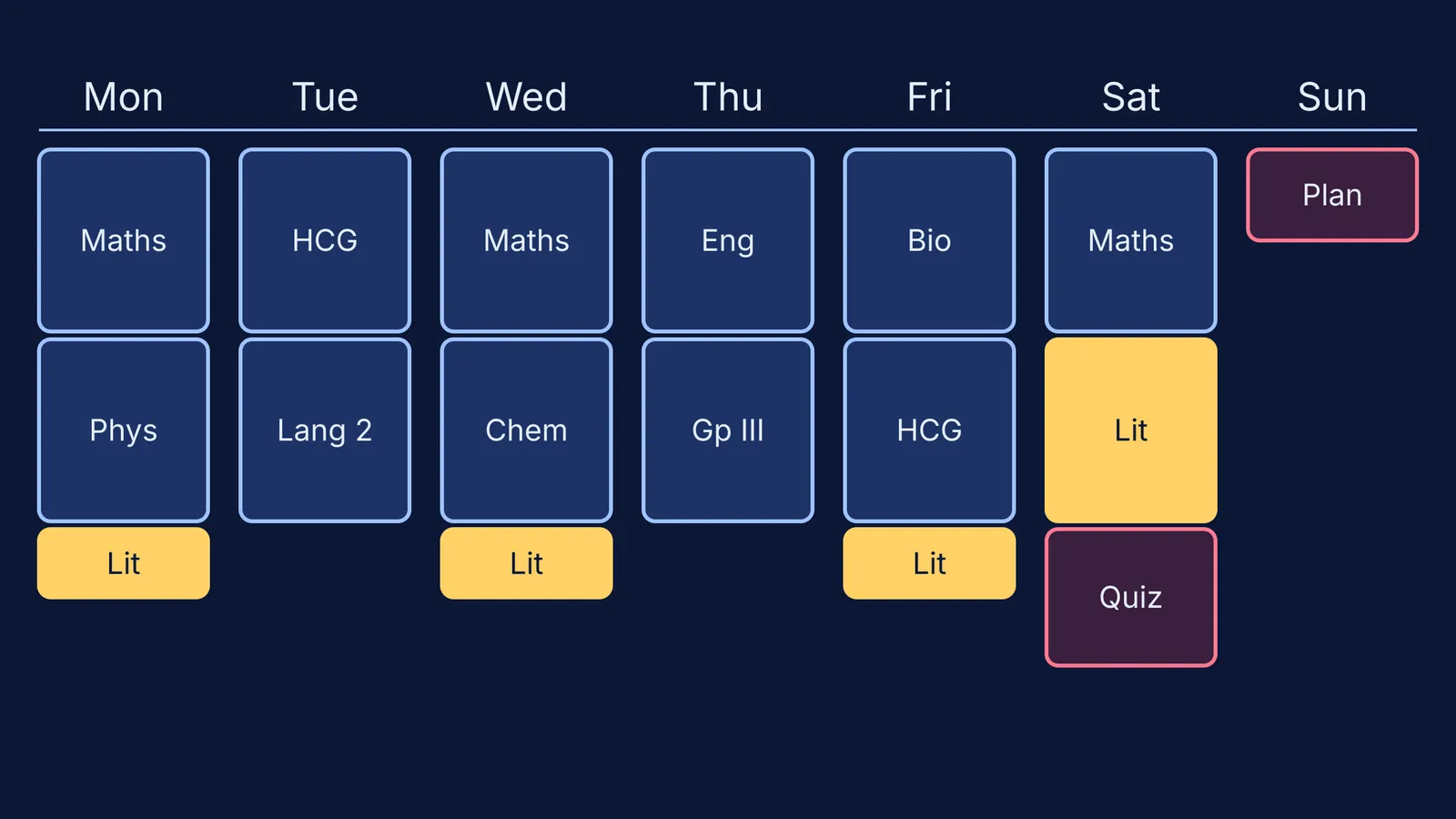
Here is one plan for a student home by about 4 pm. Science rotates: physics on Monday, chemistry on Wednesday, biology on Friday.
Monday: Maths 40 minutes, physics 40, literature recall 15
Tuesday: History, Civics and Geography 40, second language 40
Wednesday: Maths 40, chemistry 40, literature recall 15
Thursday: English Language 40, your Group III subject 40
Friday: biology 40, History, Civics and Geography 40, literature recall 15
Saturday: Maths 40, literature reading and one written answer 40, a mixed quiz across the week's subjects 30
Sunday: 20 minutes to check next week's school tests and move slots; the rest of the day is free
That adds up to just under ten hours a week, or 80 to 95 minutes on a school day. When a unit test is coming, swap rather than add: give that subject two slots that week and return the borrowed slot the week after. For the one-subject-a-day question, see a weekly plan that mixes single-subject days with daily practice.
If a subject has already slipped and you cannot tell where to begin, Fermi's AI tutor can work out what you already know and build a plan for the session, so the 40-minute slot starts with a clear next step.
Why start revising English Literature in Class 9?
The play runs across both years. The CISCE English syllabus for the 2028 examination sets Shakespeare's Julius Caesar, Acts I and II, for Class 9 and Acts III, IV and V for Class 10, alongside short stories and poems from the Treasure Chest anthology. Literature in English is its own paper of two hours and 80 marks in that syllabus. If Acts I and II are hazy by Class 10, you relearn them in the busiest year.
A 2006 meta-analysis by Nicholas Cepeda and colleagues pooled 317 experiments from 184 articles and found that spacing study out improves recall, and that the best gap between sessions grows the longer you need to remember (Psychological Bulletin). In a separate study, Henry Roediger and Jeffrey Karpicke had students read prose passages and then either reread them or write down what they remembered; on tests two days and a week later, the students who had tested themselves retained more, even though rereading made the others feel more confident (Psychological Science).
What goes in a 15-minute literature recall slot?
Close the book and write, from memory, what happened in the scene or poem you studied last (5 minutes).
Open the book and mark what you missed or got wrong in a different colour (5 minutes).
Write one line each for two characters: what they want in this scene and one phrase they say (5 minutes).
On Saturday, read the next scene or poem, then write one full answer in your own words. For answer structure, see how to prepare for ICSE English Literature.
How can parents help without taking over?
Ask about the plan, not the hours. Try "Which slot was hardest this week?" or "Do you want me to quiz you on Julius Caesar on Saturday?" instead of "How long did you study today?" Let your child decide which slots to move on Sunday. For next year, our ICSE Class 10 parent's guide to subjects, projects and revision sets out what changes.
If worry about marks starts affecting sleep, appetite or mood for more than a couple of weeks, talk to the school counsellor or a doctor. Tele MANAS, the government's free mental health helpline, is open round the clock on 14416.
Copy the plan into a notebook tonight, write tomorrow's two tasks, and give it two weeks before you change it.


