

On this page
When students consider plant sciences after Class 12, they often picture general botany or cereal farming. Modern high-value agriculture, however, revolves around horticulture: cultivating fruits, vegetables, flowers, and spices. For students exploring options beyond engineering and medicine, applied plant sciences offer technical depth and entrepreneurship.
What is a horticulture degree and who is eligible?
A B.Sc. (Honours) in Horticulture is a four-year professional degree governed by standards from the Indian Council of Agricultural Research. While agriculture degrees emphasize broadacre cereal agronomy, horticulture concentrates on high-value, perishable garden crops requiring intensive canopy management, micro-irrigation, and controlled-environment polyhouses.
Admissions to Central and State Agricultural Universities run primarily through the CUET (UG) entrance examination conducted by the National Testing Agency. Applicants must pass Class 12 with Physics, Chemistry, and Biology, Mathematics, or Agriculture (PCB, PCM, PCMB, PCA, ABC). Minimum aggregate marks are 50% for General, OBC, and EWS, and 40% for SC, ST, and PwBD. Candidates must be at least 16 years old by 31 August.
Understanding applied plant biology helps students weigh alternatives to clinical medical tracks. As highlighted in Fermi's guide on talking about STEM careers beyond engineering and medicine, specialized life-science degrees connect laboratory science directly to commercial agricultural production.
What do you study across the four-year curriculum?
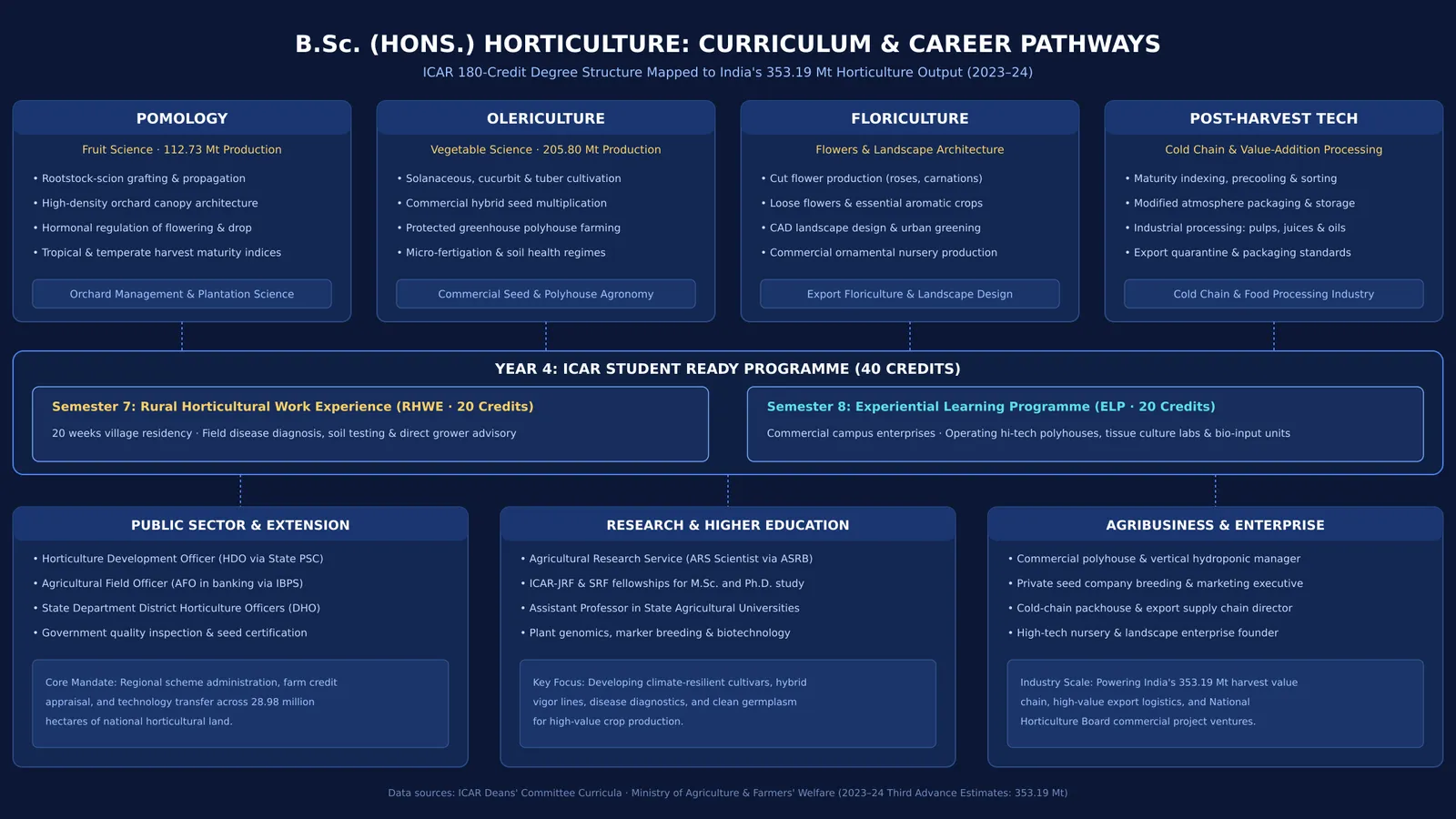
The degree encompasses roughly 180 credit hours over eight semesters under the Indian Council of Agricultural Research Deans' Committee framework. The curriculum divides into four foundational divisions:
Fruit Science (Pomology): Rootstock-scion grafting, high-density planting, canopy architecture, and maturity indices for temperate and tropical fruits. Managing fruit set and drop uses hormonal pathways detailed in plant growth regulators.
Vegetable Science (Olericulture): Cultivation and breeding protocols for solanaceous crops, cucurbits, leafy greens, tubers, and spices, alongside hybrid seed multiplication.
Floriculture and Landscape Architecture: Protected cultivation of commercial cut flowers like roses and carnations, loose flowers, turf management, and CAD-based landscape design.
Post-Harvest Technology and Processing: Post-harvest physiology, modified atmosphere packaging, cold chain storage, and commercial processing into pulps, juices, and essential oils.
Supporting courses include soil chemistry, plant pathology, entomology, and molecular breeding. For students building foundational knowledge in plant physiology, the Fermi Concept Library covers cellular transport, mineral nutrition, and metabolic cycles, with each concept mapped in its place across the sciences.
How do practical field training and rural immersion work?
The fourth year shifts entirely from classroom lectures to the Indian Council of Agricultural Research Student READY (Rural Entrepreneurship Awareness Development Yojana) initiative:
Rural Horticultural Work Experience (RHWE): In Semester 7, students reside in farming villages for 20 weeks, conducting soil tests, diagnosing crop diseases, and demonstrating improved practices to local growers.
Experiential Learning Programme (ELP): In Semester 8, students run on-campus enterprises, managing production in protected polyhouses, bio-fertilizer facilities, or plant tissue culture laboratories.
Commercial propagation uses aseptic micropropagation to produce virus-free planting stock at volume, using steps detailed in our guide to plant tissue culture and micropropagation.
Inside automated greenhouses, managing humidity, transpiration, and radiation requires understanding environmental mechanics. Through interactive models in the Fermi Simulation Lab, students can visualise thermodynamic principles and gas exchange dynamics governing crop microclimates.
What career opportunities exist after graduation?
Horticultural production in India reached 353.19 million tonnes across 28.98 million hectares in the 2023-24 Third Advance Estimates from the Ministry of Agriculture and Farmers' Welfare. Vegetables accounted for 205.80 million tonnes and fruits accounted for 112.73 million tonnes in the same harvest period. This output outpaces national foodgrain production, creating three primary professional trajectories:
Public Sector and Extension: State Public Service Commissions recruit Horticulture Development Officers (HDO) and District Horticulture Officers to manage regional schemes. National banks hire Agricultural Field Officers (AFO) through IBPS examinations to appraise farm credit.
Research and Higher Education: ICAR-JRF qualified graduates pursue funded master's and doctoral research. The Agricultural Scientists Recruitment Board conducts the Agricultural Research Service (ARS) exam to recruit scientists into ICAR institutes.
Commercial Agribusiness and Enterprise: Private roles span greenhouse operations, seed marketing, and cold-chain logistics. Entrepreneurs establish nurseries and packing facilities using capital subsidies from the National Horticulture Board.
Optimising fertigation formulas and chemical spray concentrations requires calculating parts-per-million dosages and stock dilutions accurately. The Fermi Problem Library provides worked problems with a step-by-step solver that explains the quantitative reasoning rather than printing an answer.
How should students decide between horticulture, agriculture, and botany?
When choosing between plant-oriented degrees, consider this functional decision framework:
Choose B.Sc. (Hons.) Horticulture if you want to specialize in high-value, perishable crops, protected greenhouse systems, post-harvest supply chains, or urban landscape architecture.
Choose B.Sc. (Hons.) Agriculture if you prefer broadacre grain cropping, macro-agronomic policy, livestock integration, and general agricultural economics.
Choose B.Sc. Botany if your primary interest lies in pure plant taxonomy, evolutionary morphology, and laboratory-centered cell genetics without commercial agronomic field requirements.
Explore the Indian Council of Agricultural Research portal or your state agricultural university website to compare course outlines before entrance applications close.


