On this page
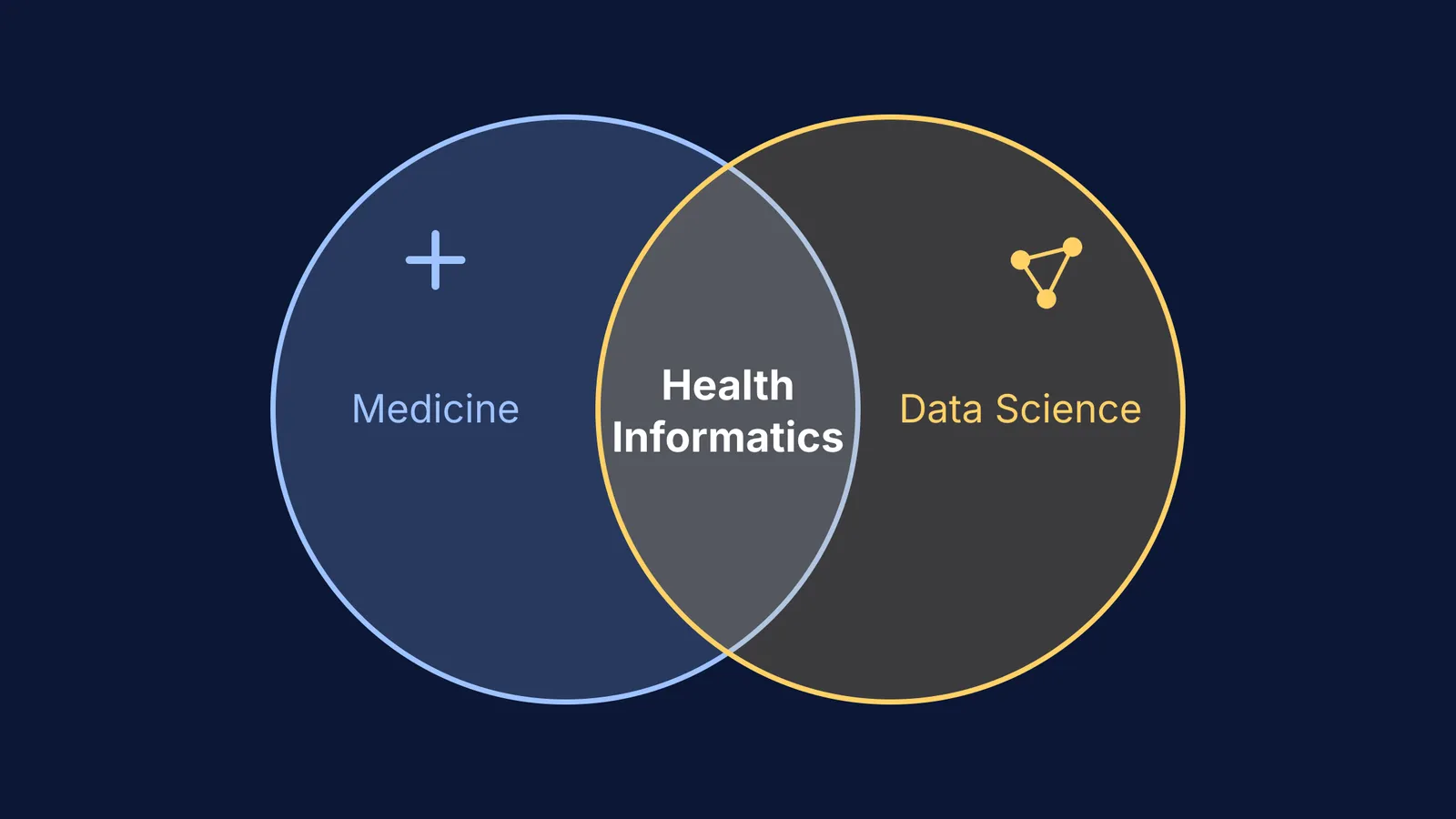
If you are a science student who is fascinated by medicine but does not want to become a doctor, or if you love software and want your work to have a direct impact on human lives, health informatics is the bridge between the two.
It is a rapidly growing career path in science, driven by the large amounts of data generated by modern hospitals. Every time a patient visits a clinic, takes a blood test, or receives a scan, new information is added to their digital record. Here is what the work involves, the skills you will need, and how to prepare for it.
What is a health informatics career?
A health informatics career involves managing, analyzing, and designing systems for healthcare data. Professionals in this field ensure that doctors have the right information at the right time to treat patients, and that hospital systems run efficiently without losing critical details.
The Indian health-tech sector is projected to reach US$ 50 billion by 2033 (India Brand Equity Foundation). This growth creates a vast job market for roles such as:
Clinical Data Analysts: Examining patient data to find trends that improve treatments, track disease outbreaks, and reduce hospital readmission rates.
Health Informatics Specialists: Designing and managing Electronic Health Records (EHR) systems for hospitals, ensuring data is securely stored and easily accessible to authorized staff.
Telemedicine Operations Managers: Building the digital infrastructure that allows doctors to consult patients remotely, managing video feeds, prescription software, and follow-up schedules.
Instead of treating patients directly, you build and manage the software and data structures that make treatment possible. You turn raw numbers and text into actionable insights that can save lives.
Why is there a sudden demand for healthcare IT?
The demand for digital health professionals comes from a global shortage of clinical staff combined with a surge in medical data. Modern medicine relies on complex diagnostic tools, and keeping track of all this information manually is no longer feasible.
The World Health Organization projects a global shortfall of 10 million health workers by 2030 (WHO). To maintain care standards with fewer clinical staff per patient, hospitals must rely heavily on technology. Software is needed to automate administrative tasks, predict patient risks, and scale the reach of the existing workforce through remote care.
When nurses and doctors spend less time searching through paper files and typing out basic forms, they can spend more time with their patients. A health informatics professional designs the systems that make this efficiency possible.
What backgrounds suit a health informatics career?
Health informatics requires an understanding of both human biology and computing. You need to know how the body works to understand the data, and you need computing skills to process it.
If you chose PCB (Physics, Chemistry, Biology) in Class 12, you already understand anatomy, diseases, and medical terminology. Your challenge will be learning data analysis, statistics, and programming languages like Python or SQL. You will need to shift from thinking about biological mechanisms to thinking about how those mechanisms are represented as data points in a database.
If you chose PCM (Physics, Chemistry, Mathematics), you have the foundation for coding, logic, and algorithms. Your challenge will be learning the biological context of the data you handle, such as how the cardiovascular system works, what specific blood test results mean, or why certain medications interact poorly with others.
If you need to patch gaps in your biology or maths knowledge before a university course, the Fermi Concept Library holds every concept in physics, chemistry, biology, mathematics and computing, each with its own lesson and its place in the map.
How do you enter the field in India?
There are two main educational routes for science students to enter healthcare IT in India. You can either start directly after school or transition into the field after a general science degree.
Direct undergraduate degrees: Several institutions now offer a B.Sc. in Health Informatics or a B.Tech in Computer Science with a specialization in Health Informatics. These programs teach medical terminology and coding side by side, giving you a balanced foundation from the very beginning. You will learn about database management alongside human physiology.
The postgraduate route: Many professionals start with a traditional B.Sc. in Biology, Bioinformatics, or Computer Science, or a B.Pharm. They then pursue an M.Sc. in Health Informatics or Public Health. This is often the preferred route for moving into public health careers in India or transitioning into biostatistics as a career. A master's degree allows you to specialize and often includes a project or internship in a hospital setting.
How can you test your interest in health informatics?
Before committing to a multi-year degree program, you can test whether this intersection of disciplines actually suits your working style:
Learn a data language: Try a basic Python or SQL tutorial online. See if you enjoy organizing, cleaning, and querying data. These are the daily tasks of an informatics professional.
Understand medical terminology: Pick up a basic anatomy book or search for introductory clinical terms online. You must be comfortable reading about diseases and treatments to design systems for them.
Explore EHR standards: Read a summary of Health Level Seven (HL7), the international standard for the transfer of clinical data. It shows exactly how medical information is standardized so that different computers and hospitals can share patient records securely.
By building skills in both science and software, you position yourself for a career that is both technically rigorous and deeply connected to human health. You become the crucial link that allows modern medicine to function at scale.