

On this page
When we think of school science tracks, we often imagine a strict divide: Physics, Chemistry, and Mathematics (PCM) for engineering, and Physics, Chemistry, and Biology (PCB) for medicine. But modern science rarely stays inside these boxes. The fields of genetics, epidemiology, and drug discovery are producing more data than human minds can process alone. To turn that raw data into treatments, researchers need sophisticated mathematical models.
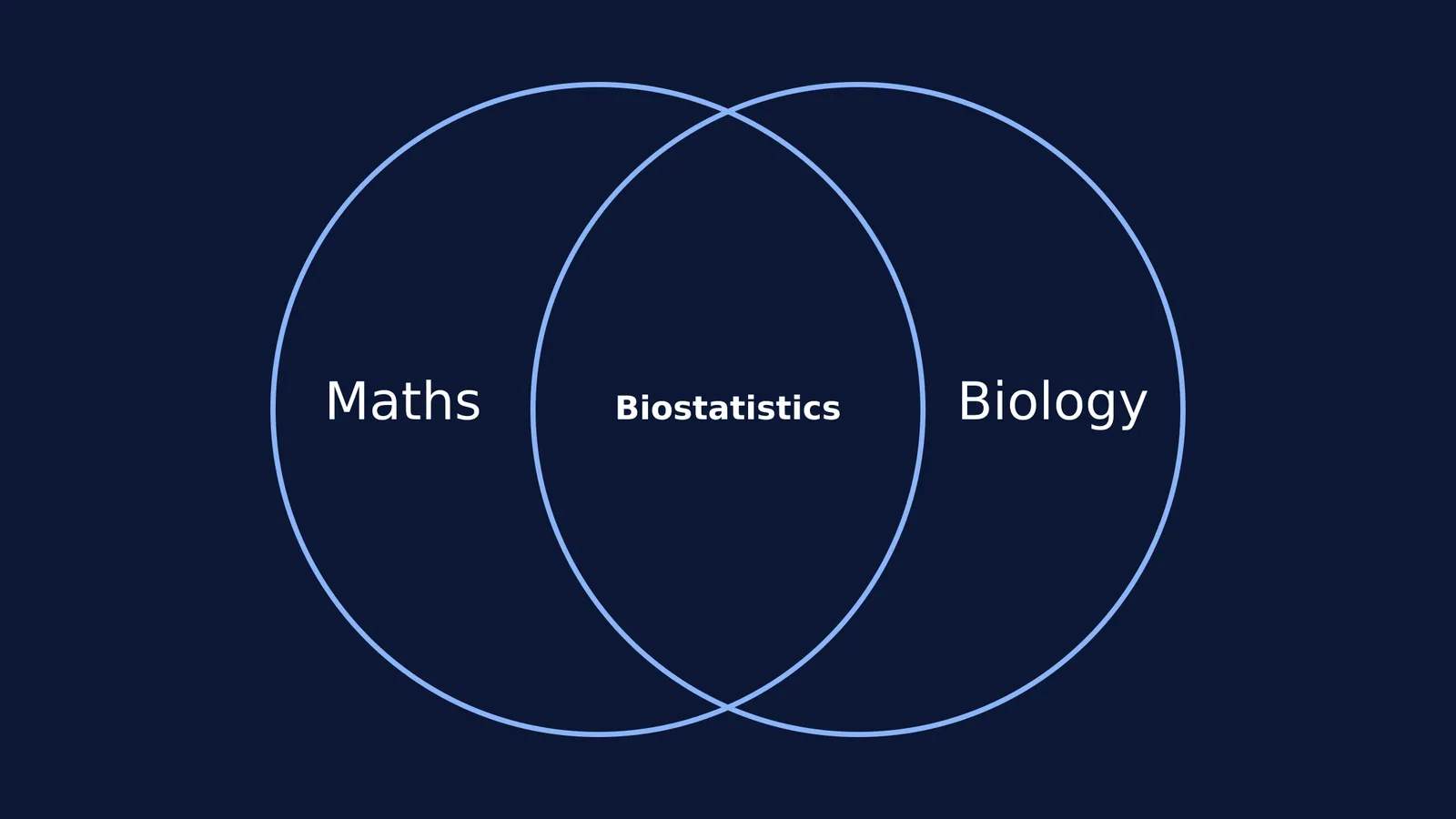
This intersection is where biostatistics lives. If you enjoy the analytical rigor of mathematics but are fascinated by human health and the natural world, a career in biostatistics offers a way to combine both.
What Does a Biostatistician Do?
Medical researchers might conduct a clinical trial for a new cancer drug, but it is the biostatistician who determines whether the drug actually works or if the results were just a statistical fluke.
Biostatisticians design the mathematical frameworks for experiments. They calculate exactly how many patients a clinical trial needs to be reliable, ensure the data is collected without bias, and use probability to analyze the outcomes. If a trial fails to account for variables—like the differing ages or underlying conditions of patients—the entire study can be invalidated.
Beyond drug trials, their work involves tracking disease outbreaks and modelling the spread of viruses in real time. In the realm of genomics, biostatisticians analyze massive sequences of DNA to find the roots of rare diseases, helping public health officials make evidence-based policy decisions.
Historically, this kind of crossover was pioneered by scientists like J. B. S. Haldane, whose maths of evolution showed how genetics could be understood through numbers, or D'Arcy Thompson, who explored the mathematics of growth and form in nature. Today, that same spirit is applied to massive datasets generated by modern hospitals and laboratories.
What Degrees Do You Need for Biostatistics?
To become a biostatistician in India, the standard path is to complete a Bachelor’s degree (BSc) in Mathematics or Statistics, and then pursue a specialized Master’s degree. Students from biology backgrounds can also enter the field, provided they have taken mathematics or statistics as a main or allied subject during their undergraduate studies.
Several premier medical and research institutes in India offer specialized MSc Biostatistics programs:
Christian Medical College (CMC), Vellore: Known for its clinical research, CMC offers a two-year MSc in Biostatistics. According to their admissions criteria, applicants to CMC Vellore's MSc in Biostatistics need a background in statistics as a main or allied subject.
NIMHANS, Bangalore: The National Institute of Mental Health and Neurosciences offers an MSc program focusing on neuro-research.
Indian Statistical Institute (ISI): While primarily known for pure statistics, ISI's rigorous programs offer excellent pathways into health data analysis and epidemiological modelling.
What Skills Are Needed for Medical Research?
While a standard statistics curriculum covers the theory, applied biostatistics requires a specific toolkit tailored to the medical industry:
Programming Languages: You cannot do modern statistics on paper. Proficiency in R, Python, and SAS (a standard in the pharmaceutical industry for regulatory reporting) is essential for handling large clinical datasets.
Medical Context: You do not need to be a doctor, but you must understand clinical trial phases, basic anatomy, and epidemiological terms. A biostatistician must speak the language of the biologists they collaborate with.
Advanced Mathematics: A firm grasp of probability distributions, survival analysis, and calculus is required to build and critique models. You can work through probability and calculus problems with a step-by-step solver that explains the reasoning in the Fermi Problem Library.
How Can You Start Preparing Today?
If you are currently in secondary school or early university, here is how you can build a solid foundation for this career:
Keep Maths in the Mix: If you are a biology student, do not drop mathematics. Take it as an elective or consider an integrated course. If you are in CBSE, you might look into Applied Mathematics to keep your quantitative skills sharp.
Learn to Code Early: Start by learning the basics of Python or R. There are many free online resources to introduce you to basic data manipulation and visualization.
Focus on Fundamentals: Ensure you have a deep understanding of algebra and probability. These topics are the bedrock of statistical modelling.
Prepare for Entrances: Look at the syllabi for entrance exams like IIT-JAM (Mathematical Statistics) or the NIMHANS entrance test to understand the level of mathematical rigour expected.
Read Scientific Papers: Get used to reading the "Methods" sections of medical papers to see how statistics are actually used in real-world research.


