

On this page
A practical file, a chemistry investigatory project and an English assignment, all due in the same fortnight as your JEE mock tests. Most students either let school work spill into every evening or leave it all for the last weekend. Both cost you JEE time.
The fix is to treat school projects as a fixed-size job: plan once, give them a set number of time blocks, and stop at a standard you decided in advance.
Why do school projects always take longer than you plan?
Because your first estimate is built from how the work should go, not how similar work went last time. Psychologists call this the planning fallacy.
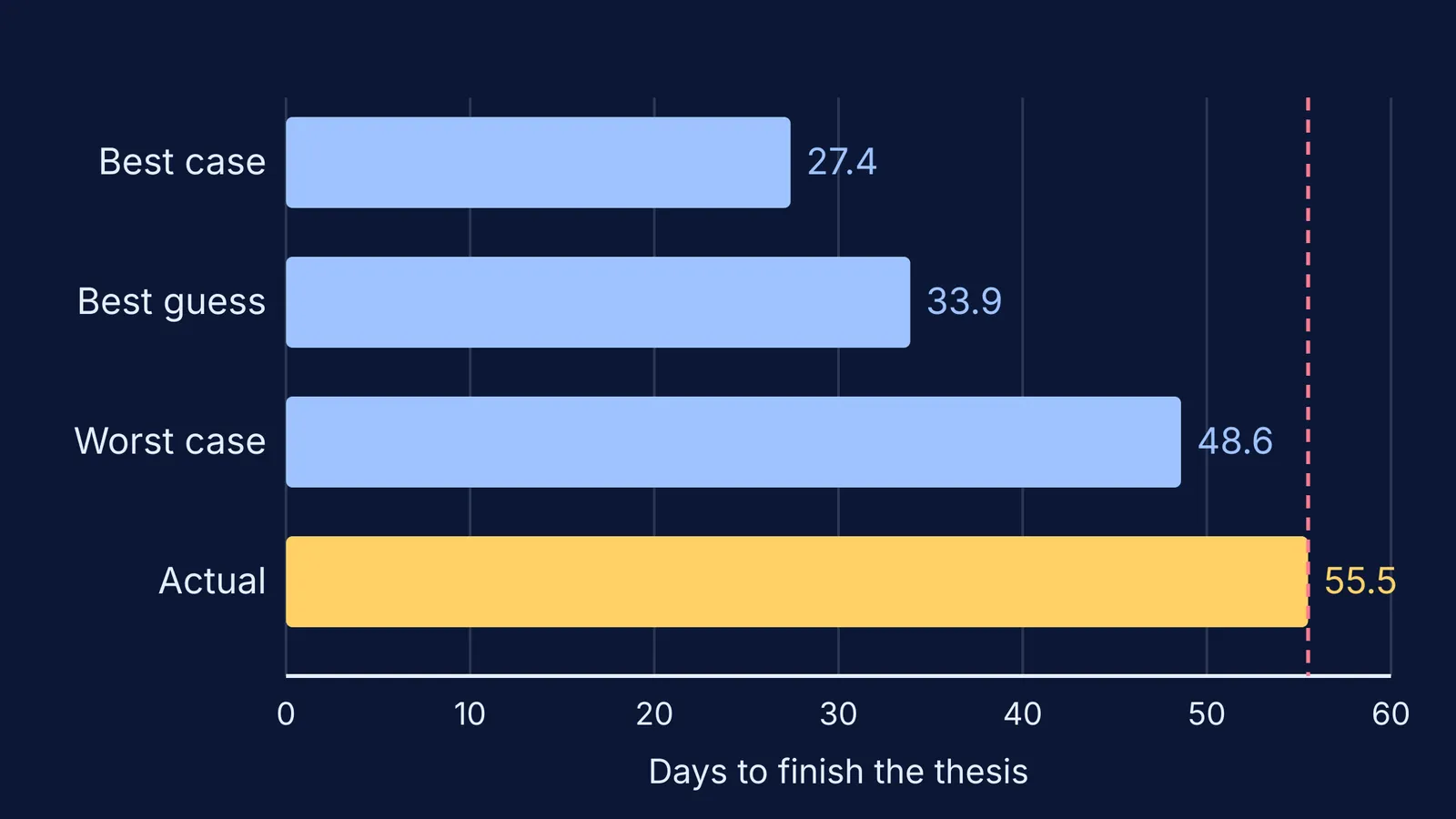
In Buehler, Griffin and Ross (1994), 37 psychology students at the University of Waterloo predicted when they would finish their honours theses. Among the 33 whose theses could be analysed, the average best guess was 33.9 days; they actually took 55.5 days. Only 29.7% finished by their best guess, and even their "if everything went as poorly as it possibly could" estimate, 48.6 days on average, still fell short.
In a classroom survey reported in the same paper, students said they finished about three quarters of their projects (73%) on the day of the deadline. And in a later experiment, the optimistic bias disappeared when people were asked to connect their past experiences to the new prediction before making it.
How do you plan a school project in one sitting?
Give it one 30-minute sitting with the rubric in front of you, without starting the work itself.
List every deliverable: experiments to write up, readings, graphs, diagrams, the index page, signatures.
Write a finish line for each one, taken from the rubric: what does the teacher actually check?
Estimate each piece in 40-minute blocks, then recall the last similar project and adjust. With no record, try the ratio from the thesis study: 55.5 against 33.9 days, about 1.6 times.
Put the blocks into your week as fixed slots, with the last block at least two days before the deadline.
Note anything you need from someone else (lab readings, a printer, a signature) and ask for it now.
If you do not understand the theory behind an experiment, sort that out now rather than mid-block. The Fermi Concept Library covers every concept in physics, chemistry, biology, mathematics and computing, each with its own lesson, so you can check what a meter bridge or a titration is actually measuring before you write the aim and result.
How do you fit project work around JEE preparation?
Give school projects your low-energy slots and protect your best hours for JEE problem practice.
Write each slot as an if-then plan: "If it is Tuesday at 7 pm, then I write two experiments into the physics file." A meta-analysis by Gollwitzer and Sheeran (2006) of 94 independent tests found that plans of this "when, where, how" form had a medium-to-large effect (d = 0.65) on people reaching their goals.
For building the whole week around school and coaching, see our guide to time blocking for students juggling school and coaching, and for the Class 12 crunch, balancing board exams with JEE preparation.
When is a school project good enough to stop?
When it meets the finish line you wrote in the planning sitting. Run this check at the end of each block:
Every item the rubric lists is present.
Readings, units and graphs are correct and labelled.
It is neat enough that a teacher can read it without effort.
It is signed, dated and in the right order.
If all four are true, stop. Re-colouring diagrams or rewriting a neat page costs you a block of JEE practice for almost no marks. If stopping is hard, our piece on perfectionism and studying has more on holding high standards without getting stuck.
A worked example: a physics practical file in 10 days
Riya has eight experiments to write into her Class 12 physics file, due in 10 days. Last term, a six-experiment file took her three evenings, not the two she had planned.
Planning sitting (Sunday, 30 minutes): rubric lists aim, apparatus, diagram, observation table, graph, result and precautions. She estimates one block per experiment, plus one for graphs and one for the index: 10 blocks.
Buffer: her last file took about 1.5 times her plan, close to the 1.6 ratio from the thesis study, so she books 16 blocks, 1.6 times her estimate.
Slots: two blocks every evening after school for eight days; mornings stay for JEE.
Finish: the last block is on day 8. Days 9 and 10 are spare, for signatures and anything that went wrong.
A parent can help without taking over by asking: "Show me your list of blocks, and tell me which day you will be done." Then check in on that day, not every evening.
If the hard part is knowing where to begin, you can bring a scanned assignment to Fermi's AI tutor, which works out what you already know and builds a plan for the session. Make the plan tonight, book the blocks, and keep your mornings for JEE.


