

On this page
Before you answer a single question in a written exam, you fill in the cover page of your answer booklet: roll number, subject, subject code, date, centre and signature. It is the easiest part of the paper, which is why students rush it. A wrong digit here can cost more than a weak answer.
Why does the answer booklet cover page matter so much?
The cover is the only link between your answers and your name. CBSE's Examination Bye-Laws state that answer books received in candidates' real roll numbers "shall be converted into fictitious numbers" (rule 49), and that approved examiners evaluate books bearing those fictitious roll numbers (rule 51). The examiner is not meant to know whose book it is, so your marks reach you only through the details on the cover.
The same bye-laws set the opposite rule for the rest of the book. Under rule 36.1(iii), a candidate may not write their name, put their signature or make "any sign or mark which may disclose his/her identity to the examiner" in the answer book; a candidate who does is deemed to have used unfair means and their result is not declared.
Other exam bodies are just as strict. The Kerala Public Service Commission's answer booklet instructions say the roll number must be written and bubbled correctly because "no correction is permitted", and booklets where the number is missing, not written distinctly and correctly, or written in the answering part are liable to be invalidated.
The CBSE bye-laws above are an archived edition (updated to December 2004), and every board prints its own cover, so the instructions on your booklet and the invigilator's announcements are the final word.
How do you fill the answer booklet cover page, step by step?
Read the instructions printed on the booklet first. Note which pen is allowed and which boxes say "for office use" or "for invigilator".
Place your admit card beside the booklet. Copy every detail from the card, not from memory.
Write the roll number in figures, one digit per box. If there is a box for the number in words, read the card again rather than your own figures.
If there are bubbles under the roll number, darken each one fully and only one per column.
Write the subject name and subject code exactly as printed on your admit card or question paper, whichever your board tells you to use.
Fill in the date, centre number and any other fields the cover asks for.
If the cover has a box for your signature, sign there and nowhere else.
Leave every invigilator or office box blank.
How do you check the cover page twice without second-guessing?
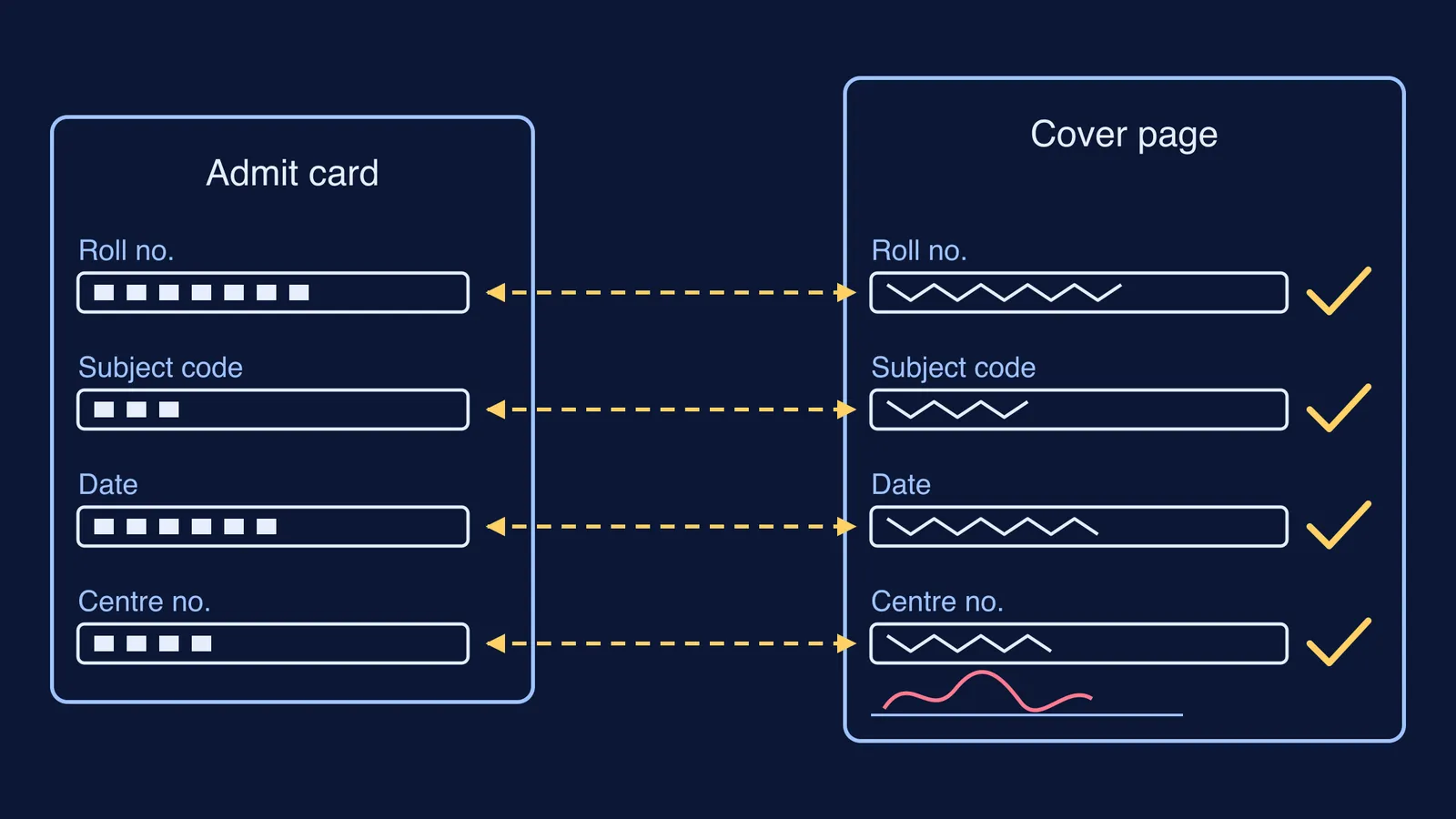
Use a two-direction check. First read from the card to the booklet, then from the booklet back to the card. Reading in both directions gives you a second chance to catch a digit your eye skipped the first time.
A worked example with an invented roll number: your card says 26140738 and you write 26147038. At a glance, both look right. Split them into chunks, 261-407-38 and 261-470-38, and the middle chunk does not match. Point at each digit with your pen cap and the swap shows up.
Do the first check when you finish the cover and the second just before you hand in. CBSE's Controller of Examinations advises students to "always clearly write the correct question number" before attempting each answer, and to cross out an answer written twice that they do not want evaluated.
A final check you can run in your head:
Roll number matches the admit card, in figures and words.
Bubbles match the figures above them.
Subject code matches the paper on your desk today.
Signature is in its box, and nowhere inside.
Question numbers are written beside every answer.
Supplementary sheets are filled in and tied in as instructed.
What should you do if you spot a mistake on the cover?
Raise your hand and tell the invigilator exactly what is wrong, rather than overwriting or scratching out the number yourself. If you notice only after the exam, our guide on what to do if you wrote the wrong roll number on your answer sheet walks through the next steps, and our piece on exam-day problems like a missing admit card or wrong centre covers the rest.
How can you make this routine automatic?
Practise it in every school test and pre-board: fill the cover from your admit card or a mock roll slip, run the two-direction check, then start the paper. By exam day it runs without effort. Our guide on using the reading time in board exams shows what to do once the paper is in your hands.
A careful cover only helps if the answers inside hold up. If one type of numerical keeps going wrong in your mocks, the Fermi Problem Library has worked problems with a step-by-step solver that explains the reasoning rather than printing an answer.


