

On this page
A few weeks into coaching, most students have a stack of paper with no order: a module for every chapter, a DPP (daily practice problem sheet) most days, and regular test papers. When you need DPP 4 of Rotational Motion the night before a test, it is somewhere in that stack. A filing system fixes this with three decisions you make once and a short weekly reset.
Why bother filing practice sheets at all?
Because a DPP you can find is a DPP you can re-attempt, and re-attempting is the part that helps you remember. In a study by psychologists Roediger and Karpicke, students who took recall tests on a passage remembered substantially more on final tests 2 days or 1 week later than students who restudied it the same number of times, even though restudying made them feel more confident. Your old DPPs and tests are a ready-made bank of practice tests, but only if you can pull them out again.
A second reason is mixing chapters. In a classroom study of 126 seventh-graders run over 3 months, Rohrer and colleagues found that interleaved practice, where problems from different topics are mixed, beat blocked practice on an unannounced test given 1 or 30 days later. If your sheets are filed by chapter, building a mixed set is easy: take two questions each from three folders.
How do I set up the system?
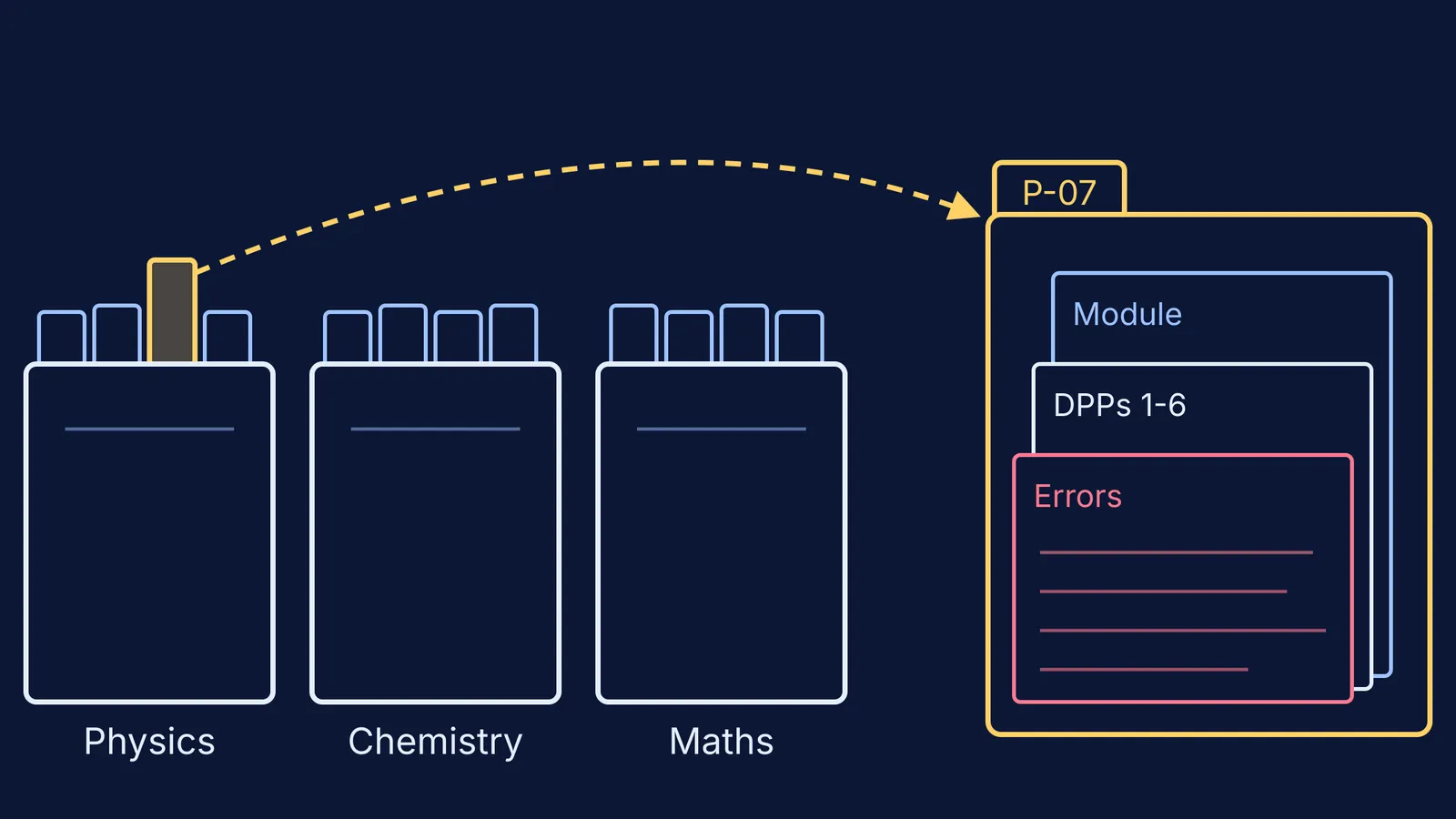
You need one box file per subject, one plastic L-folder per chapter, and a marker.
Subject first. One box each for Physics, Chemistry and Maths (or Biology). Tests that cover several subjects get a fourth box, filed by date.
Chapter second. Number your chapters in your coaching's order and write a short code on each folder: P-07 for Physics chapter 7, C-03 for Chemistry chapter 3. Put the codes on the top edge so you can read them without lifting anything out.
Sheet type third. Inside every chapter folder, keep the same order: the module at the back, the DPPs in number order in front of it, and an errors sheet at the very front.
Label each sheet in the top corner the day you get it, for example P-07 D04 for Physics chapter 7, DPP 4. That label is what makes finding a sheet take seconds.
Where do full test papers go?
Test papers mix chapters, so they can't live in one chapter folder. File the whole paper in the tests box, by date. Then, after you check it, write each question you got wrong or skipped onto the errors sheet of its chapter: test name, question number, and one line on why it went wrong (concept, calculation, misread, time). Now the P-07 folder holds every Rotational Motion question you have ever got wrong, from every test. If you want more from your test results, our guide on reading your mock test data for accuracy and time goes further.
What does this look like on a real evening?
Say your coaching announces a part-test on Rotational Motion and Gravitation on Sunday. On Thursday you take out P-07 and P-08. From each folder you pull the errors sheet and two DPPs you haven't re-attempted. You solve them on fresh paper against a timer, mark them, and put a second tick beside anything still wrong. None of that evening was spent searching.
If a question keeps going wrong in the same place, the method is the problem, not your memory. Working it through in the Fermi Problem Library, which has a step-by-step solver that explains the reasoning rather than printing an answer, can show you which step breaks. If the gap is the idea itself, the chapter's lesson in the Fermi Concept Library is a good place to restart.
How do I keep it from turning back into a pile?
Pick one fixed slot a week, Sunday evening for example, for a quick reset:
Every loose sheet gets a label and goes into its folder.
Every checked test goes into the tests box, and its errors go onto the chapter sheets.
Finished chapters move to the back of their box, but stay in the box. You will need them for revision.
Anything you are not using that day leaves the desk.
That last point matters more than it seems. Research on the visual system by McMains and Kastner describes how several objects in view at once compete for processing in the brain, and how grouping things in the scene reduces that competition. That is a lab finding about vision, not a study of desks, but it is a fair reason to keep one folder open at a time. For the rest of the setup, see our checklist for parents on setting up a good study space at home.
Once the boxes are in place, you can plan when each folder comes back out with a 4-week spaced revision schedule for any chapter. Start tonight with one subject and one box.


