

On this page
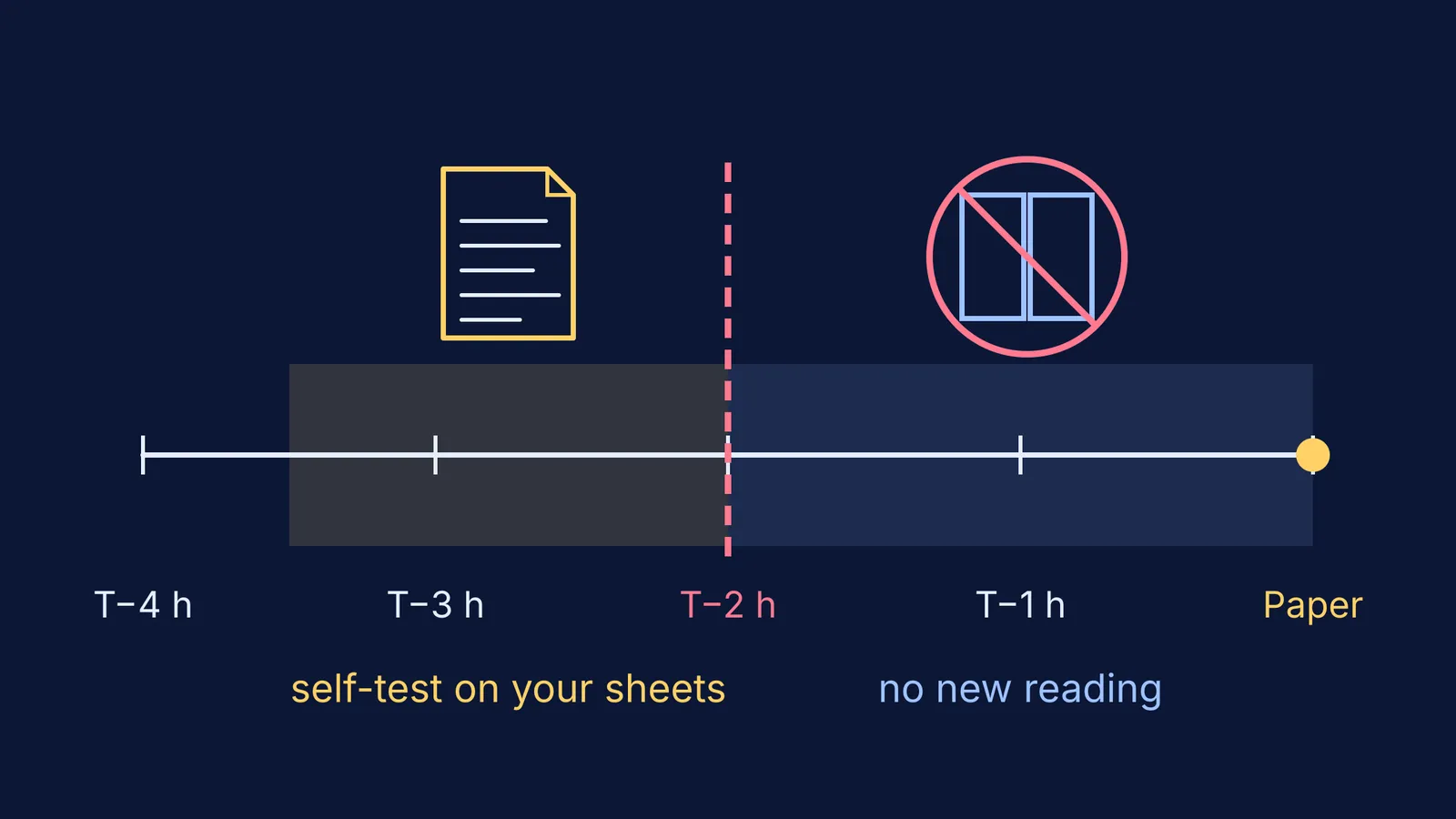
Most students spend exam morning flipping through a full notebook, hoping something sticks. A better plan is smaller: one page per subject, built in the days before, that you test yourself on at breakfast. Then a hard rule: no new reading in the last two hours before the paper.
What should you revise on the morning of the exam?
Revise only what you have already learned, and revise it by recalling, not rereading. In Roediger and Karpicke's 2006 study, students who took recall tests on a passage remembered more of it two days and one week later than students who reread it, even though rereading made students more confident.
Recall also holds up under pressure. In Smith, Floerke and Thomas (Science, 2016), 120 students learned words and pictures either by practice tests or by restudying, then faced a stressful public-speaking and maths task. As ScienceDaily reported, the practice-test group recalled around 11 of 30 items under stress, while the restudy group recalled about 7.
What goes on a one-page morning sheet?
Three blocks, and nothing else:
Formulas you actually use, written the way you apply them, with units and sign conventions. Not every formula in the chapter: only the ones you reach for in problems.
Traps: the places where the paper catches people. Units that need converting, conditions under which a formula fails, words like "not" or "except" in options.
Last errors: the mistakes you made in your last three or four mock tests or practice papers, written as a rule ("I forget to square the 2 in the denominator").
Build the sheet over the final week, not the night before. If you have never made one, our guide to making your own formula sheet and testing yourself on it walks through the first draft.
What does a sheet look like for Class 12 optics?
Formulas: mirror 1/v + 1/u = 1/f; lens 1/v − 1/u = 1/f; magnification for a lens m = v/u; power P = 1/f with f in metres.
Traps: in the Cartesian convention, a real object has u negative; a concave mirror has f negative; power in dioptres needs f in metres, not centimetres.
Last errors: "Used the mirror formula on a lens question in mock 3." "Wrote P = 1/20 for f = 20 cm; it is 1/0.2 = 5 D."
On the morning, fold the sheet so only the headings show, write each formula and trap from memory on scrap paper, then unfold and check. Retry anything you got wrong.
If your last-errors block keeps filling up with the same wrong-method mistakes, work through a few of them in the week before with the Fermi Problem Library, whose step-by-step solver explains the reasoning rather than printing an answer.
Why stop new reading two hours before the paper?
This is our rule of thumb, not a number from a study, though it fits the research above. Something you meet for the first time on exam morning has had no chance to be practised, and in the Smith study it was restudied, unpractised material that held up worse under stress. New reading also tends to raise panic ("I never saw this") at the moment you most need a steady head.
Two hours also leaves room for eating, travel and reaching the centre by the reporting time on your admit card.
What does a good exam morning look like?
A sample plan for a paper that starts at T (adjust to your timings):
T − 4 h: wake up, water, breakfast. This assumes you slept; sleep before an exam does more than an all-nighter.
T − 3 h 30 min: the folded-sheet self-test for each subject in today's paper, about 15 minutes per sheet.
T − 2 h: the line. Put the notebooks away. Pack admit card, ID and permitted stationery.
T − 1 h: travel or wait. If nerves are loud, you could try writing about your worries for 10 minutes. In Ramirez and Beilock's classroom study, anxious ninth-graders who did this before a biology final averaged a B+ against a B− for anxious students who did not, ScienceDaily reported. Later attempts to repeat the result have been mixed, as our post on writing about worries before a test explains.
T − 15 min: one last glance at the last-errors block only. Then put it away.
What should parents say on exam morning?
Keep it short: "Admit card and ID? Eat something. You've done the work; read every question twice." Avoid quizzing, comparisons, or "Did you finish the syllabus?" at the door.
If exam stress is lasting for weeks or affecting sleep and eating, talk to a school counsellor or doctor. In India, the Health Ministry's free mental health helpline, Tele MANAS, is 14416 (or 1800-891-4416), as listed by IIT Kanpur's counselling service.
If you are starting the sheets from a blank page a week out, Fermi's AI tutor can work out what you already know in a chapter and build a plan for the session, so the sheet starts from your real gaps.


