On this page
Most Class 12 students apply for more entrance exams than they need, because each form looks cheap on its own. Travel, a night's stay and the crash course you buy for that one exam can cost far more. Here is how to add it up and decide what to cut.
What does it cost to apply for an entrance exam?
The JEE Main 2027 Information Bulletin sets the fee for one paper at ₹1,000 for a general-category male candidate, ₹900 for a Gen-EWS or OBC-NCL male candidate, ₹800 for women in these categories, and ₹500 for SC, ST, PwD and third-gender candidates, for each session.
JEE Main 2027 runs in two sessions, January and April, and you pay separately for each one, according to NTA's public notice of 24 October 2026. Applying in the late window adds ₹500 to the fee, and processing charges and GST are extra.
The NEET-UG 2026 Information Bulletin set the fee at ₹1,700 for general candidates, ₹1,600 for Gen-EWS and OBC-NCL, and ₹1,000 for SC, ST, PwBD and third-gender candidates.
CUET-UG charges by the number of subjects you choose. The CUET-UG 2026 Information Bulletin charged general candidates ₹1,000 for up to three subjects and ₹400 for each additional subject, up to five.
How do you add up the full cost of each exam?
For every exam on your list, write three lines:
Fee: the official fee for your category, plus any late fee if you might miss the deadline.
Travel: tickets for you and anyone going with you, one night's stay if the centre is far, and food. Entry for JEE Main's morning shift runs from 7:00 to 8:30 a.m., according to the JEE Main 2027 bulletin, so a distant centre can mean arriving the night before.
Extra coaching: any crash course, test series or book you would buy only for this exam.
Then ask how many study hours this exam will take from your main exam.
A worked example: one student, four exams
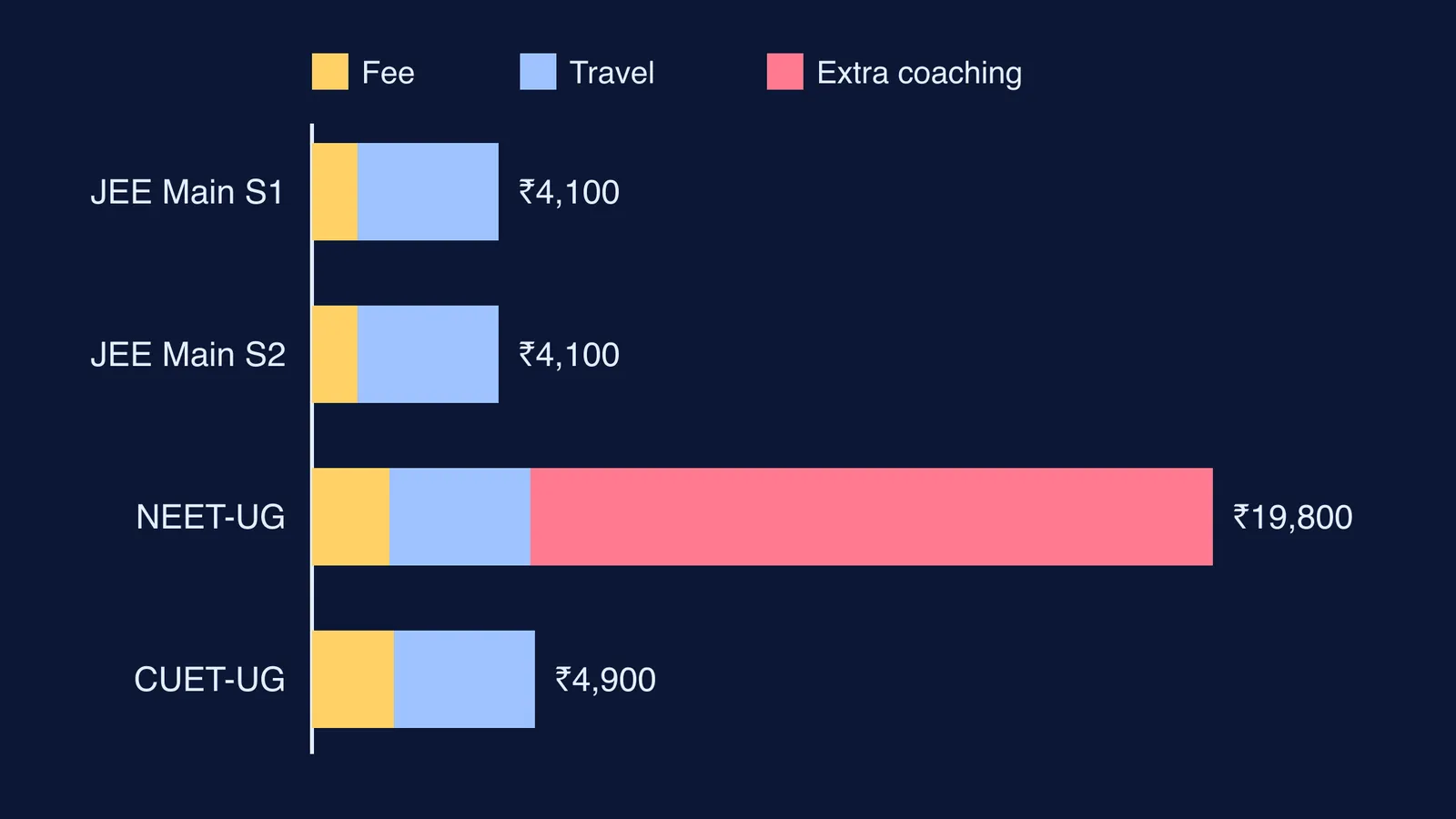
Take a general-category student in Class 12 with physics, chemistry, maths and biology, who wants to keep every door open. The fees come from the bulletins linked above. The travel and coaching figures are our assumptions, so replace them with your own: ₹3,100 a trip for the student and a parent (₹1,200 tickets, ₹1,500 for one night, ₹400 food), and a ₹15,000 NEET crash course.
JEE Main Session 1: ₹1,000 fee + ₹3,100 travel = ₹4,100
JEE Main Session 2: ₹1,000 fee + ₹3,100 travel = ₹4,100
NEET-UG: ₹1,700 fee + ₹3,100 travel + ₹15,000 crash course = ₹19,800
CUET-UG, five subjects: ₹1,800 fee + ₹3,100 travel = ₹4,900
The total is ₹32,900, and the fees are only ₹5,500 of it. NEET alone is about 60% of the bill, and it brings a whole extra biology syllabus.
Which entrance exam should you drop?
Run each exam through four questions. Drop it if you answer "no" to the first two.
Does it lead to a course and college you would actually join?
Is this exam the only route to that course?
Does most of its syllabus overlap with your main exam?
Is it cheap insurance, a low cost for a real backup?
In the example, if the student would not take an MBBS seat, NEET goes, saving ₹19,800 and many biology hours. CUET stays: at ₹4,900 it keeps a central-university BSc route open. JEE Main Session 2 does not have to be decided now. The JEE Main 2027 bulletin keeps the Session 2 form open until 3 February 2027, after the Session 1 exam days (20 to 28 January), so you can sit Session 1 first and then choose.
If you are juggling engineering exams, our guide to preparing for JEE Main, BITSAT and a state CET together helps you see how much the syllabi overlap.
How can you cut costs without dropping an exam?
Choose nearby cities. The JEE Main 2027 bulletin lets you pick up to four cities from the state of your permanent or present address, though NTA can still allot a different one.
Fill forms early. A calendar stops late fees; see how to track entrance exam form deadlines in Class 12.
Question every exam-only purchase before you pay.
In the Comprehensive Modular Survey: Education 2025, 27.0% of school students were taking or had taken private coaching in the current academic year, and average annual household spending on coaching per higher secondary student was ₹6,384.
If you are not sure where to start on your own, Fermi's AI tutor can work out what you already know and build a plan for the session, and the Fermi Problem Library has worked problems with a step-by-step solver that explains the reasoning.
Parents can also read how to talk with a child about what coaching costs. Then sit down with this list and decide together before the next form opens.