On this page
Engineering drawing can catch out students who are strong in maths. It is hard because you must picture a solid from three sides, then draw it neatly to a standard, sheet after sheet. Both are skills you can practise.
What does the first-year engineering drawing course cover?
Course names vary, so check your own syllabus. As one example, the MAKAUT first-year B.Tech curriculum lists Engineering Graphics & Design at 1 lecture hour and 4 practical hours a week, for 3 credits. Its modules include:
lines, lettering, dimensioning and scales
conics, cycloids, involutes and spirals
projections of points, lines, planes and solids, in first and third angle
sections of solids and development of surfaces
isometric views, and converting them to orthographic views
CAD drawing with layers and annotation
Four practical hours for every lecture hour tells you where the course lives: on the drawing board. If you took the subject in school, see whether CBSE Class 11 Engineering Graphics is worth it.
Why do projections feel so hard at first?
Seeing a solid from different sides is called spatial visualisation, and it can be trained. At Michigan Technological University, Sheryl Sorby and Beverly Baartmans ran a pre-graphics course for first-year engineering students who had scored poorly on a spatial test (Journal of Engineering Education, 2000). Students built objects from snap cubes and sketched isometric and orthographic views on grid paper, alongside computer lab exercises. Across the course's first six years, average spatial test scores rose from about 50% before the course to about 80% after it. In a follow-up of the 1993 group, later graphics course grades averaged 3.03 on a 4-point scale for the 24 students who took the course, against 2.70 for 72 similar students who did not. That is one university and one cohort, so read it as encouraging, not as a guarantee.
The practical lesson: when a view will not come, stop staring at the question. Make the object from an eraser or folded paper, turn it in your hand, and sketch each side freehand before you touch the drafter.
Which drawing tools do you actually need?
Your college will give a list; the usual core:
a mini drafter and a board that takes an A2 sheet
45 degree and 30-60 degree set squares, and a protractor
a large compass and a small bow compass
clutch pencils: a hard lead for construction lines, a softer one for final lines
an eraser, an erasing shield and clips
An A2 sheet is 420 x 594 mm under BIS SP 46:2003, Engineering Drawing Practice for Schools and Colleges. SP 46 also makes wide lines twice the width of narrow lines, so keep two leads and use them consistently.
How does first-angle projection work?
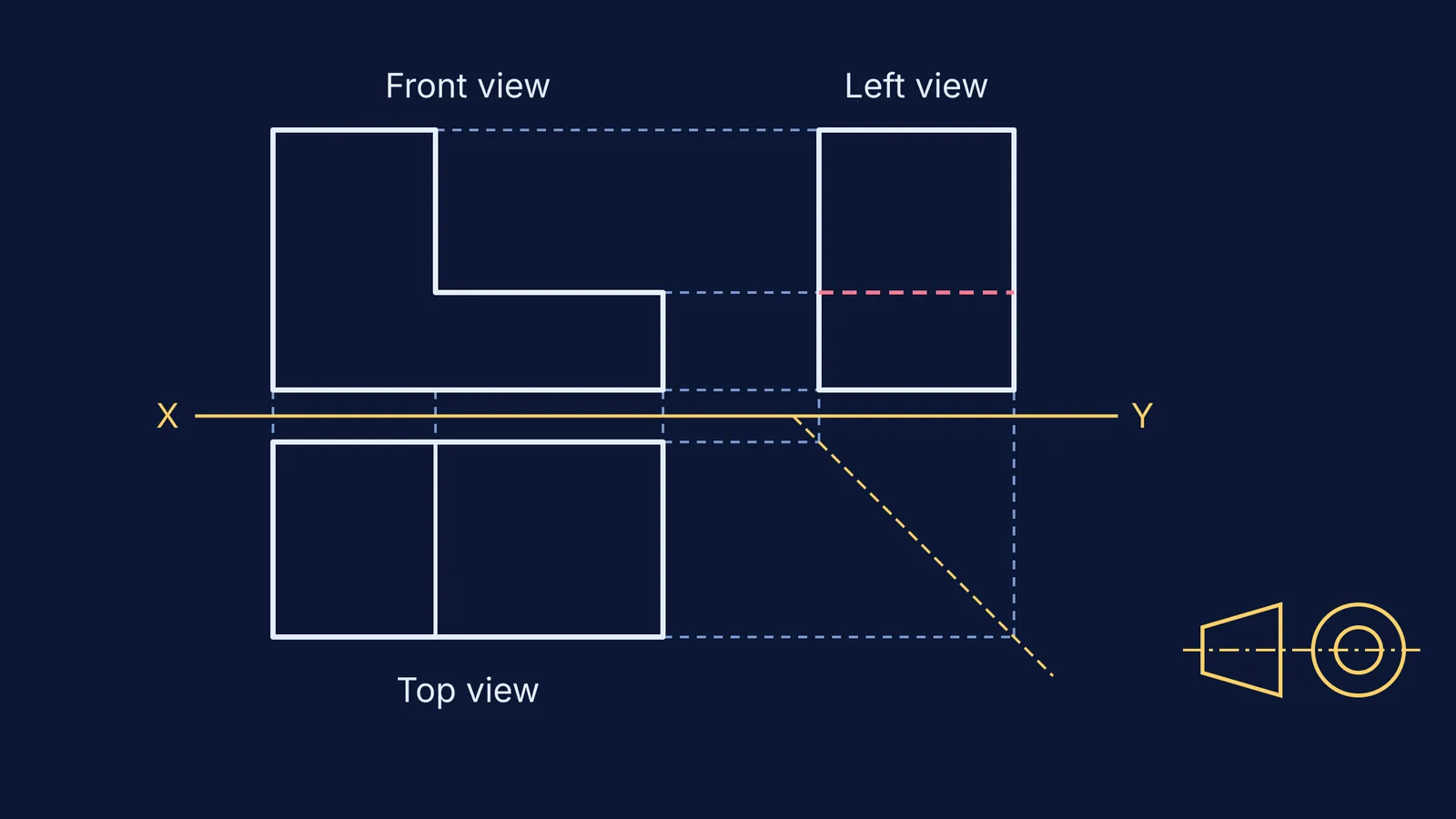
Under SP 46, only the first-angle method is to be used for drawings made after 31 December 1991. In first angle, the object sits between you and the plane it is projected on. The standard then places the views like this:
the view from above goes underneath the front view
the view from the left goes on the right
the view from the right goes on the left
The diagram at the top shows this for an L-shaped block 60 mm long, 30 mm deep and 40 mm high. The step at 15 mm height is hidden in the left view, so it is dashed.
How do you find the top view of an inclined line?
Line AB is 80 mm long, parallel to the VP and inclined at 30 degrees to the HP. The front view shows the true length, 80 mm at 30 degrees. The top view is a horizontal line 80 x cos 30 degrees, about 69.3 mm long. If your top view does not measure close to 69 mm, a projector is off. If cosines feel rusty, the Fermi Concept Library has a lesson for every mathematics concept.
How should you plan your drawing sheets each week?
Lab day: redo one class problem freehand in a rough notebook.
Next day: solve the sheet problems in rough, with dimensions.
Third day: draw light construction lines on the sheet and check every projector.
Fourth day: darken final lines, letter, dimension and fill the title block in the bottom right corner, where SP 46 places it.
Weekend: one mixed problem against the clock.
If you sit down and do not know where to start, Fermi's AI tutor can work out what you already know and build a plan for the session.
Semester exams test the same skills against the clock; adapt the plan in how to prepare for semester exams in engineering college. If drawing has already become a backlog, read how to clear a backlog subject in engineering.
Start this week: build one object, sketch its three views, and check them with projectors.