On this page
Families switch coaching format mid year for ordinary reasons: a parent's transfer, a long commute, fees, illness, or a batch that moves too fast. Either way, three things change at once: when you study, who notices that you are stuck, and where your doubts go. Plan those, and the money, before your last day in the old batch.
Can you get a refund if you leave coaching mid year?
In January 2024 the Ministry of Education sent States and UTs its Guidelines for Regulation of Coaching Center, model rules for each state to adopt through its own law.
Under clause 8(iv) of those guidelines, a student who paid in full and leaves in the middle of the course should be refunded for the remaining period on a pro-rata basis within 10 days, including hostel and mess fees for hostel students.
For example, if you paid ₹1,20,000 for a 12-month course and leave after 5 months, the remaining 7 months come to 7/12 of the fee, or ₹70,000. Ask the centre for its own calculation in writing, and read the fine print with our guide on how to read a coaching fee refund policy.
How should your timetable change when you switch to online coaching?
Online coaching removes the commute and much of your day's structure with it.
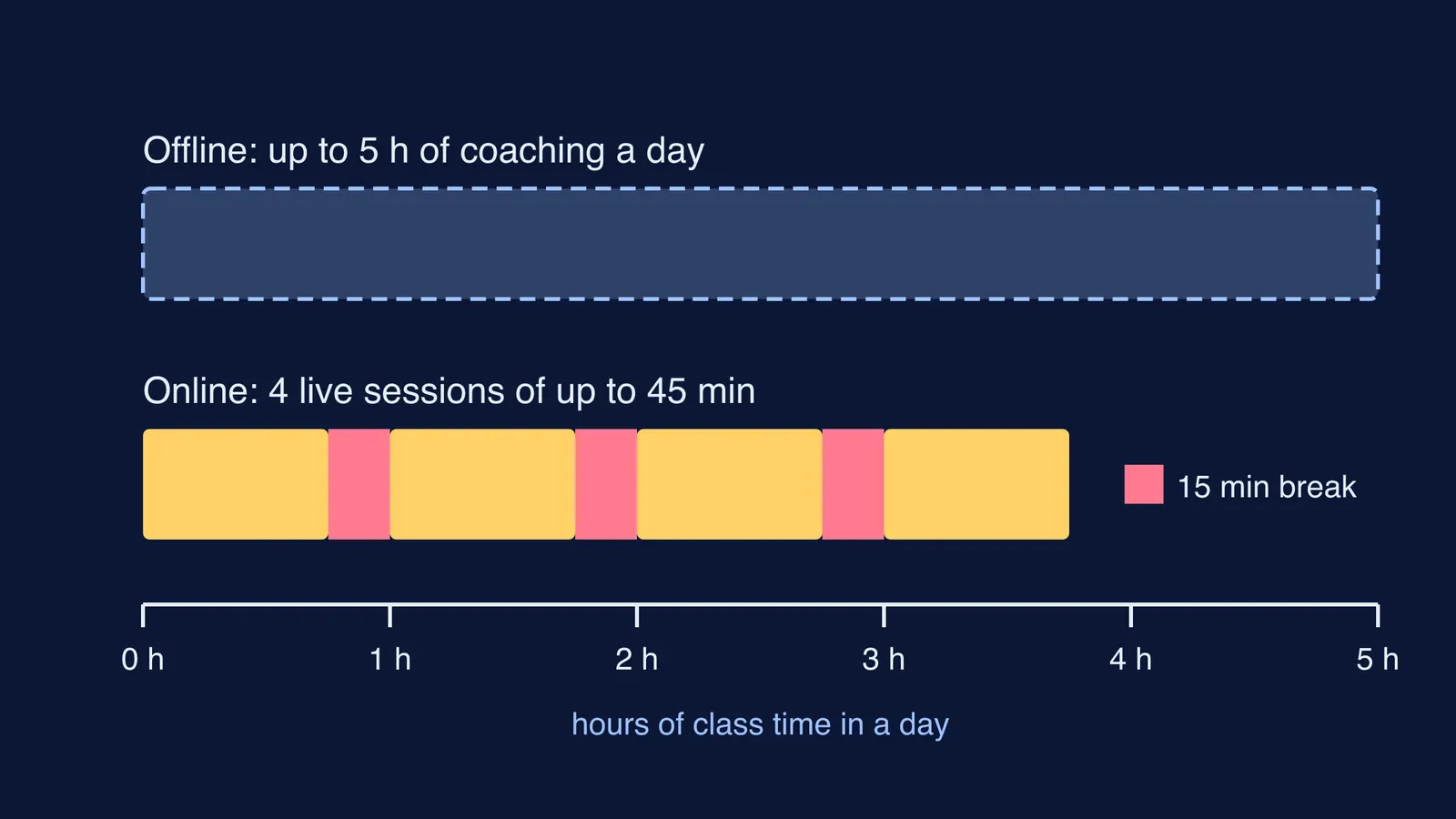
NCERT's PRAGYATA guidelines for digital education, written for schools in 2020, are a useful yardstick. For Classes 9 to 12 they suggest no more than four live online sessions of 30-45 minutes a day, and for senior students a 10-15 minute break between consecutive classes. They advise taking notes during the online class and reviewing them offline, and avoiding the phone or internet for 40 minutes before bed.
For classroom batches, the Ministry's coaching guidelines say coaching should not run more than 5 hours a day, and that students should get a weekly off (clauses 10.1(viii) and 10.1(v)).
A practical way to rebuild the day:
Keep your old wake-up time and class start time.
Turn the old commute into a fixed revision block for that day's class.
Keep your phone in another room during every live class.
Write the next day's plan on paper the night before.
Going the other way, from online to offline, the risk flips: you can no longer pause or rewatch a lecture. Rewrite the day's notes the same evening, while you still remember what was on the board.
If your connection is patchy, set things up with our guide to studying online with slow internet or a small data pack.
Where do doubts go after you switch?
The Ministry's coaching guidelines say doubts should be resolved by the tutors who taught the class (clause 11(viii)). Online, doubts may go to a chat box or a separate team, so ask before you join:
Who answers doubts: my class teacher or someone else?
How quickly, and during which hours?
Can I ask live by voice or video, or only by typing?
Who helps with chapters I studied in my old batch?
Keep a one-line doubt log: date, chapter, question, answered or not. If a doubt sits unanswered for two days, raise it in the next live session. Between sessions, the Fermi Problem Library has worked problems with a step-by-step solver that explains the reasoning, which helps when your doubt is about method rather than a fact. For questions that come up late, try this routine for solving doubts at night with an AI tutor.
Is online coaching as effective as classroom coaching?
The research does not settle it, but it points to what surrounds the class. A 2013 meta-analysis by Barbara Means and colleagues pooled 50 effects from 45 studies comparing fully or partly online learning with face-to-face teaching; about half the learners were graduate students or professional trainees, not school students. On average, students in online conditions did modestly better, but the advantage was significant only for blended learning, not for purely online courses. The authors note that the blended studies often added extra learning time, resources and interaction among learners.
So plan practice, review and a reliable way to ask questions, not just the live class.
A two-week plan for the switch
Before your last day: get the refund calculation in writing and collect your notes and test records.
Days 1-3: list the chapters your old and new batches have each covered, and mark the gaps.
Days 4-10: fill one gap a day in a single focused block, and keep the doubt log going.
Day 14: sit with a parent and check three things: classes attended, doubts answered, and sleep.
If the gap list is long and you don't know where to start, Fermi's AI tutor can work out what you already know and build a plan for the session, so you sit down to a clear next step.
A mid-year move can feel unsettling. If low mood or worry stays with you, talk to a parent, a school counsellor or a doctor, or call Tele MANAS, the government's mental health helpline, on 14416.
Start this week with the refund letter and the chapter list.