

On this page
Why do 11 pm doubts feel impossible?
Late at night, your brain's cognitive reserves are depleted. When you hit a wall in a difficult physics or maths problem, the frustration compounds quickly. You might be tempted to look up the final answer just to get it over with, but doing so skips the learning process entirely.
Instead of fighting your tiredness, you can use it. Sleep is not a passive state; it is an active neurological window where your brain stabilises and integrates new information. During deep sleep, the hippocampus "replays" the day's memories and transfers them to the long-term storage of the neocortex. A 2006 study by Jeffrey Ellenbogen and colleagues published in *Current Biology* found that sleep can lead to a 25% increase in memory retention by protecting newly learned facts against interference. If you study just before bed, you give those newly formed neural pathways priority access to this consolidation process.
The Zeigarnik effect: why should you leave it unfinished?
You do not have to solve every problem before you go to bed. In fact, you might learn more if you do not finish it.
In 1927, psychologist Bluma Zeigarnik published a landmark experiment showing that people remember interrupted tasks approximately 90% better than tasks they have completed. This phenomenon, known as the Zeigarnik effect, occurs because starting a task creates a state of mental tension. If you leave the task unfinished, this cognitive "open loop" keeps the material active and accessible in your memory.
When you abandon a difficult problem midway through, your brain continues to process the uncompleted task while you sleep. This subconscious processing is often what leads to sudden clarity or an "Aha!" moment the next morning.
How to solve doubts at night with an AI tutor?
When you are stuck at 11 pm revising for your boards or JEE, you cannot call a teacher, and standard search results will often just hand you the final answer. This is where an AI tutor becomes uniquely useful.
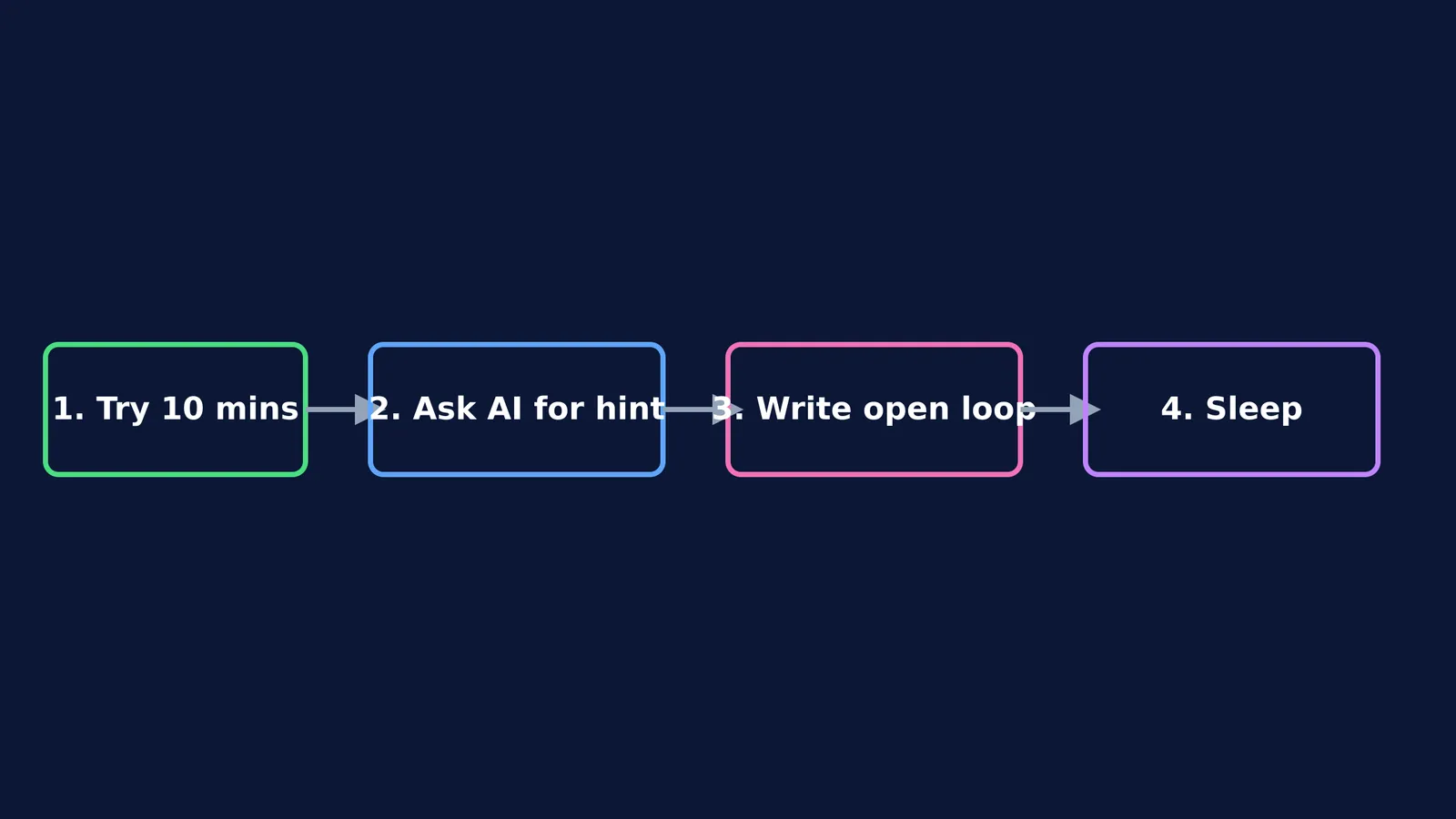
Here is a four-step routine to handle late-night doubts without ruining your sleep schedule or your learning:
1. Struggle productively for ten minutes
Productive struggle is the effortful process of learning that happens when you are challenged just beyond your current comfort zone. Before seeking help, give the problem a genuine, focused attempt for exactly ten minutes. Draw the diagram, write down the given values, and try setting up the equations. The more effort it takes to encode the information, the stronger the neural pathway will become.
2. Ask AI for a hint, not an answer
If you are still stuck after ten minutes, do not ask for the full solution. Use a prompt script like this:
"I am stuck on this rotational mechanics problem. I have tried balancing the torques, but my signs seem to be wrong. Do not solve it for me. Just give me one hint about where my free-body diagram might be failing."
A good tool will adapt to this prompt, helping you understand what a good step-by-step AI explanation looks like. For example, Fermi's AI tutor is built to teach rather than answer. It holds a line of reasoning across a session, notices where a student is stuck, and decides whether to explain, ask or show. It will work out what you already know and build a plan for the session, giving you just enough guidance to take the next step.
3. Write down the open loop
Take the hint from the AI and try to apply it. If it solves the problem, that is a success. If you still cannot see the final answer, stop. Write down exactly what you are confused about on a piece of paper. This formalises the doubt and creates the mental tension needed to trigger the Zeigarnik effect.
4. Sleep to consolidate the memory
Close your books and go to sleep. Trust that the slow-wave sleep cycles will process the productive struggle you just put in. If you want to review the full method the next day, you can run the question through the Fermi Problem Library to see a step-by-step solver that explains the reasoning rather than just printing an answer.
How can you build this into your schedule?
This routine works best when it becomes a habit. Figuring out how to use an AI tutor for your physics doubts is a skill you develop over time. Rather than relying on passive reading or binge-watching solution videos, you are combining active problem-solving with the biological benefits of sleep.
If you are setting up a regular self-study plan, integrating a weekly routine for learning physics with AI can help you structure your late-night sessions. By closing your books with a clear, written question rather than a sense of defeat, you will wake up ready to learn instead of feeling stuck.


