On this page
Every counselling season, thousands of students choose college preference lists by a single metric: previous years' closing ranks. The common assumption is to claim the highest-ranked branch an exam score permits and figure out personal interest later. Entering a four-year technical programme without testing your daily enthusiasm turns college into a prolonged struggle of disconnected coursework.
Why does choosing a branch by entrance rank backfire?
Treating cut-off rank as a proxy for personal aptitude creates widespread disengagement. According to the Ministry of Education's AISHE 2021-2022 report, Engineering and Technology is the fourth largest undergraduate discipline in India, accounting for 11.8% of all undergraduate enrollments within 98.5 lakh students pursuing STEM degrees. Many students accept non-preferred branches hoping to transfer after first year. Yet premier institutions, including IIT Bombay (by Senate decision in May 2023) and IIT Madras (effective from the 2024 batch), have scrapped branch changes to curb student stress, removing that escape route.
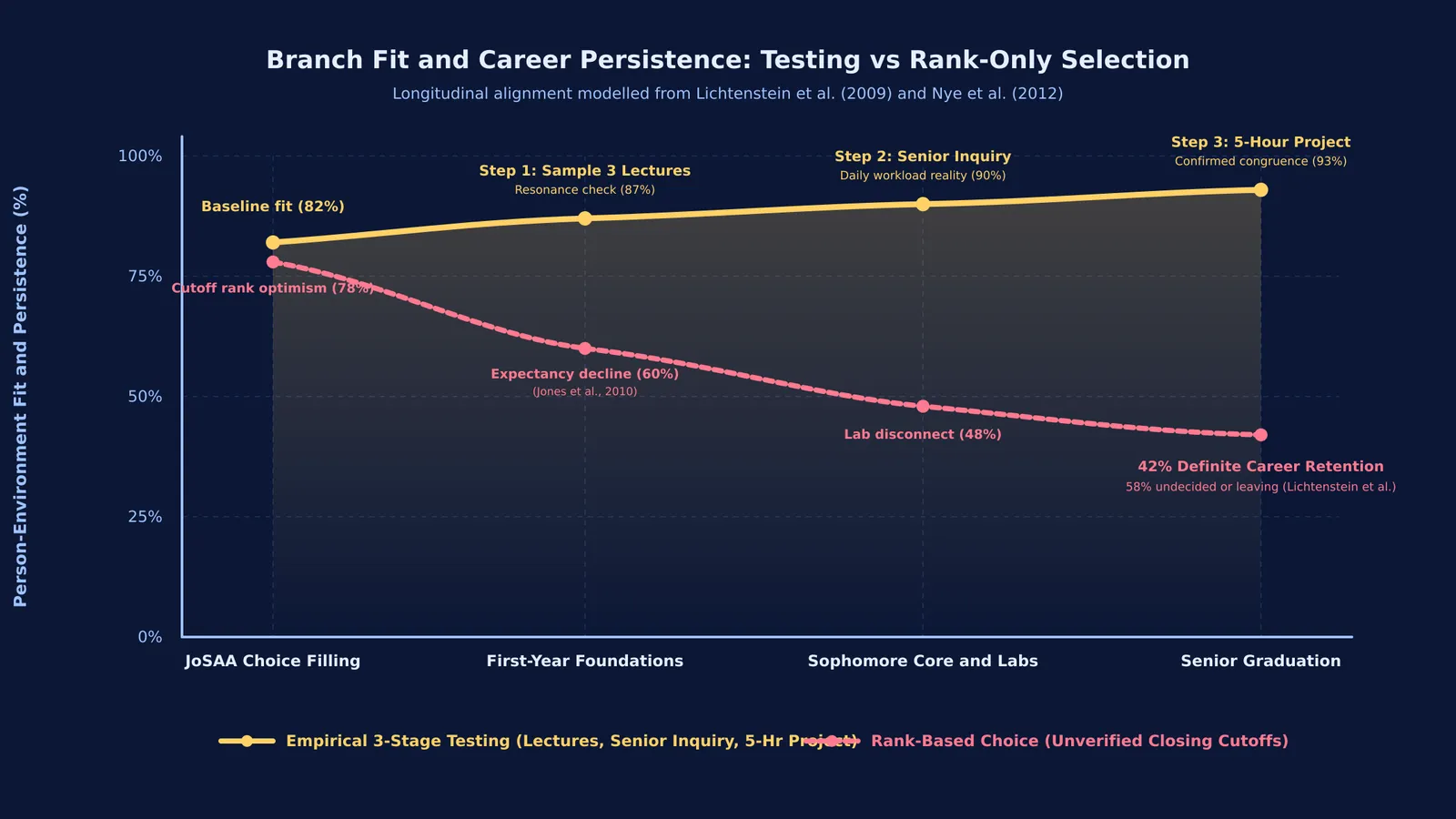
When choice ignores daily study, regret quickly surfaces. A study in the *Journal of Engineering Education* surveyed senior undergraduates and found that only 42% definitely intended to pursue engineering careers, while 44% remained undecided and 14% had decided against it, because initial choices lacked practical exposure. Furthermore, research in the *Journal of Engineering Education* demonstrated that while exam confidence predicts grades, subjective task values—genuine curiosity and perceived utility—predict whether students stick to their career plans. Before choice filling closes during JoSAA counselling for parents: rounds, choices and documents, you need empirical evidence.
How can sample lectures test your academic interest?
The fastest way to evaluate an engineering branch is to sample its authentic coursework before admissions begin. School science rarely mirrors departmental study: high school electrostatics differs sharply from AC circuit analysis, and school kinematics rarely prepares you for rigid-body dynamics. Watching two or three recorded university lectures from an introductory core course exposes the exact reasoning you will encounter every week.
Pay close attention to your reaction to cognitive friction. When auditing a sophomore lecture on data structures or thermodynamics, you need not understand every formula right away. What matters is whether the underlying questions make you want to pause, take notes, and work through the logic. To explore collegiate teaching early, Fermi Courses offers university-level courses taught by working scientists, with an AI tutor available on every lecture. When an unfamiliar proof or definition slows you down, the Fermi Concept Library maps individual lessons across computing, mathematics, and physics so you can check what prerequisites a branch requires.
What should you ask college seniors before deciding?
Promotional brochures highlight top packages but rarely describe the daily academic reality. A study across over 20,000 student academic records in the *Journal of Engineering Education* found that while parents and teachers guide early aspirations, peer dialogues and departmental contacts become the primary social influence when deciding a specific engineering discipline.
Speaking directly to third- or fourth-year seniors provides ground-level clarity. Instead of asking whether a branch is "good," ask focused operational questions:
"What does a normal weekday look like in third semester across lectures, tutorials, and labs?"
"Which foundational subject causes the highest backlog rates in your branch, and why?"
"How many students in your batch build core engineering projects versus non-core software prep?"
"Do laboratory sessions involve routine measurements or open-ended design problems?"
Their answers reveal whether the departmental workload matches your temperament as you prepare for your first semester at science or engineering college: what changes.
How do 5-hour micro-projects confirm your choice?
Active problem solving delivers the ultimate check. A meta-analysis across 60 studies in *Perspectives on Psychological Science* confirmed that interest congruence—the match between individual interests and the work environment—strongly predicts academic success and persistence. To test that alignment, spend five focused hours on an entry-level branch exercise:
Computer Science: Build a Python script that queries a public weather API, parses JSON, and plots regional temperatures.
Electronics: Simulate an operational amplifier filter in an open-source SPICE tool and test its frequency response.
Mechanical and Civil: Model a simple bridge truss in free CAD software and run stress analysis to identify load hotspots.
Chemical Engineering: Calculate a material and heat balance for an industrial heat exchanger in a spreadsheet.
Where workshop hardware is unavailable, the Fermi Simulation Lab provides interactive simulations for ideas that are easier to see than to read, allowing you to manipulate physical systems and verify your curiosity. If spending five hours troubleshooting a model motivates you to look up documentation and fix errors, that branch is a genuine fit. If the process feels entirely tedious, that resistance is crucial guidance for your preference list, protecting your academic health and helping you know how to improve your CGPA: a semester plan backed by research from the start.