On this page
If you are studying BSc Agriculture, or choosing it after Class 12, seed and fertiliser companies are worth a close look. The work runs from a breeding plot to a dealer's shop counter, and each step needs different people with different strengths.
What jobs do seed companies offer agriculture graduates?
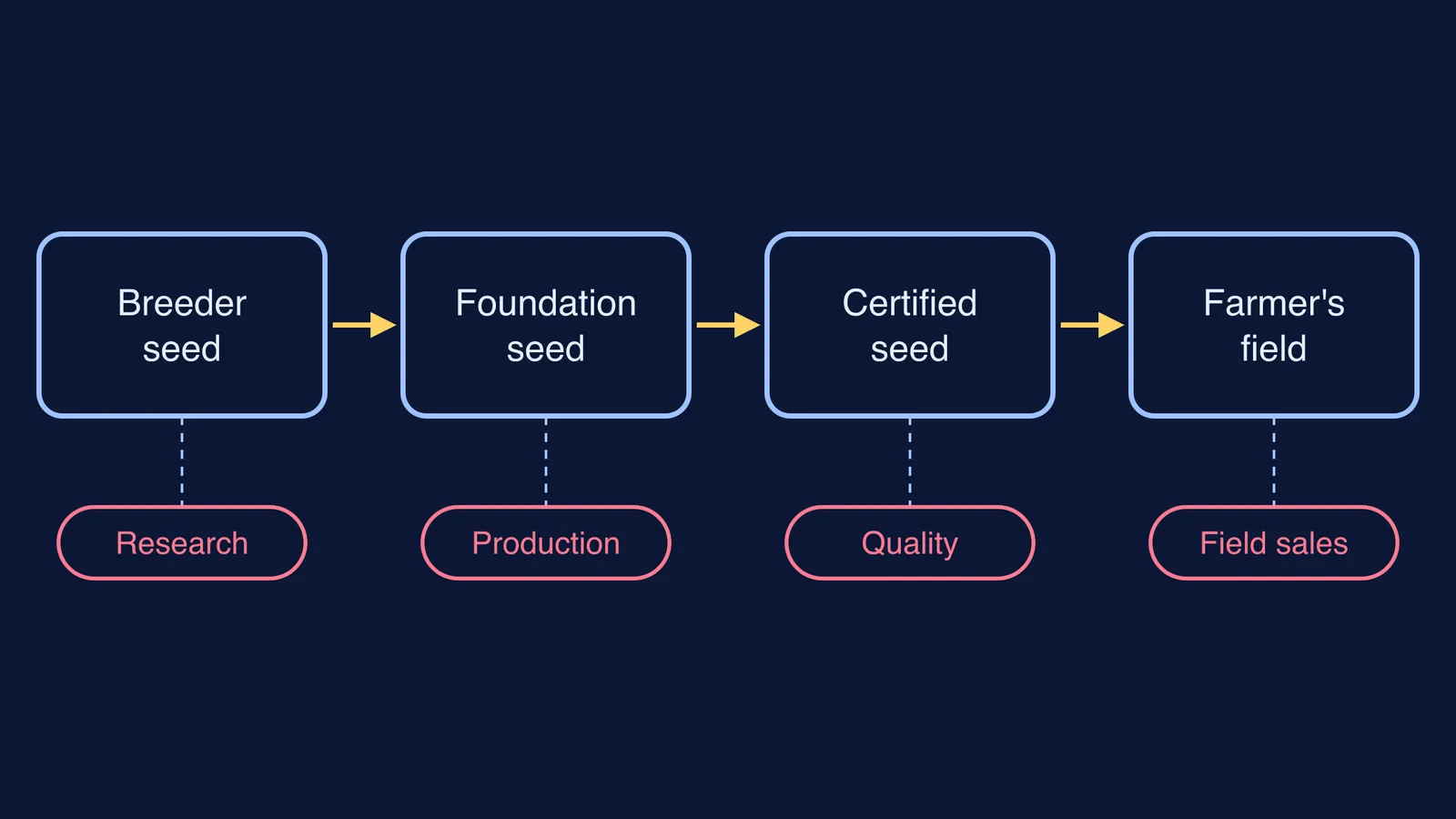
A July 2026 Ministry of Agriculture reply in Lok Sabha describes the production and multiplication of breeder, foundation and certified seed: a breeder-to-certified chain that ends with the seed farmers buy. The same reply says 17 State Seed Corporations, National Seeds Corporation Limited and private seed companies contribute to producing and distributing quality seed. Each link in that chain is a family of jobs.
Research and breeding. Developing new varieties, running trials at several locations, and lab work. The ministry reply notes that ICAR institutes and the private sector use marker-assisted selection, gene editing and speed breeding. Some breeding posts ask for a postgraduate degree, so read the qualification line in every advert.
Seed production. Production staff work with the farmers who grow seed crops under contract: checking fields, removing off-type plants and timing the harvest. Expect travel in season.
Quality control. Testing germination and purity before a seed lot is sold. India has 178 notified Seed Testing Laboratories, according to the same Lok Sabha reply.
Field sales and marketing. Territory staff run crop demonstrations, train dealers and answer farmers' questions.
Regulatory and licensing. Seed quality is regulated under the Seeds Act, 1966, the Seeds Rules, 1968 and the Seeds (Control) Order, 1983, per the ministry reply. Companies need people who keep labels, licences and variety records right.
Public research and private firms are closely linked: 27 ICAR institutes signed 1,317 licensing agreements for seeds, crop varieties and planting material with public and private sector organisations from 2023-24 to 2025-26, the reply states.
What jobs do fertiliser companies offer?
In fertiliser firms, agriculture graduates often work in the field: advising farmers, running demonstrations and supporting dealers. IFFCO's 2026 Agriculture Graduate Trainee advert on its careers portal asked for a four-year full-time BSc Agriculture with at least 60% aggregate (55% for SC/ST candidates). It offered one year of training on a stipend of Rs 33,300 a month, for posts in field offices across India and selection through online tests. Treat this as an example and always check the current notice.
Your degree also counts at the retail end. Under the Fertiliser Control Order, a new applicant for a retail fertiliser dealership needs a 15-day certificate course, but holders of a BSc in Agriculture or Chemistry (or a diploma in agricultural science) are exempt, per clause 8(4) of the order. That is one route into running your own agri-input shop.
Other names to watch include National Fertilizers Limited, the cooperative KRIBHCO and Hindustan Insecticides Limited, which the ministry reply lists alongside seed corporations as producers and distributors of quality seed.
Which role suits you?
Match the job to how you like to spend a working day:
You enjoy careful lab work and numbers: research or quality control.
You like being outdoors and managing a crop calendar: seed production.
You like people, travel and targets: field sales and marketing.
You like rules and paperwork that must be exactly right: regulatory.
A worked example: a third-year student scores well in genetics, enjoys lab practicals, and dislikes long travel. Quality control fits best now, with an MSc in seed science or plant breeding as a later step towards research. A classmate who enjoys village visits and speaks the local language well is better placed for field sales or production.
How do you prepare during BSc Agriculture?
Years 1 and 2: make genetics, plant breeding and soil science solid. The roles above all draw on them.
Year 3: learn spreadsheets and basic statistics, because trial data and sales reports both live in them. Ask your college about a visit to a seed processing plant or testing laboratory.
Final year: use your field placement to talk to farmers, and note three real problems you saw and what was done about them.
While applying: track notices from IFFCO, National Seeds Corporation and your State Seed Corporation, and go to campus drives by private firms.
If Mendelian ratios or soil chemistry calculations keep going wrong, the Fermi Problem Library has worked problems with a step-by-step solver that explains the reasoning rather than printing an answer. For a topic you never fully understood, the Fermi Concept Library has a lesson for every concept in biology and chemistry.
If you want to manage the business side, read our guide to agribusiness management after BSc Agriculture. If breeding research appeals, see building a career in agricultural research. Still in Class 12? Start with how to get admission to an agriculture university.