On this page
The steel bars and concrete in a new flyover or housing society are supposed to pass tests before anyone relies on them. The engineers who run those tests work in materials testing labs: they pull steel until it snaps, crush concrete cubes and check plastics against Indian Standards. This hands-on branch of engineering does not often come up when families discuss JEE branches, so here is what the job involves, which degrees lead there, and a worked example of the kind of report you would sign.
What does a materials testing lab actually do?
A testing lab checks whether a material meets the numbers its standard promises. In India, the National Accreditation Board for Testing and Calibration Laboratories (NABL), a constituent board of the Quality Council of India, accredits testing labs to the international standard ISO/IEC 17025. NABL's website lists more than 14,000 accredited and recognised laboratories, across every field from medical to mechanical.
Most materials work falls into three families:
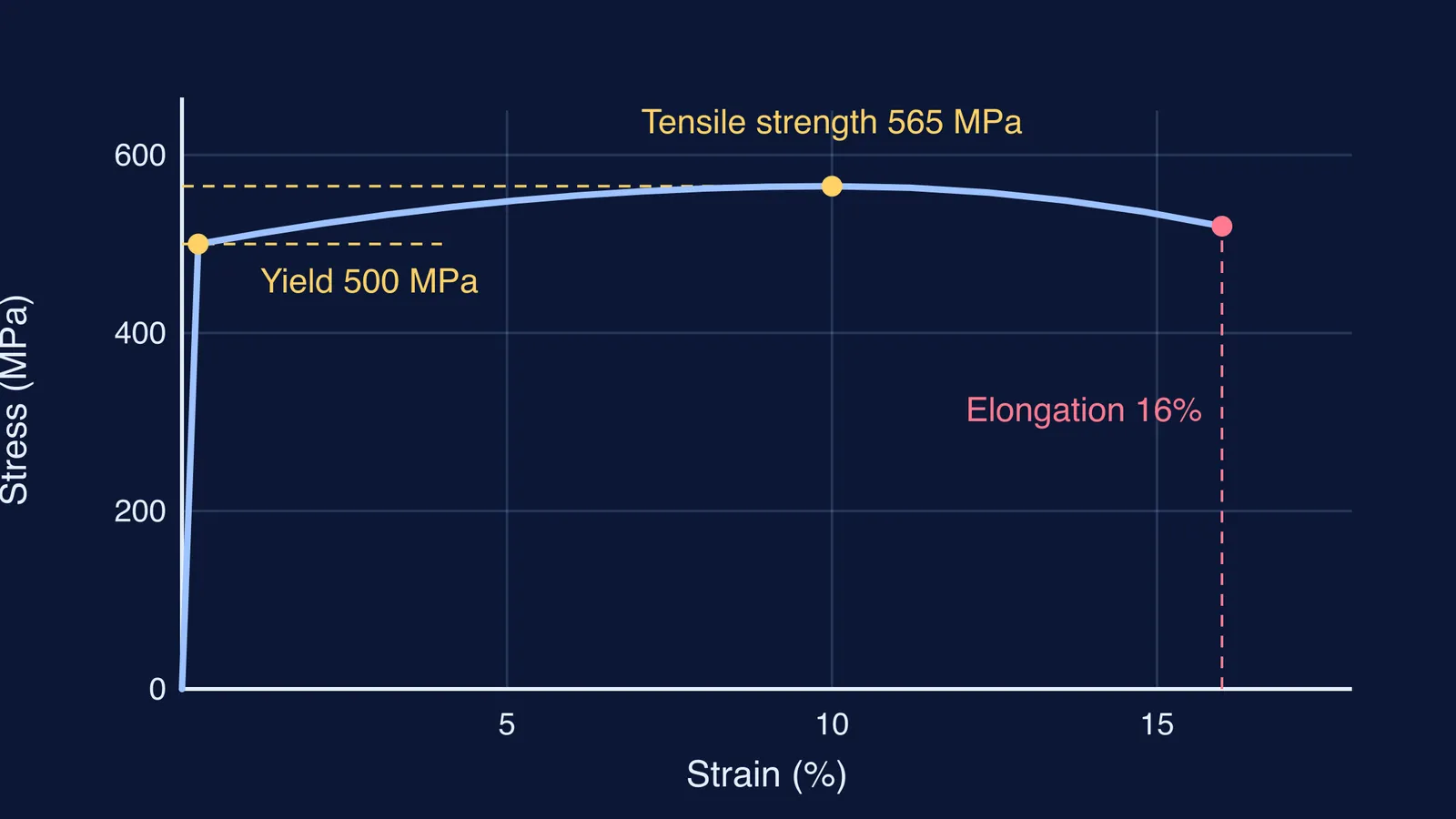
Metals. A tensile test pulls a bar until it breaks. Under IS 1786:2008, the Indian Standard for steel reinforcing bars, an Fe 500D bar needs at least 500 N/mm² yield stress (or 0.2% proof stress), 565 N/mm² tensile strength and 16% elongation.
Concrete. IS 456:2000 names concrete grades by the characteristic compressive strength of 150 mm cubes at 28 days, so M25 means 25 N/mm².
Polymers. The Plastics Testing Centre at CIPET Murthal is NABL-accredited to ISO/IEC 17025:2017 and recognised by the Bureau of Indian Standards for testing plastics.
Which engineering branches lead to materials testing lab jobs?
There is no single entry door. Four routes are common:
Metallurgical and materials engineering is the closest fit: heat treatment, microstructure and why metals fail.
Civil engineering leads to construction-material labs that test concrete, cement, aggregates and soil.
Mechanical engineering covers tensile, hardness and fatigue testing of metal parts.
Polymer and plastics technology: CIPET runs diploma, post-diploma and PG-diploma programmes approved by AICTE, according to CIPET Murthal's own page.
For a sense of demand, the US Bureau of Labor Statistics says materials engineers develop, process and test materials, usually hold a bachelor's degree in materials science and engineering or a related field, and will see employment grow 8% from 2025 to 2035. That is American data, so treat it as a direction, not a promise for India.
How do you read a concrete cube test result?
Here is a routine lab task. IS 516 (Part 1/Sec 1):2021 asks for at least three specimens per test age, a loading rate of 14 N/mm² per minute, and accepts the average only if no single result is more than 15% away from it, as summarised in this guide to IS 516 provisions.
Suppose a site sends three M25 cubes, and at 28 days they fail at 612 kN, 655 kN and 590 kN.
Find the loaded area: 150 mm × 150 mm = 22,500 mm².
Divide load by area: 612,000 N ÷ 22,500 mm² = 27.2 N/mm². The others give 29.1 and 26.2 N/mm².
Average them: 27.5 N/mm², reported to the nearest 0.5.
Check the spread: 15% either side of 27.5 is about 23.4 to 31.6. All three sit inside, so the average stands.
Sanity-check the timing: 14 N/mm² per minute on 22,500 mm² is 315 kN per minute, so the first cube took about two minutes to crush.
The batch beat 25 N/mm², but the lab's number is not the final verdict. IS 456 sets separate acceptance criteria for a series of results, which the site engineer applies.
Is a testing lab career right for you?
If most of these sound like you, the work is worth a closer look:
You prefer getting the same answer twice to getting a quick answer once.
You don't mind reading a standard clause by clause.
You enjoy handling equipment as much as solving equations.
You can write a clear report that someone else will rely on.
The physics starts in Class 11. Stress, strain, Young's modulus and the stress-strain curve from mechanical properties of solids are the daily language of a testing lab. If those ideas feel shaky, the Fermi Concept Library gives every physics concept its own lesson and its place in the map, so you can see how stress and strain connect to elasticity. Not sure where to begin? Fermi's AI tutor can work out what you already know and build a plan for the session.
When you get a lab visit or internship interview in college, ask three questions:
Which tests and standards is this lab accredited for?
What would I run in my first month?
Who signs the test reports, and how do engineers grow into that role?
This week, sketch the stress-strain curve of a steel bar from memory, then check it against your textbook.