On this page
If you are an MBBS student or intern wondering whether the civil services are open to doctors, the answer is yes. The harder questions are whether it is worth it and which optional to take.
Can MBBS graduates join civil services?
Yes. The minimum qualification for the Civil Services Examination is a graduate degree from a recognised university, and an MBBS counts, according to the UPSC Civil Services Examination 2026 notice. The same notice has a rule written for medical students. If you have passed the final professional MBBS exam but have not finished internship when you apply, you are admitted provisionally, as long as you send a certificate of passing that exam with your application. At the interview you must then show your degree, or a certificate saying you completed every requirement, internship included.
The other limits, all from that notice, apply to everyone:
Age: for CSE 2026 you had to be at least 21 and under 32 on 1 August 2026. The upper limit is relaxed by up to five years for SC/ST candidates and three years for OBC candidates who are eligible for reservation.
Attempts: six for general candidates, nine for OBC candidates and unlimited for SC/ST candidates. Sitting even one prelims paper counts as an attempt.
Stages: a prelims of two objective papers of 200 marks each (the second only needs 33% to qualify), then the mains and an interview.
UPSC revises its rules, so check the newest notice every year.
How much does the optional subject count?
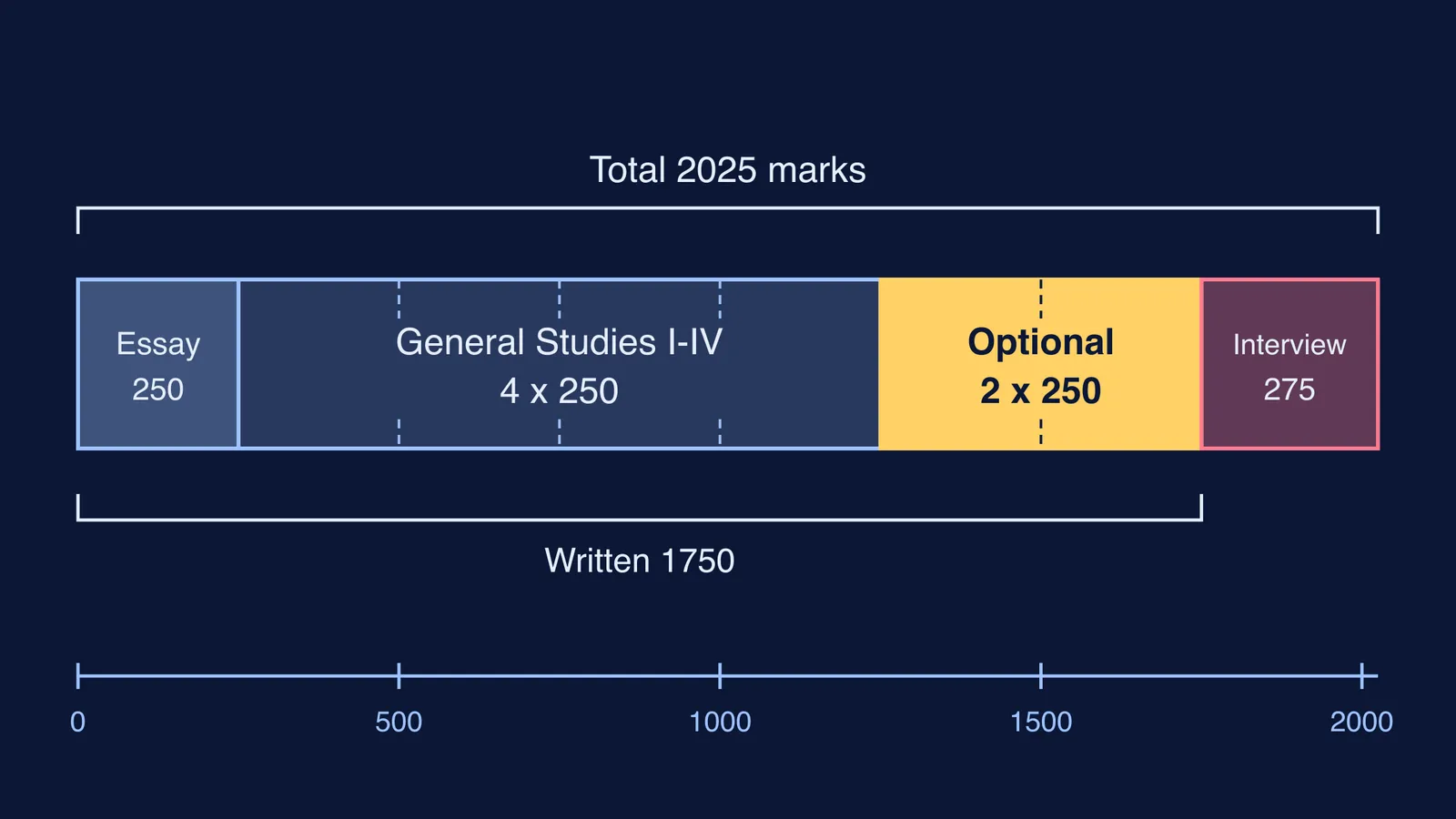
The mains has 1,750 written marks and a 275-mark personality test, 2,025 marks in all (UPSC CSE 2026 notice). That total is made up of an essay (250), four General Studies papers (250 each) and two optional papers (250 each). Two language papers also have to be passed, but they don't count towards your rank.
So the optional is worth 500 marks, about a quarter of your rank total, and it is the one part you choose.
Should doctors take Medical Science as their optional?
Medical Science is on UPSC's optional list. Most optional papers are pitched at roughly honours-degree level, but Medical Science is set at bachelor's level, which for you means MBBS (UPSC CSE 2026 notice). Paper I covers anatomy, physiology, biochemistry, pathology, microbiology, pharmacology and forensic medicine. Paper II covers general medicine, paediatrics, dermatology, surgery, obstetrics and gynaecology, and community medicine, including national disease-control programmes and health-system management.
What works for it:
You have already studied it, up to MBBS level.
It overlaps with NEET-PG revision, useful if you keep a backup plan.
Community medicine links to the governance themes of General Studies.
What works against it:
It is two full papers covering most of the MBBS subjects.
Detailed clinical recall can fade once you stop seeing patients.
Other subjects on the same list, such as Anthropology, Sociology or Public Administration, overlap more with General Studies. Some doctors choose one of these and learn it from scratch.
Neither route is automatically better. Pick the syllabus you can revise again and again over several attempts.
What do doctors give up by leaving practice?
Under the All India Services (Conduct) Rules, an IAS or IPS officer cannot take up any other employment, or accept fees for work done for private people, without government sanction (rule 13, All India Services (Conduct) Rules). So you cannot keep a paid private practice going alongside the job without that sanction. Honorary social or charitable work is allowed without it.
Years spent preparing are years outside residency, so read how the path from MBBS to a specialisation works before you pause it. If your state or college requires bond service, check how MBBS bond rules work first.
If you want government service and also want to keep practising medicine, UPSC runs a separate Combined Medical Services Examination. Its 2026 written exam was scheduled to begin on 2 August 2026. Read its notice to see which posts it fills.
How should an MBBS graduate decide?
Write down why in one sentence: what you want to change that you cannot change from a clinic.
Work out how many years you have, using the age and attempt rules in the UPSC CSE 2026 notice. Worked example: a general-category intern born on 15 March 2001, who has never sat the prelims, was 25 on 1 August 2026. If the age rule stays the same, they stay under 32 on 1 August each year up to 2032. That gives six exams from CSE 2027 to CSE 2032, which matches their six attempts.
Run the optional test from the callout above. If the underlying biology and chemistry are rusty, the Fermi Concept Library has its own lesson for each biology and chemistry concept.
Set a checkpoint now, for example after your second attempt, and agree on your backup plan (NEET-PG, the Combined Medical Services exam or a hospital job) with your family before you start.
Preparing while your batchmates start residency can feel lonely. If the stress stops feeling manageable, talk to someone you trust or call Tele MANAS on 14416.
Start with step 1 tonight.