

On this page
What is an MBBS service bond in state medical colleges?
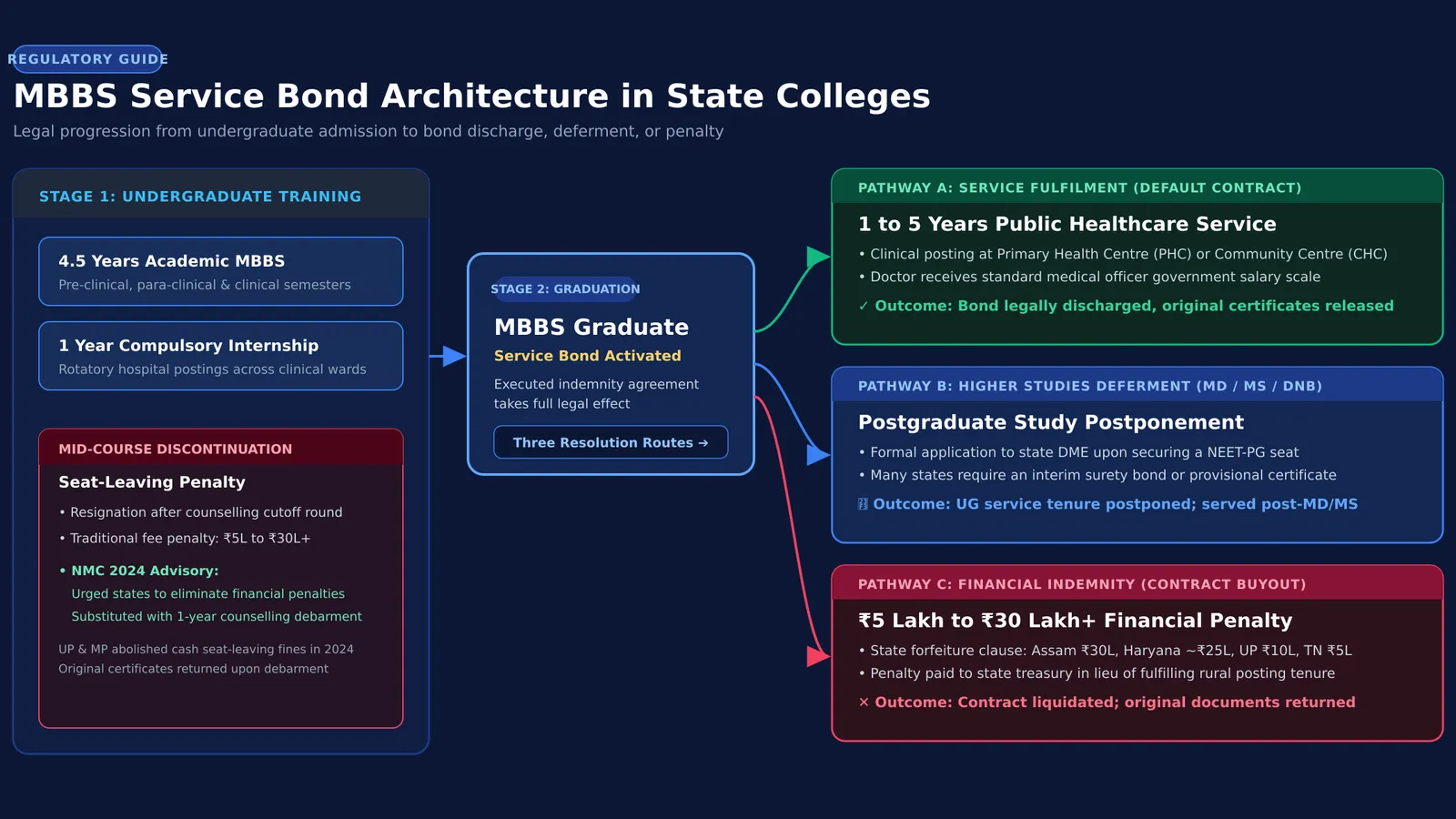
When you accept an MBBS seat in a state-run medical college in India, admission often requires signing a service bond. Under this agreement, executed on stamp paper with a parent or guardian as surety, you pledge to serve in the state's public healthcare system after completing 4.5 years of coursework and a one-year compulsory rotatory medical internship.
These postings assign junior doctors to rural Primary Health Centres (PHCs), Community Health Centres (CHCs), or district hospitals. If a graduate defaults, the contract mandates paying a predetermined financial penalty to the state.
The Supreme Court affirmed the validity of compulsory service bonds in *Association of Medical Super Speciality Aspirants and Residents v. Union of India* (2019) 8 SCC 607. Justices L. Nageswara Rao and Hemant Gupta ruled that state governments have authority under Article 162 of the Constitution to impose service conditions. Because public funds heavily subsidize state medical education, the court recognized a legitimate public interest in sending doctors to underserved areas.
What is the difference between a service bond and a seat-leaving bond?
Prospective medical students often encounter two distinct bond conditions:
Compulsory rural service bond: Applies after graduation, mandating one to five years of public clinical service or an indemnity payment of ₹5 lakh to ₹30 lakh.
Seat-leaving or discontinuation bond: Applies during the 5.5-year course. Resigning after the counselling cutoff round or quitting midway levies a penalty to prevent seat wastage.
In January 2024, the National Medical Commission (NMC) recommended ending financial seat-leaving penalties, citing severe mental stress and proposing a one-year counselling debarment instead. States including Uttar Pradesh and Madhya Pradesh subsequently abolished cash seat-leaving fines.
For candidates experiencing admission stress, confidential mental health support is available through the Ministry of Health's Tele MANAS helpline at 14416.
How do bond duration and penalty amounts vary across states?
According to state guidelines compiled on the Medical Counselling Committee portal, service terms vary widely:
Assam: Requires five years of state service (including at least one rural year) or a ₹30 lakh penalty.
Haryana: Implements a five-year service model structured as a state-subsidized loan of approximately ₹25.77 lakh for male candidates and ₹23.19 lakh for female candidates.
Tamil Nadu: Mandates five years of rural service or a ₹5 lakh penalty.
Uttar Pradesh: Requires two years of rural service or a ₹10 lakh indemnity payment.
Maharashtra: In July 2024, Maharashtra abolished its one-year undergraduate service bond (previously ₹10 lakh penalty) due to an excess of graduates over sanctioned rural posts.
Central medical institutes: Central institutions such as AIIMS and JIPMER, along with states like Bihar and West Bengal, impose no post-MBBS rural service bond.
In April 2025 hearings in *Roshina Naeem v. State of Uttarakhand*, the Supreme Court of India questioned imposing state rural service bonds on 15% All India Quota (AIQ) students, citing the practical hurdles of posting doctors to states where they do not speak the local language.
When planning preferences, our NEET UG counselling overview for parents explains All India and state quota rounds. Reviewing NEET UG tie-breaking rules assists with rank expectations, while candidates considering defence medical seats can check AFMC Pune MBBS admission conditions for service liability terms.
Can you pursue NEET-PG immediately if you have a service bond?
Whether an MBBS bond impacts your postgraduate entrance timeline depends on state deferment rules:
Deferment policies: Many states allow students who secure an MD or MS seat to postpone undergraduate service until postgraduate completion, adding the tenures together.
Bank guarantees and surety: Some states require a bank guarantee or fresh indemnity bond before releasing original certificates for PG joining in another state.
Certificate retention: Certain directorates retain original MBBS degree documents until bond clearance, providing only provisional certificates for PG admissions.
Where states require immediate service without deferment, postgraduate entrance is postponed for the bond's duration unless the penalty is settled.
What should you check before locking your college choices?
Before submitting your choices during NEET UG counselling, verify these four factors:
Download official bond terms: Open "Participating Institutes" on the Medical Counselling Committee website and inspect the exact bond deed for each institution.
Confirm postgraduate deferment: Verify whether the state permits clean deferment for MD or MS entry without demanding commercial bank collateral.
Review certificate retention rules: Clarify how original documents are released for postgraduate counselling and residency registration.
Weigh career trade-offs: A lengthy five-year rural obligation with limited PG reservation incentives may constrain flexibility compared to a bond-free seat.
While evaluating counselling options and planning academic milestones, building a disciplined foundation in core sciences keeps you prepared for every stage of medical training. For mastering fundamental pre-medical topics, the Fermi Concept Library covers every concept in physics, chemistry, biology, mathematics and computing. If you are reviewing tricky scientific problems or analytical questions, the Fermi Problem Library provides worked problems with a step-by-step solver that explains the reasoning rather than printing an answer.


