

On this page
Agrometeorology examines how weather and climate interact with crops, livestock, and soils. The World Meteorological Organization sets international standards in its *Guide to Agricultural Meteorological Practices*, defining how atmospheric observations guide crop protection. While general meteorologists focus on broad weather patterns, agricultural meteorologists translate variables—such as solar radiation, vapor pressure deficit, and soil temperature—into farm advisories.
In India, this translation is directed by the India Meteorological Department (IMD) under the Gramin Krishi Mausam Sewa (GKMS) scheme. Specialists at Agromet Field Units and District Agromet Units issue localized advisory bulletins every Tuesday and Friday. As explored in our guide on talking about STEM careers beyond engineering and medicine, agrometeorology allows students strong in physics and biology to create direct agricultural impact.
How do weather forecasts guide sowing and irrigation decisions?
Two core field operations rely directly on meteorological calculations:
Sowing windows: Sowing requires sufficient moisture in the top 15 to 20 cm of soil for germination. Specialists monitor cumulative rainfall thresholds—typically 50 to 75 mm of early monsoon rain—alongside 5-day forecasts. If an isolated shower precedes a dry spell, advisories urge farmers to delay sowing. They also track Growing Degree Days (GDD), defined as ((T_max + T_min) / 2) - T_base, ensuring crops mature before heatwaves arrive.
Irrigation scheduling: Irrigation advice follows crop water standards from the Food and Agriculture Organization (FAO) in Paper No. 56. Specialists calculate reference crop evapotranspiration (ET₀) using the FAO Penman-Monteith equation, then multiply by a crop coefficient (K_c) to determine water demand (ET_c = K_c × ET₀).
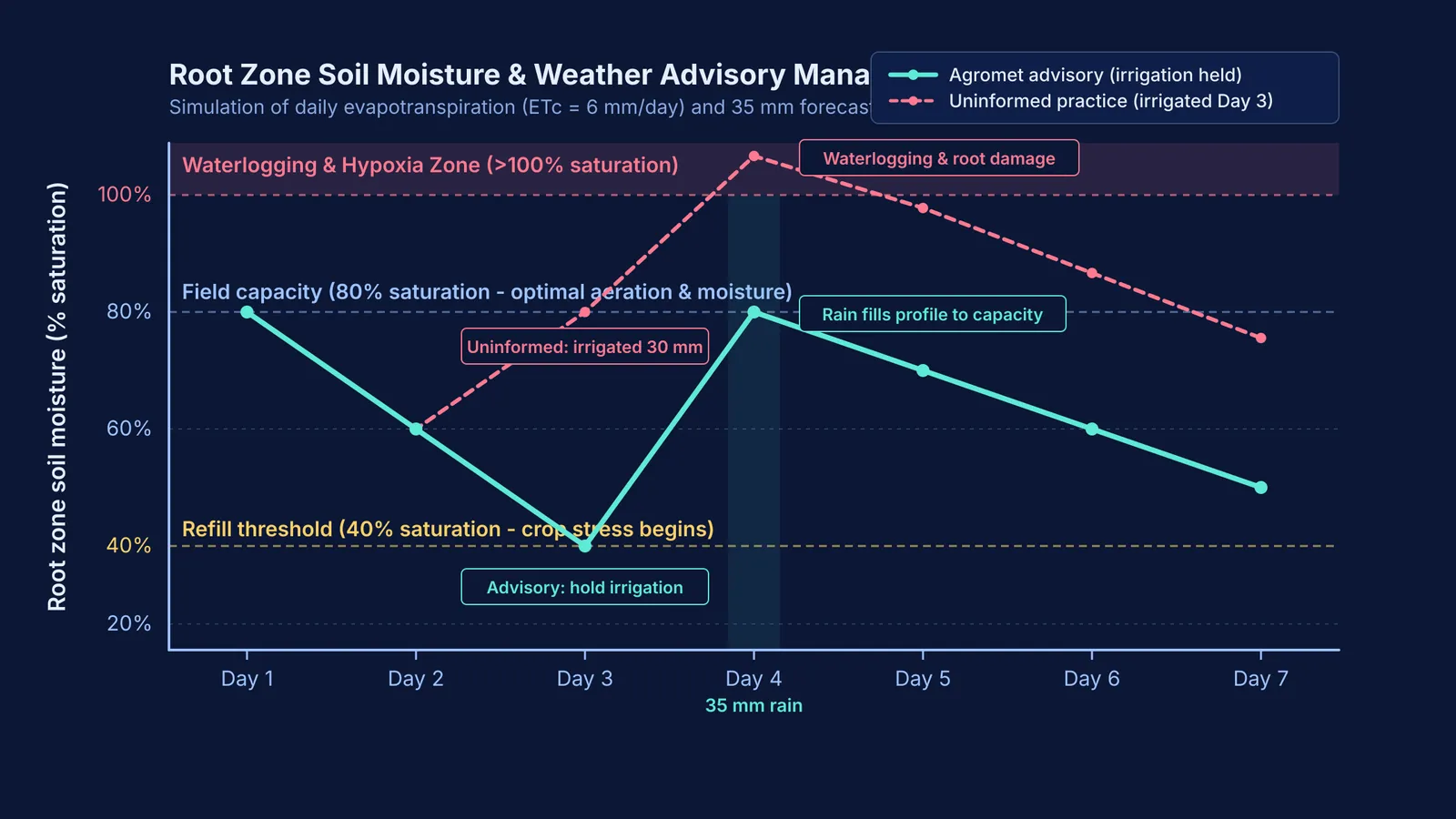
If a crop needs 6 mm of water daily and forecasts predict 35 mm of rain within 48 hours, advisories tell farmers to suspend irrigation. Holding back irrigation saves groundwater and pumping electricity while preventing waterlogging that can suffocate root systems.
Why do farm advisories matter for the rural economy?
Timely weather guidance delivers verified economic returns for rural households. A 2020 evaluation by the National Council of Applied Economic Research (NCAER) assessed India's Monsoon Mission investments. According to the Press Information Bureau, the study found that 98% of surveyed farmers modified at least one of nine critical agricultural operations based on weather advisories.
The study estimated that weather-based advisories generated an annual economic benefit of ₹13,331 crore for agricultural households. Over five years, every ₹1 invested in weather modeling produced an estimated ₹50 in economic returns, while 94% of those farmers reported avoiding losses or increasing their income.
What is the degree and entrance route into agrometeorology?
Entering the field in India follows a defined academic progression accredited by the Indian Council of Agricultural Research (ICAR):
Undergraduate degree (4 years): Complete a B.Sc. (Hons) in Agriculture, Horticulture, or Agricultural Engineering after Class 12 with PCM or PCB.
Master's specialization (2 years): Take the national ICAR AIEEA (PG) entrance exam under the Physical Science group to enter an M.Sc. in Agricultural Meteorology. Coursework covers micrometeorology, radiation physics, remote sensing, and crop models like DSSAT.
Research qualifications: To enter university faculties or ICAR institutes, graduates take the National Eligibility Test (NET) and Agricultural Research Service (ARS) exam conducted by the Agricultural Scientists Recruitment Board.
The field builds on pioneering foundations, from Anna Mani's work building weather instruments to P. R. Pisharoty's pioneering remote sensing work.
Understanding how radiation drives evapotranspiration requires intuition for fluid dynamics and heat exchange. To see how these physical variables interact across conditions, you can explore interactive simulations in the Fermi Simulation Lab.
Where do agricultural meteorologists work?
Graduates find roles across research centers, extension networks, and private technology companies:
State Agricultural Universities and KVKs: Preparing block-level bulletins as Subject Matter Specialists.
National Research Institutes: Conducting crop-climate research at centers like the ICAR-Central Research Institute for Dryland Agriculture (CRIDA) in Hyderabad, which coordinates the All India Coordinated Research Project on Agrometeorology (AICRPAM).
India Meteorological Department (IMD): Managing automated weather station networks and regional crop-weather calendars.
AgTech and Crop Insurance: Designing algorithms for precision irrigation, satellite vegetation monitoring, and parametric crop insurance.
How can agriculture undergraduates prepare across four years?
Agriculture undergraduates targeting agrometeorology can follow this four-year roadmap:
Years 1 & 2: Build physical science foundations. Focus on soil mechanics, plant physiology, thermodynamics, and radiation balance.
Year 3: Develop computational and geospatial skills. Learn Python or R for weather data analysis, alongside open-source GIS tools for processing satellite vegetation indices like NDVI.
Year 4: Prepare for the ICAR AIEEA PG exam. Preparing for the Physical Science paper requires structured practice with quantitative physics and soil chemistry problems. The Fermi Problem Library provides worked problems with a step-by-step solver that explains the reasoning rather than printing an answer.


