On this page
You have your first offer letter, and on page three is a line saying you must stay for two years or pay a fixed sum if you leave. That line is a service bond, also called a minimum service clause or indemnity bond. Here is how Indian law treats it and what to ask before you sign.
Is a service bond legal in India?
Mostly yes, if it is reasonable. Section 27 of the Indian Contract Act, 1872 makes any agreement that restrains a person from exercising a lawful profession, trade or business void to that extent, as the Supreme Court's 2025 judgment in Vijaya Bank v Prashant B Narnaware explains. But the court separated restrictions that apply while you work from those that apply after you leave. A bond asking you to stay for a minimum term operates during the job, so the court held it is not a restraint of trade.
In that case, decided on 14 May 2025, a bank officer had agreed to serve at least three years or pay ₹2 lakh, resigned early, paid under protest and challenged the clause. The judgment upheld it: a public sector bank must refill posts through open, slow and expensive recruitment; the clause aimed to reduce attrition; and for a senior manager on a "lucrative pay package", ₹2 lakh was not so high as to make resigning "illusory".
The same judgment also helps you. It says standard-form employment contracts are prima facie evidence of unequal bargaining power, and that the employer, not the employee, must prove a restrictive clause is lawful. The case was about a senior officer in a public bank, not a fresher at a private firm, and the court stressed that judgments must be applied to the facts of each case.
Will you have to pay the full bond amount if you leave early?
Not necessarily. Under Section 74 of the Contract Act, the side hurt by a breach is entitled to "reasonable compensation not exceeding the amount so named", so a court can award less than the figure in your letter, as this IndiaCorpLaw analysis of Section 74 and the Supreme Court's cases sets out. In practice, arguing that in court takes time and money, so plan as if you might owe the full sum.
Watch your documents too. In 2022 the Madras High Court ordered certificates returned to doctors who had not completed a government service bond, holding that "an Educational certificate is not a marketable commodity" and cannot be held as a lien. That case involved medical colleges, not companies, but the principle is worth knowing.
What questions should you ask before signing?
Ask these by email, so the answers are in writing:
How long is the bond, and does it start on my joining date or after training ends?
What is the exact amount, and does it reduce for each month I serve?
What training does it cover, and what does that cost the company?
Does the bond still apply if the company ends my job, or changes my role, city or pay?
Will you keep any original documents or ask for cheques?
Does any restriction continue after I leave, such as not joining a competitor?
A polite script: "Thank you for the offer. Before I sign, could you confirm the bond period, whether the amount reduces month by month, and that my original certificates will be returned after verification?" If a pre-placement offer carries a bond, the same questions apply; our guide to turning an internship into a pre-placement offer covers the rest of that process.
Flat bond or pro-rata bond: what difference does it make?
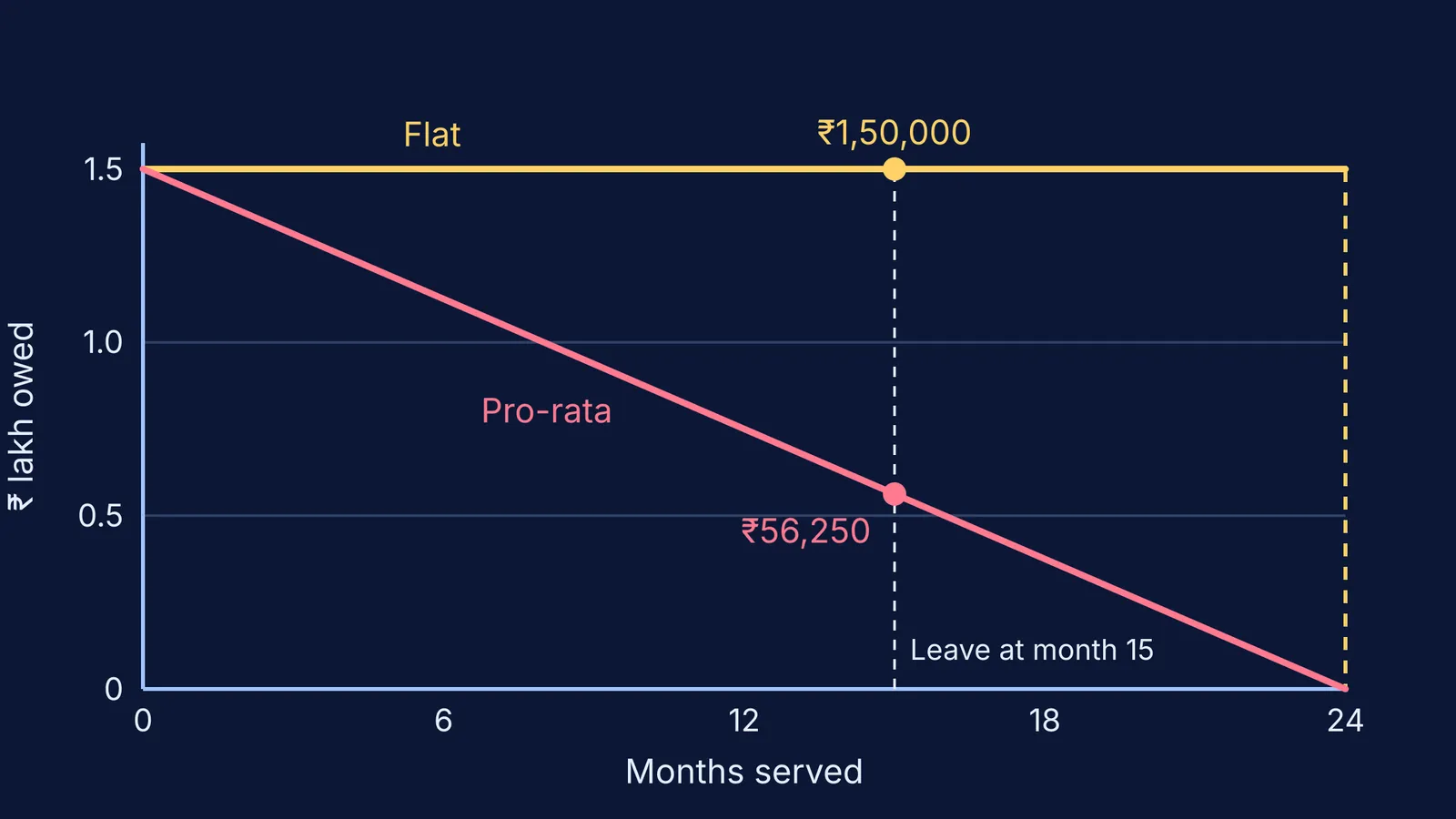
Say your offer is ₹30,000 a month, with a 24-month bond of ₹1,50,000, and you get a better job at month 15.
Flat clause: you owe the full ₹1,50,000, which is five months of your gross pay.
Pro-rata clause: the amount falls evenly as you serve. With 9 of 24 months left, you owe 9 ÷ 24 × ₹1,50,000 = ₹56,250.
Same bond, same exit date, a difference of ₹93,750.
If the bond pays for technical training, you can revise the basics before you join: the Fermi Concept Library covers every concept in physics, chemistry, biology, mathematics and computing, so the training builds on ground you already have.
So should you sign a service bond in your first job?
You can sign more comfortably when:
the period is one you would probably stay anyway
the amount is one you could pay from savings
it is tied to real, named training
it reduces as you serve
no originals or cheques are held
Push back, or keep looking, when the sum is many months of pay, the clause is vague, or the company wants to hold your certificates. Talk it through with family, and with a lawyer if the amount is large.
If you decide to keep searching, see our guide to getting a job off campus as a fresher in India. For how bonds work in medicine, see what an MBBS bond in a state college means.