On this page
Pre-placement offers (PPOs) are rarely decided in the final week of an internship. At companies ranging from tech startups to established engineering firms, conversion decisions follow a continuous audit of independence, communication, and risk reduction. Understanding how leadership evaluates your work allows you to steer your day-to-day contributions toward a permanent position.
How are pre-placement offer decisions actually made?
Hiring managers and talent committees evaluate interns on a simple risk-reward ratio: does this candidate require constant supervision, or do they already operate like a junior full-time colleague? Completing assigned tasks on time is the baseline requirement; earning a pre-placement offer requires demonstrating that you can solve ambiguous problems, communicate blockers early, and collaborate across teams.
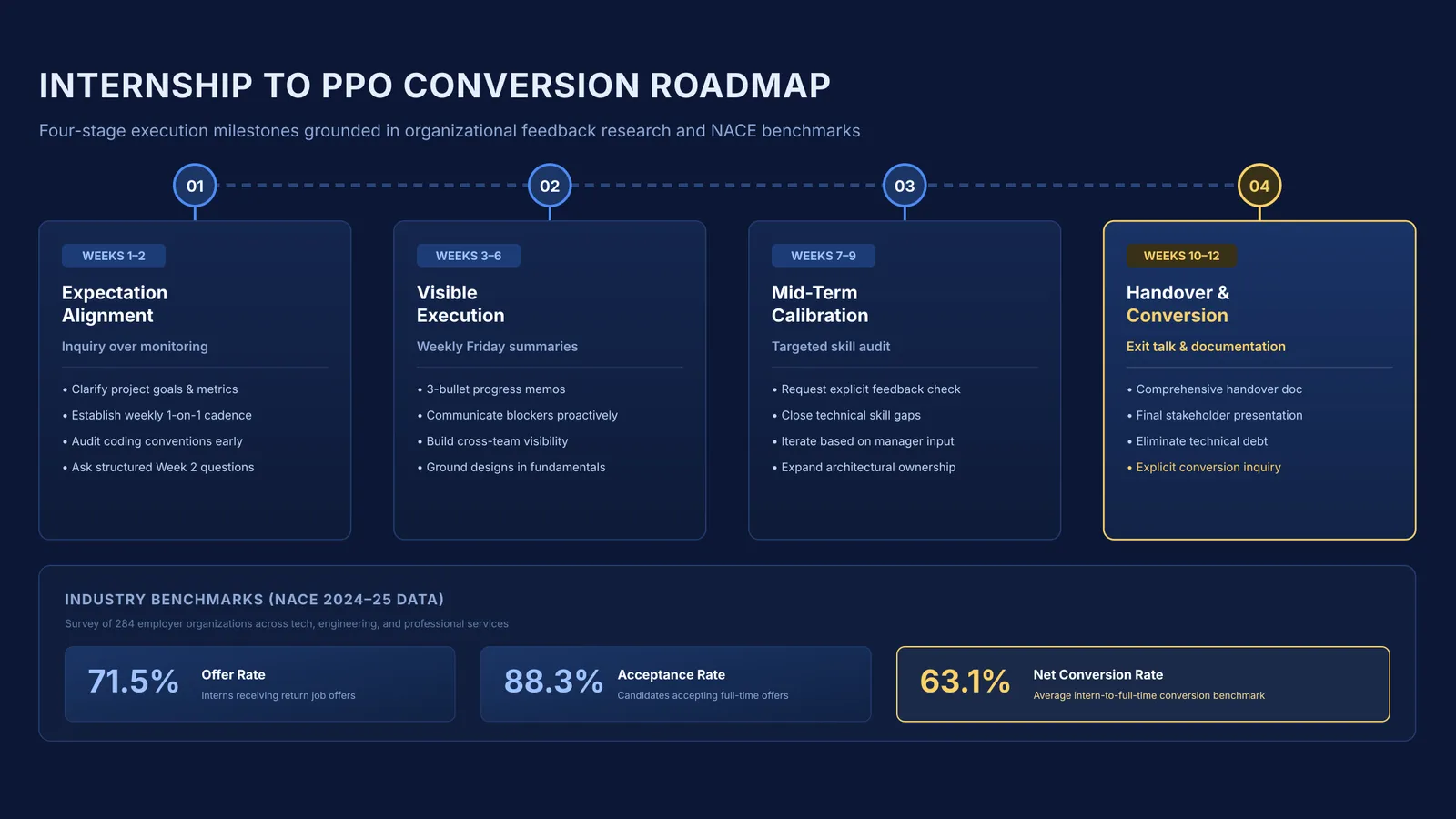
According to data from the National Association of Colleges and Employers (NACE), the average intern-to-full-time conversion rate climbed to 63.1% for the 2024–25 cohort, while the offer acceptance rate reached 88.3%. Employers in the survey cited collaborative ability as a decisive differentiator, with 85% of organizations prioritizing teamwork skills when evaluating candidates. Companies view internships as their primary talent pipeline, but conversion requires meeting operational and communication standards alongside technical tasks.
For undergraduates transitioning from their first semester at college to industrial environments, this process demands a cognitive shift. While college examinations reward solitary problem-solving, corporate environments reward collaborative execution and predictable delivery.
Why is asking for feedback better than waiting for it?
A frequent mistake interns make is waiting silently for the scheduled end-of-term evaluation. By the time a manager highlights an issue in Week 7 or 8, the internship is nearly over, leaving no time to demonstrate growth.
In organizational psychology, proactive feedback seeking is treated as an active self-regulation strategy. In a foundational study published in Organizational Behavior and Human Performance90156-3), Susan J. Ashford and Larry L. Cummings distinguished between two methods of gathering performance data: monitoring (quietly observing cues and reactions) and inquiry (asking directly). While monitoring feels safer, it carries severe inferential costs because busy managers often nod politely even when an intern's work misses technical standards.
Further research by Elizabeth W. Morrison in the Academy of Management Journal demonstrated that newcomers who proactively seek performance feedback achieve higher performance ratings and experience less role ambiguity. Many students hesitate to ask for feedback because they fear looking unqualified. You can eliminate this awkwardness by asking structured, low-friction questions:
Week 2 alignment check: "I want to confirm my current implementation aligns with team standards. Are there any coding conventions or architectural patterns I should adjust before the next sprint?"
Week 5 mid-term check: "Looking ahead to our deliverables for next month, what is one technical or communication skill you would like to see me strengthen before the final review?"
These questions demonstrate professional maturity and give your manager a chance to steer your trajectory while there is still time to act.
How do you make your daily work visible?
High-quality work that stays hidden on a private branch or in an unread document rarely leads to a conversion. In distributed or hybrid engineering setups, managers cannot monitor every pull request. Creating disciplined visibility rituals ensures that the hiring committee has a tangible record of your impact.
Adopt the Weekly 3-Bullet Summary. Every Friday afternoon, send a brief update to your manager and mentor covering:
What was delivered: Links to merged pull requests, closed tickets, or finished design documents.
What was unblocked or learned: Concrete technical insights, such as resolving a database schema bottleneck or optimizing an API query.
Next week's focus: Upcoming milestones and any open dependencies requiring team input.
Visibility also requires solid technical fundamentals. When tackling complex system architecture or unfamiliar algorithms, returning to core principles is essential. The Fermi Concept Library covers every concept in physics, chemistry, biology, mathematics and computing, each with its own lesson and its place in the map, helping interns verify foundational ideas before presenting system designs to senior peers.
What should you do in the final two weeks of your internship?
The final fortnight of an internship establishes the lasting impression you leave with leadership. Rather than coasting toward the end date, use this time to package your work for long-term maintainability.
Start by writing a comprehensive handover document. Include architecture diagrams, testing commands, configuration files, and an honest log of remaining edge cases. A clean handover proves that your project will thrive without creating technical debt after you return to university. Next, schedule a closing presentation to walk stakeholders through your work, highlighting quantifiable results like latency reductions or automated test coverage.
Technical presentations often involve rapid questions from senior staff. The Fermi Problem Library provides worked problems with a step-by-step solver that explains the reasoning rather than printing an answer, helping you explain intermediate steps clearly and defend technical decisions under scrutiny.
Finally, schedule a dedicated exit conversation with your manager. Express genuine gratitude for their mentorship, and ask directly about next steps:
"I have enjoyed working on this project and would love to return to the team full-time after graduating. Could you walk me through how the conversion decision process works, and what timeline I should keep in mind?"
Whether you convert your role immediately or enter campus placements, the habits that drive internship conversion mirror the discipline required to improve your college CGPA and succeed in undergraduate research internships.