On this page
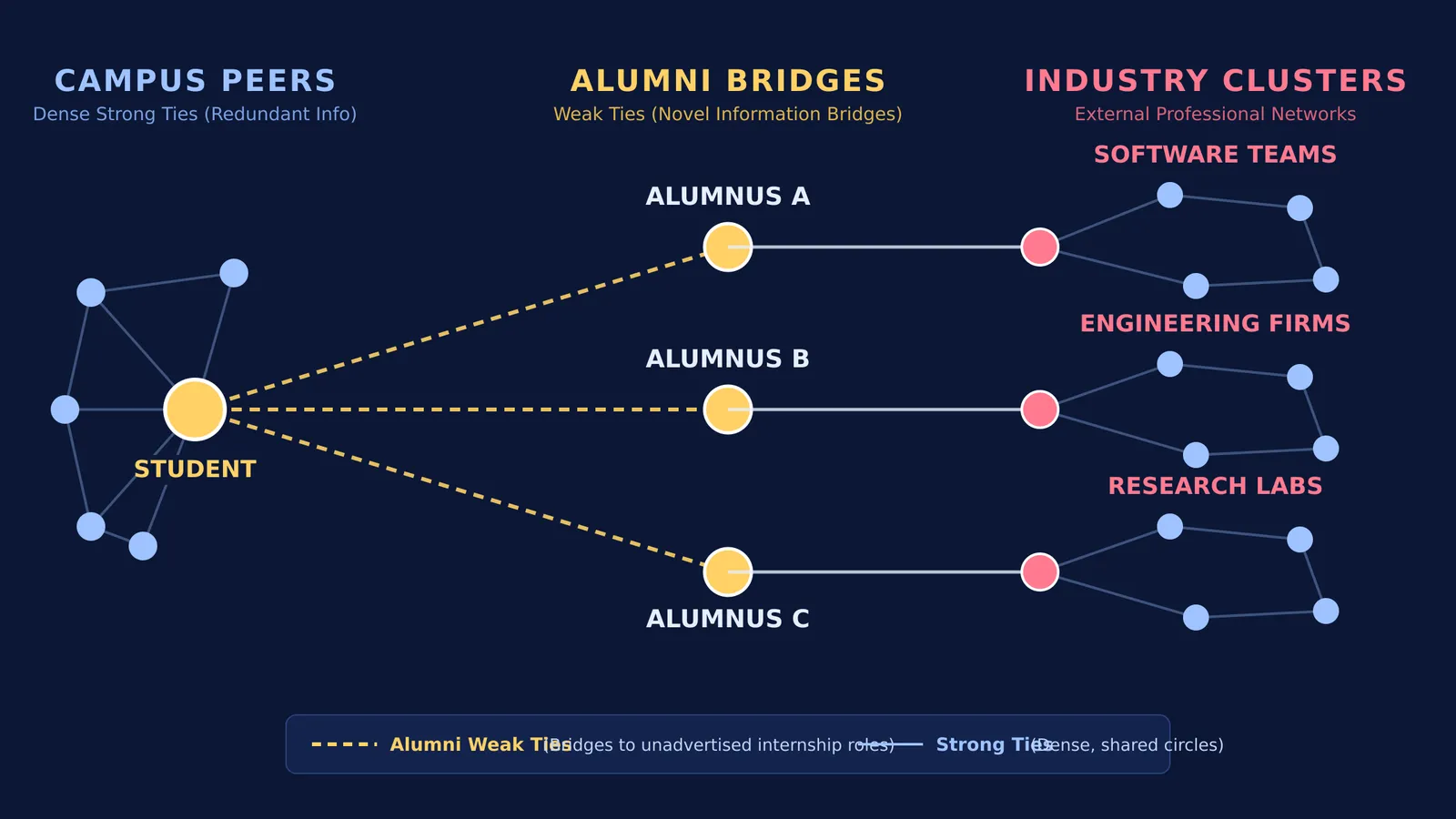
When searching for internships, many students rely solely on public job portals where hundreds of candidates compete for identical listings. However, your college alumni network provides a far more effective channel through what sociologists identify as "weak ties."
In his foundational 1973 study The Strength of Weak Ties, sociologist Mark Granovetter surveyed professionals who secured jobs through personal contacts. He discovered that 83.4% heard about openings through weak ties—people they saw only occasionally (55.6%) or rarely (27.8%)—compared to just 16.7% who learned through close friends or family. Granovetter showed that while close friends share the same information, acquaintances act as bridges into entirely separate professional groups.
This phenomenon was tested at scale in a 2022 randomized experiment published in Science. Researchers Karthik Rajkumar, Guillaume Saint-Jacques, Iavor Bojinov, Erik Brynjolfsson, and Sinan Aral analyzed 20 million LinkedIn members across five years and proved that moderately weak ties causally produce the highest rates of job mobility. College alumni fit this role: they share your campus background, but work inside companies where internship openings are never publicly advertised.
How do you find relevant alumni on LinkedIn?
To locate alumni effectively, visit your college's official LinkedIn page and open the "Alumni" tab. This directory allows you to filter former students by graduation year, location, company, and field of study.
Focus on alumni who graduated a few years ahead of you. Recent graduates still remember the internship search, understand your current academic syllabus, and often work directly with team leads who hire interns.
You can also search college clubs, student societies, and departmental forums. Seniors in these groups frequently post early notices about openings. Identifying these connections is a key part of an off-campus job search for freshers, helping you build a focused list of relevant contacts.
What should your initial outreach message say?
The most common mistake is asking for a job or referral in your first message. Alumni who do not know your work cannot comfortably vouch for you to their hiring managers.
Instead, request an informational interview—a brief conversation to learn about their domain. In a 2023 study published in The Career Development Quarterly, researcher Adam M. Kanar found that structured informational interviewing significantly increased university students' networking self-efficacy across experimental and longitudinal trials.
Keep your opening message under 100 words:
"Hi [Name], I am a second-year [Branch] student at [College]. I came across your profile while researching careers in [Field] and noticed your transition to [Company]. If you have 15 minutes in the coming weeks, I would love to ask two brief questions about how you prepared for [Role] and which skills mattered most. Either way, thank you for your time."
This note respects their time, specifies a shared background, and avoids awkward pressure. This approach mirrors the principles in how to cold email a startup for an internship.
What questions should you ask during an informational chat?
When an alumnus agrees to speak, thorough preparation ensures the conversation is productive. Research their company and team in advance so you avoid asking basic facts easily found online.
Before the call, make sure your core subject knowledge is solid. The Fermi Problem Library has worked problems with a step-by-step solver that explains the reasoning rather than printing an answer. If you need to refresh foundational principles before discussing technical projects, the Fermi Concept Library covers every concept in physics, chemistry, biology, mathematics and computing, each with its own lesson and its place in the map.
Prepare three or four specific questions for your discussion:
"What technical skill or tool do you use daily that was not covered in our college curriculum?"
"When your team reviews intern applications, what portfolio projects stand out most?"
"What surprised you most about the day-to-day workflow during your first year on the job?"
"Which technical blogs, open-source repositories, or papers do you follow to stay updated?"
How do you follow up after the conversation?
Building a lasting connection depends on how you follow up. Send a brief thank-you note the following day citing one specific insight they shared.
Next, act on their advice over the following month. If they recommended exploring a framework or building a project, do so. Then send a brief progress note:
"Hi [Name], I wanted to share that I followed your recommendation and completed a small project using [Tool]. Your advice helped me understand [Concept] much faster. Thank you again for your time and guidance."
Reporting back shows initiative, reliability, and work ethic. When an internship position opens up, you will naturally be top of mind. If an offer follows, you can then prepare for how to convert an internship into a pre-placement offer.