On this page
Air traffic controllers manage the safe and efficient movement of aircraft from the moment an engine starts until the plane parks at its destination. In India, you enter this profession by passing the Airports Authority of India (AAI) exam to become a Junior Executive (Air Traffic Control).
Unlike a standard office job, this is a high-stakes, operational role. Controllers are split into aerodrome control (managing the runways and taxiways), approach control (sequencing arriving and departing flights), and area control (managing high-altitude airspace between cities). It is a demanding career, but if you are looking for an alternative to a traditional engineering desk job—such as Mechatronics and Robotics Engineering: Career Scope—this role offers a dynamic, "zero-error" environment where work stays at the office.
What degree do you need to become an ATC?
To apply for the AAI Junior Executive ATC position, you must meet specific educational and age criteria.
The maximum age limit is 27 years for general category candidates according to AAI recruitment norms.
For your degree, you have two options:
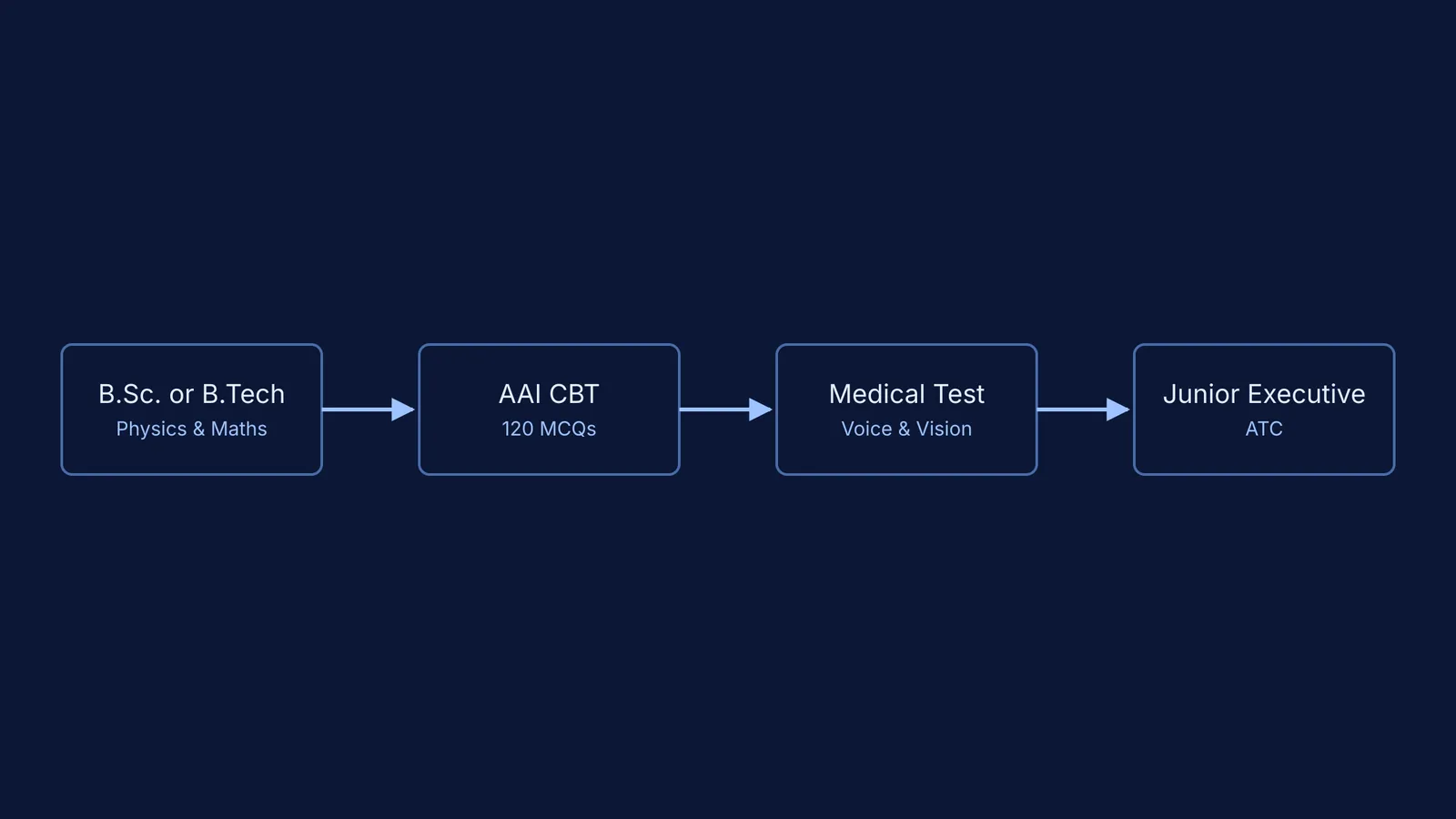
A full-time, regular three-year B.Sc. degree with Physics and Mathematics.
A full-time, regular B.E. or B.Tech degree in any engineering discipline, provided you studied Physics and Mathematics in at least one semester as noted by Testbook.
You must also have passed English as a subject in your 10th or 12th standard. The medical standards are strict: you must have 6/6 vision (spectacles are usually permitted, provided they correct to 6/6), normal hearing, and absolutely no colour blindness.
How to become an air traffic controller in India?
The selection process is straightforward but highly competitive. It begins with a Computer-Based Test (CBT), followed by document verification, a voice test to ensure your spoken English is clear, and comprehensive medical and psychoactive substance tests.
The CBT consists of 120 multiple-choice questions to be completed in 120 minutes according to Testbook.
Crucially, there is no negative marking.
Part A (50%) covers the English language, general intelligence and reasoning, general aptitude, and general knowledge.
Part B (50%) tests Class 11 and 12 (10+2 level) Physics and Mathematics.
If you are revising for Part B, the Fermi Problem Library has worked problems with a step-by-step solver that explains the reasoning rather than printing an answer. It helps to master these concepts deeply instead of just memorising formulas.
What is the day-to-day job like?
The ATC lifestyle is defined by rotational shifts, as airports operate continuously. A common roster involves a mix of morning, afternoon and night shifts, followed by rest days.
Because the job requires immense concentration, fatigue management is strictly enforced with regular breaks during shifts.
The financial compensation reflects the responsibility. The starting Cost to Company (CTC) for a Junior Executive ATC is approximately ₹13 Lakhs per annum, with a base pay of ₹40,000 per month as detailed by Testbook.
A four-step plan for college students
If you are currently pursuing your B.Sc. or B.Tech and want to aim for this career, here is a practical plan:
Check the medical standards early. Before you invest time in preparation, visit an ophthalmologist to ensure your vision is correctable to 6/6 and that you are completely free of colour blindness.
Master Class 11 and 12 physics and maths. This forms exactly half of the CBT. Practice your fundamentals and learn how to use dimensions to check your physics answers to avoid careless errors.
Practice speed without negative marking. Because the AAI exam does not deduct marks for wrong answers, you must practice attempting all the questions within the strict time limit.
Prepare for the voice test. Your radio communication must be crisp. Read English newspapers aloud daily to improve your diction and pronunciation, which is critical for aviation safety.
(If you decide the medical or shift requirements are not for you, you can always pivot; for example, look into the career paths after a B.Des degree or other engineering roles.)