

On this page
At your home state's agricultural university, the national exam covers only a small slice of BSc Agriculture seats. Most go through a state process with its own test, quotas and counselling calendar. If you are new to the national route, start with our explainer on how to get admission to an agriculture university after Class 12.
How do ICAR and state seats split at an agricultural university?
The ICAR-UG Online Counselling Brochure 2026 sets out the national route. Its key rules:
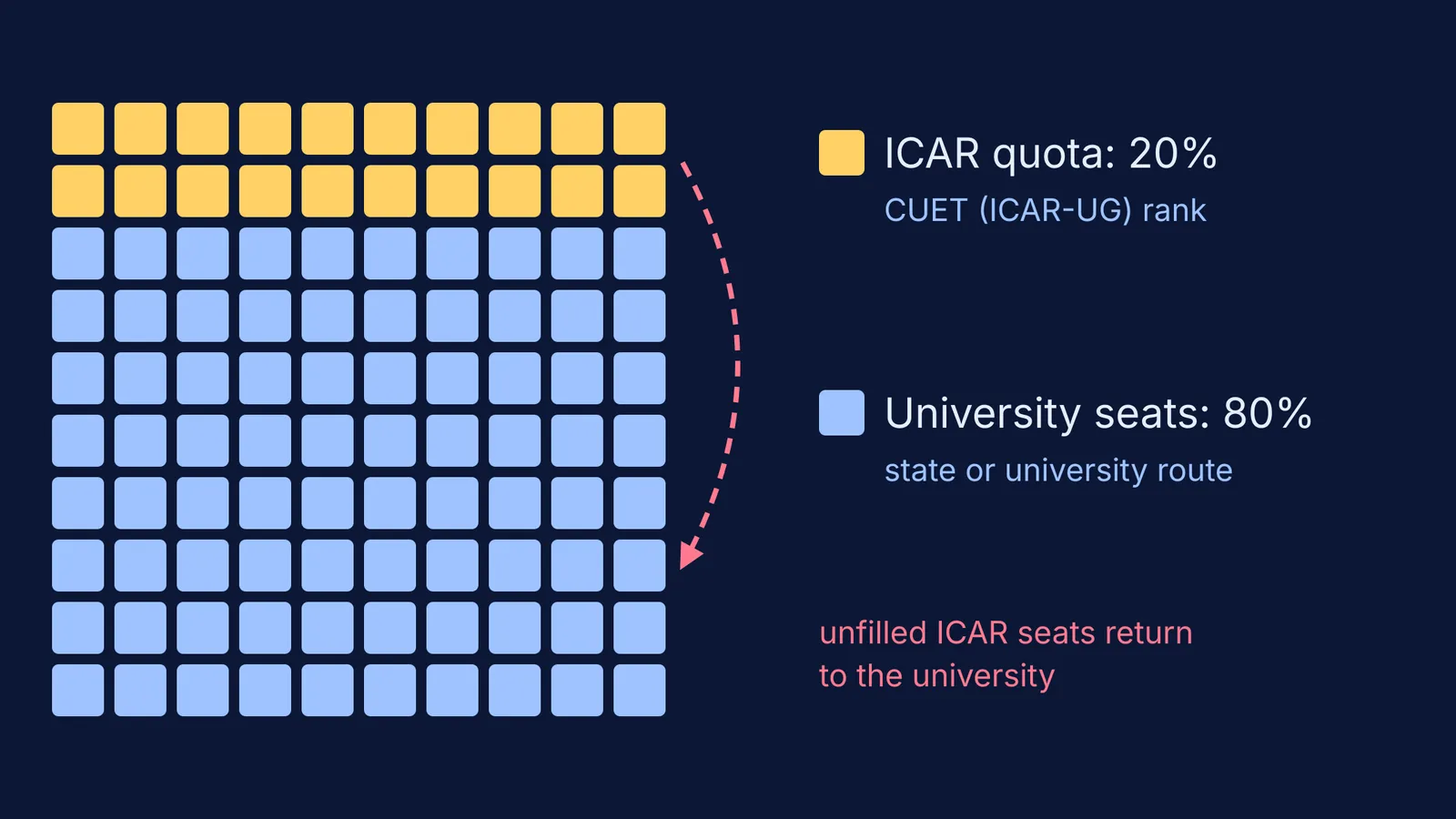
ICAR fills 20% of bachelor's seats in 72 agricultural universities, and 100% of seats at ICAR-NDRI Karnal, ICAR-IARI New Delhi, ICAR-IVRI Izatnagar, RLBCAU Jhansi and Dr RPCAU Pusa.
Ranks come from CUET (ICAR-UG), which NTA conducted from 11 May to 7 June 2026.
There are four counselling rounds plus a mop-up round. ICAR allots you a university, not a college.
ICAR seats still empty after the mop-up round are released to the university and "treated as university seats".
So at a typical state agricultural university, about 80 of every 100 bachelor's seats start out in the state or university process, and any ICAR seats left empty join them later.
How does BSc Agriculture admission through a state entrance work?
Here is what official 2026-27 documents say:
Telangana: PJTAU held counselling for BSc (Hons) Agriculture based on TG EAPCET-2026 ranks in the BiPC stream. The same notice reserves 25% of seats for a farmers' quota and 15% for an agricultural labourers' quota. The farmers' quota requires at least four years of schooling between Class 4 and Class 12 in non-municipal areas, and at least one acre of land in the name of the candidate, a parent or a grandparent.
Maharashtra: the State CET Cell's UG agriculture prospectus 2026-27 accepts MHT-CET, JEE or NEET scores in the PCB or PCM group. It asks for at least 45% in Class 12 Science (40% for reserved categories). Seats are split into a University quota, a Maharashtra quota and an Other State quota, based on domicile and where you passed Class 12.
Tamil Nadu: the TNAU admissions notice for 2026-27 describes one online application, a rank list and online counselling, starting the day Class 12 results are declared. It lists no entrance test. TNAU's constituent colleges have 1,335 BSc (Hons) Agriculture seats, and 418 seats across programmes are set aside for the 7.5% quota for government-school students.
Karnataka: the UAS Dharwad admissions page posts separate notices for ICAR-quota admission, a practical test for the agriculturist quota and, in earlier years, open counselling for vacant KCET seats.
Where do the state and national routes differ?
The test. ICAR uses CUET (ICAR-UG). States use their own test, accept several tests, or, like TNAU, draw up a rank list without listing any entrance test.
Who can apply. ICAR seats are open across India. State seats can depend on domicile or where you studied, as Maharashtra's quotas show.
Farm-family quotas. State routes may reserve seats for farmers' or labourers' families and ask for land or study certificates.
Counselling. ICAR counselling is online, with no in-person reporting during the rounds. PJTAU's notice says its counselling is held in person, not online, at a venue on fixed dates for each rank range.
Money and exits. The ICAR 2026 brochure sets a Rs 500 counselling registration fee and a Rs 10,000 seat acceptance fee. The registration fee is non-refundable. Withdraw by the end of round four and ICAR refunds the fee it collected minus a Rs 1,000 processing fee; freeze a seat and neither join nor withdraw properly, and you lose the acceptance fee. State refund rules are separate; our guide to withdrawing a seat and getting a refund covers the general steps.
Should you write CUET (ICAR-UG), your state test, or both?
For most students, both. Take a PCB student from a farming family in rural Telangana. Most BSc Agriculture seats at PJTAU go through TG EAPCET, where the student may also qualify for the farmers' quota if the schooling and land rules fit. CUET (ICAR-UG) adds the ICAR seats at PJTAU and at universities in other states. Skipping either exam closes off one pool.
A four-step plan for the year before admission:
Read last year's admission notice from your state agricultural university. Note whether it uses a state test, a national test or a rank list with no entrance test.
Collect quota documents early: domicile, caste, study certificates, and land records for a farm-family quota.
Register for both tests, choosing CUET subjects that match your Class 12 subjects exactly.
Mark both counselling calendars and fee deadlines, and decide in advance which offer you would freeze.
If a weak topic keeps costing you marks in mocks, the Fermi Concept Library has a lesson for every concept in physics, chemistry, biology and mathematics. If you are not sure where to start, Fermi's AI tutor can work out what you already know and build a plan for the session.
Next, read about careers in agricultural research after BSc Agriculture to see where the degree can lead.


