

On this page
If you are preparing for engineering admissions in India, state boundaries do not lock you out of top technical institutes. While state government colleges prioritise local students through domicile quotas, you can secure seats in other states through dedicated All India Quotas, open entrance exams, and centralized state counselling rounds.
Understanding these routes helps students and parents expand their options across India without forfeiting central counselling opportunities.
Which state engineering colleges admit students without local domicile?
State engineering admissions balance regional access with national competition. While government colleges reserve most seats for local residents as detailed on the JAC Delhi admission portal, key entry points remain open for out-of-state applicants.
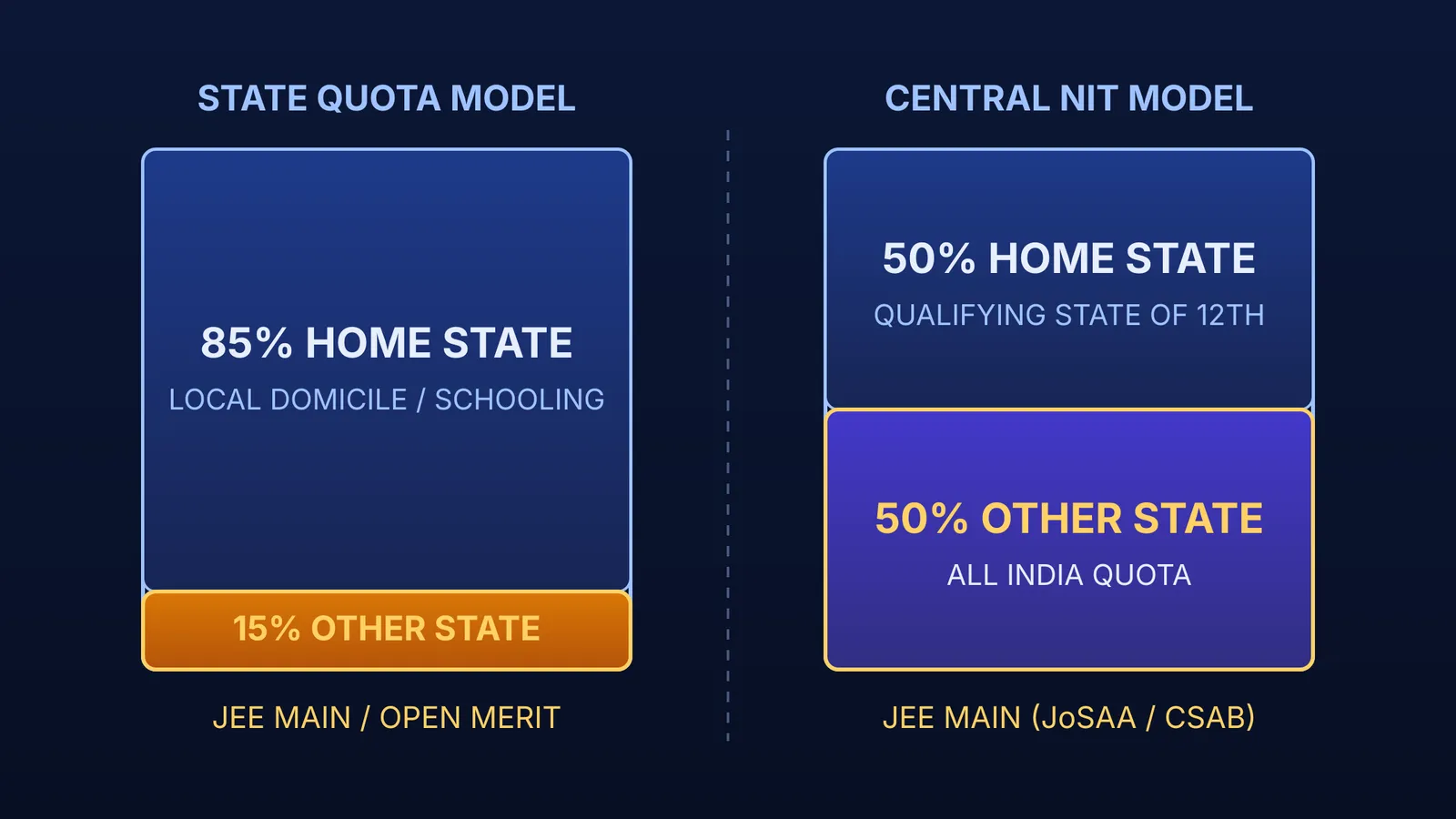
In Delhi, the Joint Admission Committee conducts admissions for Delhi Technological University (DTU), Netaji Subhas University of Technology (NSUT), and Indira Gandhi Delhi Technical University for Women. Under the JAC Delhi admission portal, seats are split into an 85% Delhi Region quota and a 15% Outside Delhi Region quota. Crucially, eligibility for the 85% home quota does not require a domicile certificate; it depends solely on passing your Class 12 qualifying examination from a school located within Delhi. Students who completed Class 12 in other states compete for the 15% Outside Delhi seats through their JEE Main rank.
Karnataka uses a dual-exam system. While the Karnataka Examinations Authority reserves government KCET seats for candidates with 7 years of local schooling, private colleges admit students across India through the COMEDK official portal. The COMEDK UGET exam requires 0% domicile documentation for general merit seats, providing access to approximately 190 private engineering colleges.
In West Bengal, admissions conducted through the WBJEEB official portal maintain strict domicile rules for state universities like Jadavpur University, which reserves 90% of general seats for West Bengal residents while keeping 10% of general seats open to out-of-state WBJEE rank holders. Additionally, private engineering colleges in West Bengal allocate a 10% All India quota filled directly through JEE Main ranks without any local domicile requirement.
How does the All India Quota work in state-level counselling?
Several state counselling boards operate an All India Quota (AIQ) within their regular centralized counselling rounds, typically allocating 15% to 20% of seats to students from across India based on JEE Main scores, as structured by authorities like the Maharashtra State CET Cell.
In Maharashtra, the Maharashtra State CET Cell mandates that unaided private engineering colleges reserve 15% of sanctioned intake for All India candidates selected through JEE Main merit. Furthermore, premier autonomous institutes offer dedicated All India quotas: COEP Technological University reserves 20% of its seats for JEE Main candidates, while the Institute of Chemical Technology (ICT) Mumbai reserves 30% of seats for All India applicants. Out-of-state candidates apply under the Outside Maharashtra State (OMS) category in centralized admission rounds, linking directly into the wider MHT CET counselling structure.
Haryana follows an 85:15 model administered through the HSTES official portal. The authority reserves 15% of seats across both government and private technical colleges as the All India Category (AIC), allocated purely on JEE Main All India Common Rank List merit without domicile constraints.
These state-level quotas operate alongside central admissions. In contrast to state colleges, National Institutes of Technology (NITs) allocate 50% of seats to the Other State quota through the JoSAA official portal. If state counselling and JoSAA rounds conclude with unfilled spots, students frequently target remaining openings in CSAB special rounds on the CSAB official portal.
What happens to caste and category reservations in another state?
One of the most frequent misconceptions among engineering aspirants concerns category reservations. Under Indian constitutional law, state-level affirmative action benefits are geographically bounded.
When you apply to a state engineering college outside your home state, your OBC-NCL, SC, ST, or EWS certificate issued by your home state is not recognised in that state's counselling. State admission authorities like the Maharashtra State CET Cell and the WBJEEB official portal treat all out-of-state applicants as General or Open category candidates.
This contrasts sharply with central institutions. In JoSAA counselling rounds and documentation, central reservation lists apply uniformly across the 50% Other State quota in NITs, IIITs, and Centrally Funded Technical Institutions under the JoSAA official portal. If you belong to the Central OBC list, you can claim reserved category benefits across India under JoSAA, but you will compete as an unreserved general candidate in state counselling outside your home territory.
What is the step-by-step strategy for out-of-state engineering applications?
Securing an engineering seat in another state requires tracking independent counselling schedules:
Map the qualifying entrance exam: Determine whether target colleges accept JEE Main (such as JAC Delhi, Maharashtra CAP, and Haryana HSTES) or require their own entrance exam (such as COMEDK UGET in Karnataka).
Register on individual state portals: State authorities do not participate in JoSAA. You must create separate profiles and pay registration fees on state portals like JAC Delhi, Maharashtra CET Cell, and HSTES when windows open in May and June.
Budget for unreserved fee tiers: Out-of-state students are generally ineligible for state-funded Tuition Fee Waiver (TFW) schemes or domestic fee concessions, so factor full tuition into your financial planning.
Monitor institutional spot rounds: After centralized rounds finish in July or August, premier colleges often hold open spot counselling rounds to fill vacant All India seats on merit.
Because JEE Main rank determines access to 15% All India quotas across institutions listed on the JAC Delhi admission portal and other state bodies, scoring high on numerical sections is critical. The Fermi Problem Library provides worked problems with a step-by-step solver that explains the reasoning rather than printing an answer, helping students build accuracy under exam conditions. To structure revision before exam dates, Fermi's AI tutor can work out what you already know and build a plan for the session, keeping practice disciplined across physics, chemistry, and mathematics.


