

On this page
If you are applying to universities in the US or the UK from India, your clubs, projects, jobs and family duties have to fit into very small boxes. Here is how to write each line so it says what you did, and how to decide the order.
How much space do you get for extracurricular activities?
The Common App lets you add up to ten activities, with 50 characters for your position, 100 for the organisation name and 150 for the description, according to its official Approaching the Activities section guide. The same guide says you do not need to enter ten, and that family responsibilities, jobs, internships, volunteering, hobbies and sports all count. Hours per week and weeks per year go in separate fields.
For UK universities, UCAS replaced the single essay with three questions from 2026 entry: 4,000 characters in total, at least 350 per answer, and a third question asking what you have done outside education and why it is useful (UCAS).
Keep activities in proportion. In NACAC's survey of 185 US four-year colleges for the fall 2023 admission cycle, 50.8% rated extracurricular activities of considerable or moderate importance, while 76.8% gave considerable importance to grades in college-prep courses (NACAC, Factors in the Admission Decision). Marks come first. Our piece on balancing extracurriculars and marks covers how families can protect both.
How do you describe an activity in 150 characters?
Use one formula for every line: action verb + what you did + a number + the result. Drop "I" and use semicolons instead of full sentences; the Common App Activities guide itself says you may need to abbreviate words and simplify your grammar.
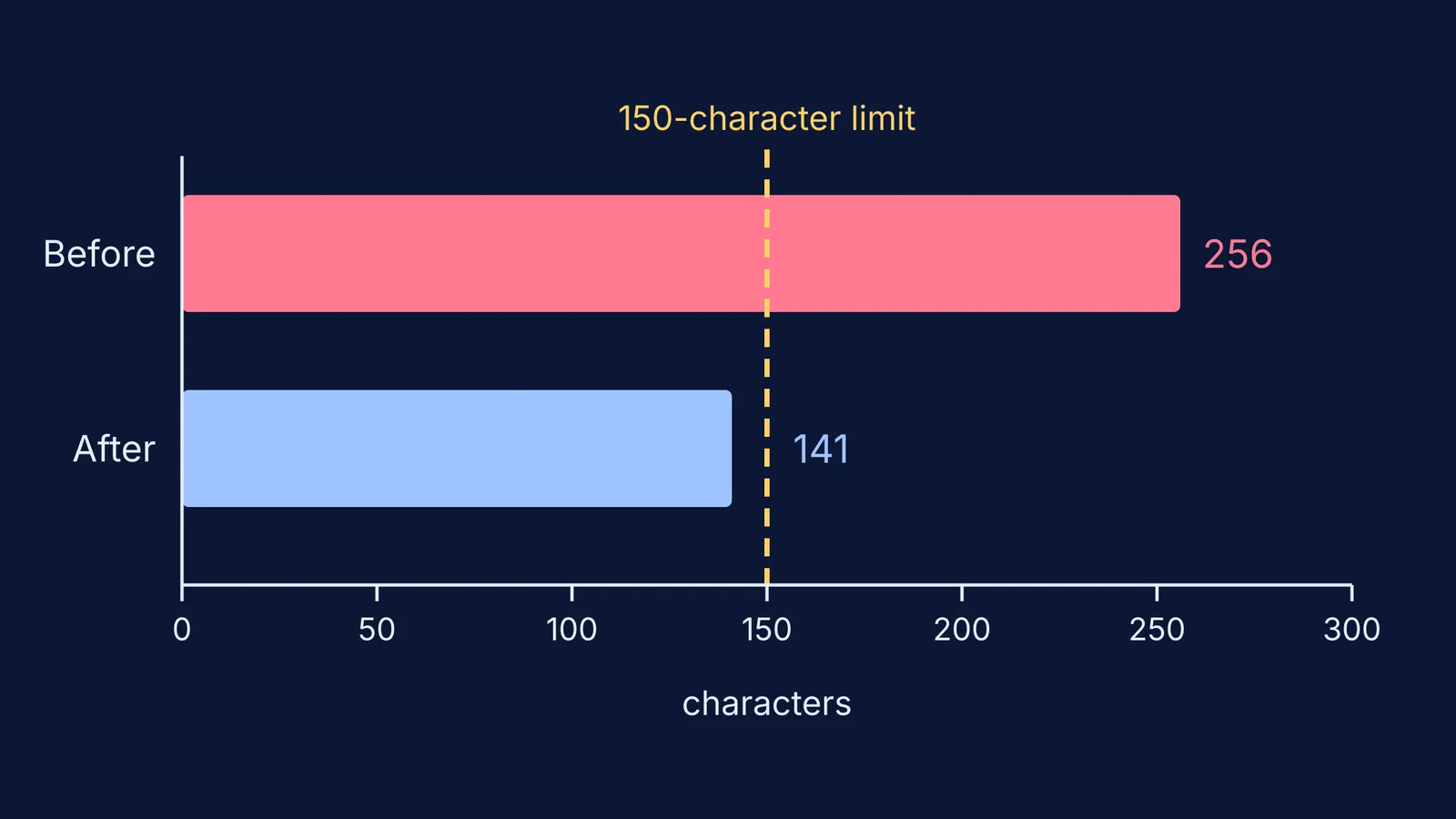
Here is an illustrative before and after for a school physics club.
Before (152 characters, over the limit): "I was part of the physics club in my school and I helped organise lots of different activities and events for the other students and the teachers there."
After (144 characters): "Started club with 3 friends, grew it to 40 members; ran 12 hands-on demos on optics and circuits; built a Rs 2,000 kit now used in Class 9 labs."
Position (35 characters): "Founder and president, Physics Club"
The second version is shorter and says far more. Two more in the same style:
Tutoring (124 characters): "Tutored 6 Class 8 students in maths every Sunday; 5 of 6 raised their school maths grade by at least one band within a year."
Family duty (140 characters): "Kept daily accounts for family grocery shop after school; moved paper ledger to a spreadsheet, cut month-end closing from 2 days to 3 hours."
Strong verbs to start with: founded, led, built, taught, organised, designed, coded, measured. Every number must be one you can explain to an interviewer; never round up to sound bigger.
How should you order your activities by significance?
Put first the activity that says the most about you. To decide without guessing, score each from 0 to 2 on four questions:
Commitment: how many hours across how many years? (0 = a few weeks, 2 = steady over two or more years)
Responsibility: what was your role? (0 = member, 1 = in charge of a part, 2 = led or founded it)
Result: what changed because of you? (0 = nothing you can point to, 2 = a number or an outcome)
Fit: does it connect to the course you are applying for? (0 = no, 2 = directly)
Add the scores, out of 8, and list from highest to lowest. For a student applying for engineering, the physics club might score 8, the family shop 6, tutoring 5 and a one-term debate team 2. Break ties with one question: which activity would you most like to be asked about? The scores are a tool for thinking, not a rule.
What if your activities are mostly academic?
Olympiads, science fairs and projects count. Describe the question you investigated, the method and the result. Our guides on supporting olympiad preparation and building a science project from a question can help you turn that work into a line with substance.
If your top entry is a physics or chemistry project, expect to explain the science in an interview. The Fermi Concept Library has a lesson for every concept in physics, chemistry, biology, mathematics and computing, so you can check the ideas behind your own project before someone asks.
A five-minute check before you submit
Each line starts with a verb, not "I" or "I was".
Each line has at least one number you can defend.
Each line ends with a result.
No line repeats hours or years.
Your highest-scoring activity is first.
A parent or teacher who knows the activity agrees every claim is accurate.
Start by writing every activity as one rough line today, then score and sort them.


