

On this page
A bottle, some sand and a cup of muddy water make a good afternoon project for a school-age child. The water that drips out looks far cleaner than what went in. The real lesson comes next: clear is not the same as safe, and your child can prove it.
How do you make a simple water filter with kids?
You need a plastic bottle, a jar it can stand in upside down, a clean cotton cloth, fine sand, coarse sand, small gravel and some muddy water from the garden.
An adult cuts the bottom off the bottle. Keep the cap off.
Stand the bottle neck-down in the jar.
Push the folded cloth into the neck so it plugs the opening.
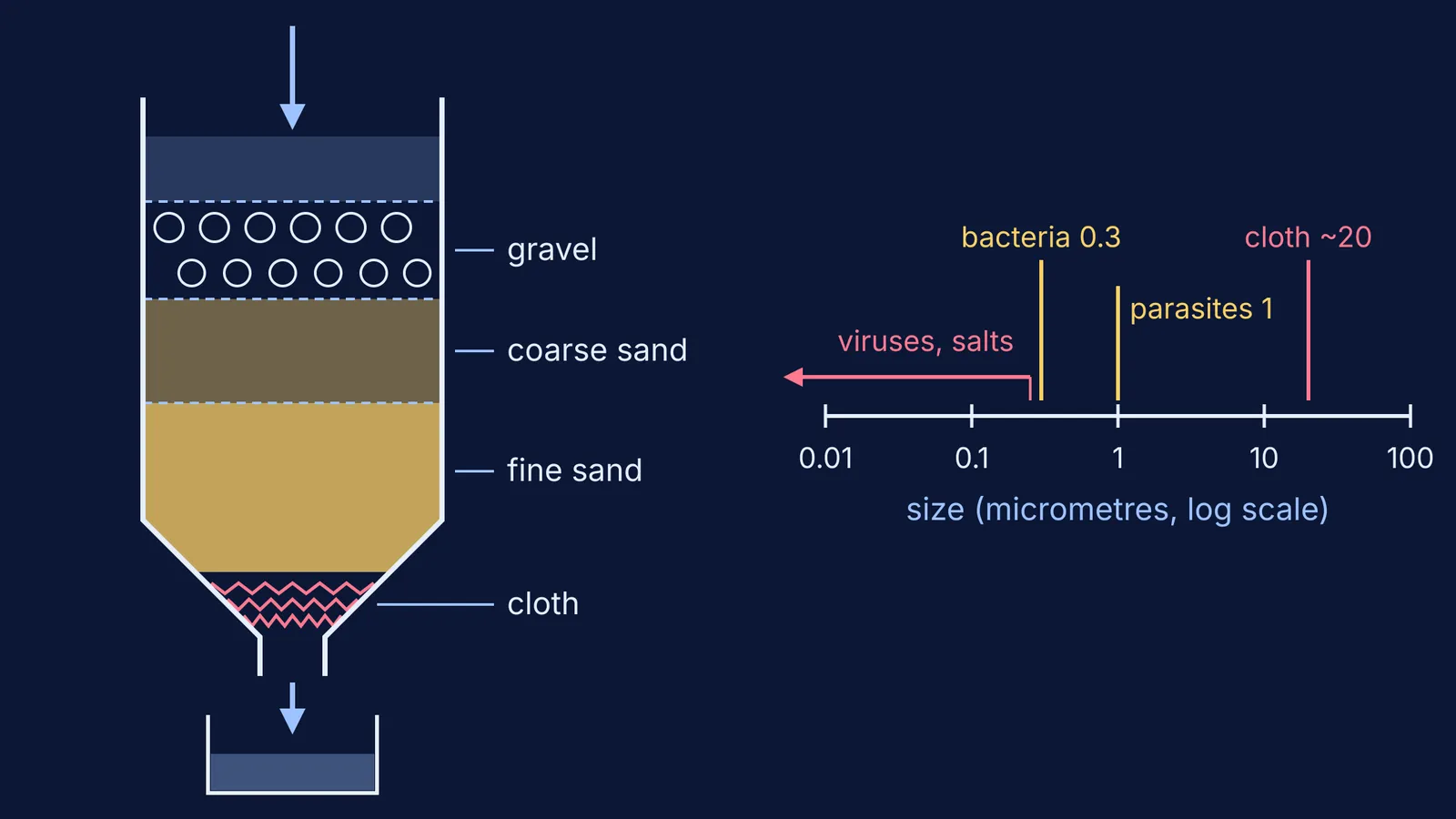
Add a layer of fine sand on the cloth, then coarse sand, then gravel on top. Rinse each layer first in a separate bowl, or the sand itself will turn the water brown.
Keep a cup of muddy water aside to compare, then pour the rest in slowly.
Before pouring, ask your child to predict which layer will catch the most dirt, and write the guess down.
What does a sand and gravel filter actually remove?
A layered filter works mostly by size. Gravel stops leaves and twigs, coarse sand catches grit, and fine sand and cloth hold back much of the silt that makes water cloudy.
Cloth on its own does more than you might expect. In a trial in rural Bangladesh from 1999 to 2002, Rita Colwell and colleagues had families filter water through old cotton sari cloth folded into eight layers. The method removed zooplankton and particles larger than 20 micrometres, including the tiny copepods that cholera bacteria live on (Colwell et al., PNAS 2003). The trial covered 65 villages and about 133,000 people, and the study reports a 48% reduction in cholera compared with control villages that did not filter (Colwell et al., PNAS 2003).
What can a homemade filter not remove?
Germs that are too small, and anything dissolved. The US CDC says a filter needs an absolute pore size of 1 micron or smaller to remove parasites, 0.3 micron or smaller to remove bacteria, and that such filters still do not remove viruses (CDC). A bottle of sand packed by hand at home has no tested pore size at all.
Dissolved substances pass straight through. CDC guidance on household water treatment says boiling, chlorine and sunlight cannot remove chemicals, and that water containing fuel or toxic chemicals will not be made safe by them (CDC). The WHO names arsenic and fluoride as natural groundwater contaminants and lead as one that can leach from pipes and fittings (WHO). None of these are visible, and sand does not stop them. Our explainers on what TDS in drinking water means and how an RO purifier pushes water through a membrane show what it takes to remove dissolved salts.
Why is filtered water still not safe to drink?
Because the dangerous things in water are mostly the ones you cannot see. The WHO estimates that at least 1.7 billion people use a drinking water source contaminated with faeces, and that contaminated water causes about 505,000 deaths from diarrhoea each year (WHO).
The CDC says boiling kills all types of germs, and advises bringing clear water to a rolling boil for 1 minute, or 3 minutes above 6,500 feet (CDC). Boiling does not remove chemicals, though (CDC).
How do you turn it into a real experiment?
Clarity test: hold the muddy cup and the filtered jar in front of a printed page. Can you read the words through each?
Order test: build a second bottle with the layers reversed. Predict which clogs faster, then time how long one full cup of muddy water takes to pass through each.
Salt test: stir a spoon of salt into a cup of clear tap water and pour it through the filter. Put a few spoonfuls of what comes out on a steel plate in the sun, with the same amount of plain tap water beside it to compare. When the salty sample dries, a white crust appears: the salt went straight through.
The salt test is the one to talk about. Here is a script you can use:
You: It looks clean now. Does that mean it is safe?
Child: Probably?
You: The salt got through and we could not see it. What else is too small to see?
Child: Germs.
You: So what would we need to do before anyone drank it?
If this leads to more questions, the Fermi Concept Library has a lesson for each concept in chemistry and biology, so your child can follow up on solutions or microbes. For a related kitchen experiment, try how alum makes muddy water clear.


