On this page
A phone leans against the water jug, a cartoon plays, and spoonfuls go in while your child stares at the screen. It works in the moment, but it teaches a toddler that eating happens to them while they watch. You can undo the habit in about four weeks without a daily battle if you go one step at a time.
Why does my toddler eat only while watching cartoons?
You are far from alone. In a study of 847 Lithuanian children aged 2 to 5, 22% were fed with a screen every day or at every meal, and another 33.7% occasionally (Jusienė et al., Medicina, 2019).
Researchers think screens work by distraction, so a child pays less attention to eating. A 2025 meta-analysis of 23 experimental studies in children and adults found that watching television alone while eating had a small effect on how much people ate, and a stronger one at the next meal (Garg, Smith and Attuquayefio, Nutrients, 2025). In a two-year Australian study of 352 children aged 6 months to 6 years, more frequent TV at mealtimes was linked to eating discretionary foods (snacks and sweets) more often two years later (Litterbach et al., Nutrients, 2022). These are links and short-term effects, not proof that one cartoon at dinner harms your child.
Then there is the daily screen budget. The World Health Organization advises no sedentary screen time for 1-year-olds and no more than 1 hour a day for 2- to 4-year-olds, with less being better (WHO, 2019). The Indian Academy of Pediatrics recommends no screens before age 2 and at most 1 hour of supervised screen time a day from 2 to 5 years (IAP guidelines, Indian Pediatrics, 2022). Three cartoon meals can use all of it.
How do I stop screen time during meals, step by step?
Stopping all at once often ends in tears, and giving in on day two teaches that crying brings the phone back. A slow step-down is easier to keep:
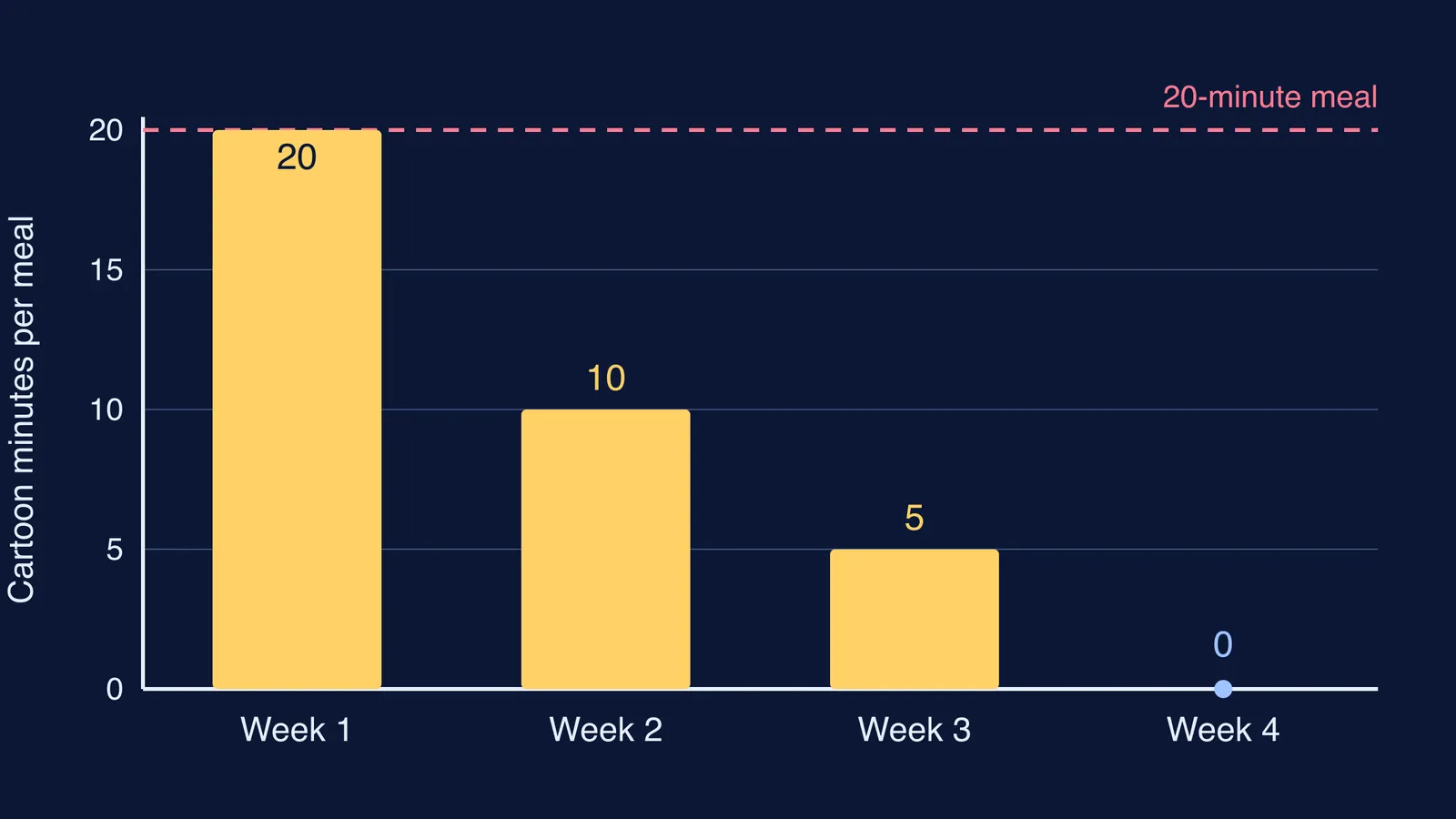
Week 1: Choose the meal when your child is hungriest (often breakfast) and make it screen-free. Leave the other meals as they are, but end each one at about 20 minutes.
Week 2: At the other meals, play the cartoon for the first 10 minutes only, then switch it off and keep eating together.
Week 3: Cut it to the first 5 minutes, or turn the sound off and the screen away.
Week 4: No screen at any meal. If your child gets screen time, give it at a different time of day, never as a reward for finishing food.
Before each meal, say the plan once: "Today the cartoon is only for the start. Then it's our talking time." If there is a meltdown, stay calm at the table and end the meal at the usual time.
What should I talk about at the table instead?
Without the screen, you fill the quiet. The American Academy of Pediatrics' parent site advises family meals with no TV or phones (HealthyChildren.org). The NHS suggests making mealtimes enjoyable by sitting down and chatting about other things too (NHS). Naming the food is the easiest place to start, because it needs no planning:
Name it: "This is dal. This is a piece of roti."
Describe it: "The cucumber is cold and crunchy. The rice is soft."
Use the senses: "Smell the jeera. Can you hear the papad crunch?"
Offer a small choice: "Roti first or rice first?"
Talk about other things: the crow on the balcony.
Keep talk free of pressure ("one more bite for Mama"). The same HealthyChildren.org tips advise against bribing with treats and note that a toddler may need 10 or more tastes before accepting a food, so a calm meal counts even if the brinjal stays on the plate. For more naming games, see building your toddler's language through everyday stories.
How long should a toddler's meal take?
Not long. Boys Town National Research Hospital advises limiting a child's eating time to 20 minutes, because a child who is going to eat will usually do it in the first 20 minutes (Boys Town).
In practice: set a kitchen timer for 20 minutes and serve dal, rice and a few cucumber slices. When it rings, say "Dinner is finished" and clear the plate calmly, however much is left, with nothing extra until the next planned snack. Snacks at fixed times, not all day, bring your child to the table hungry, which does more than any cartoon.
For the rest of the day, try these ideas for keeping your toddler busy without a phone in the morning. And when table questions grow into "why does the roti puff up?", the Fermi Concept Library has a lesson on every concept in physics, chemistry, biology, mathematics and computing, so an older sibling can look up the answer with you.