

On this page
You do not need a shelf of picture books to grow a toddler's language. The research points to something closer to hand: talk that goes back and forth, about things your child has seen and done. A trip to the sabzi market or a wedding album on the sofa can become a story your child helps tell.
Why does back-and-forth talk matter more than the number of words?
In a 2018 study in Psychological Science, Rachel Romeo and colleagues recorded the home language of 36 children aged 4 to 6. Children who had more conversational turns with adults showed greater activity in Broca's area, a language region of the brain, while listening to a story. That link held independently of socioeconomic status, IQ, and the sheer number of adult-child utterances.
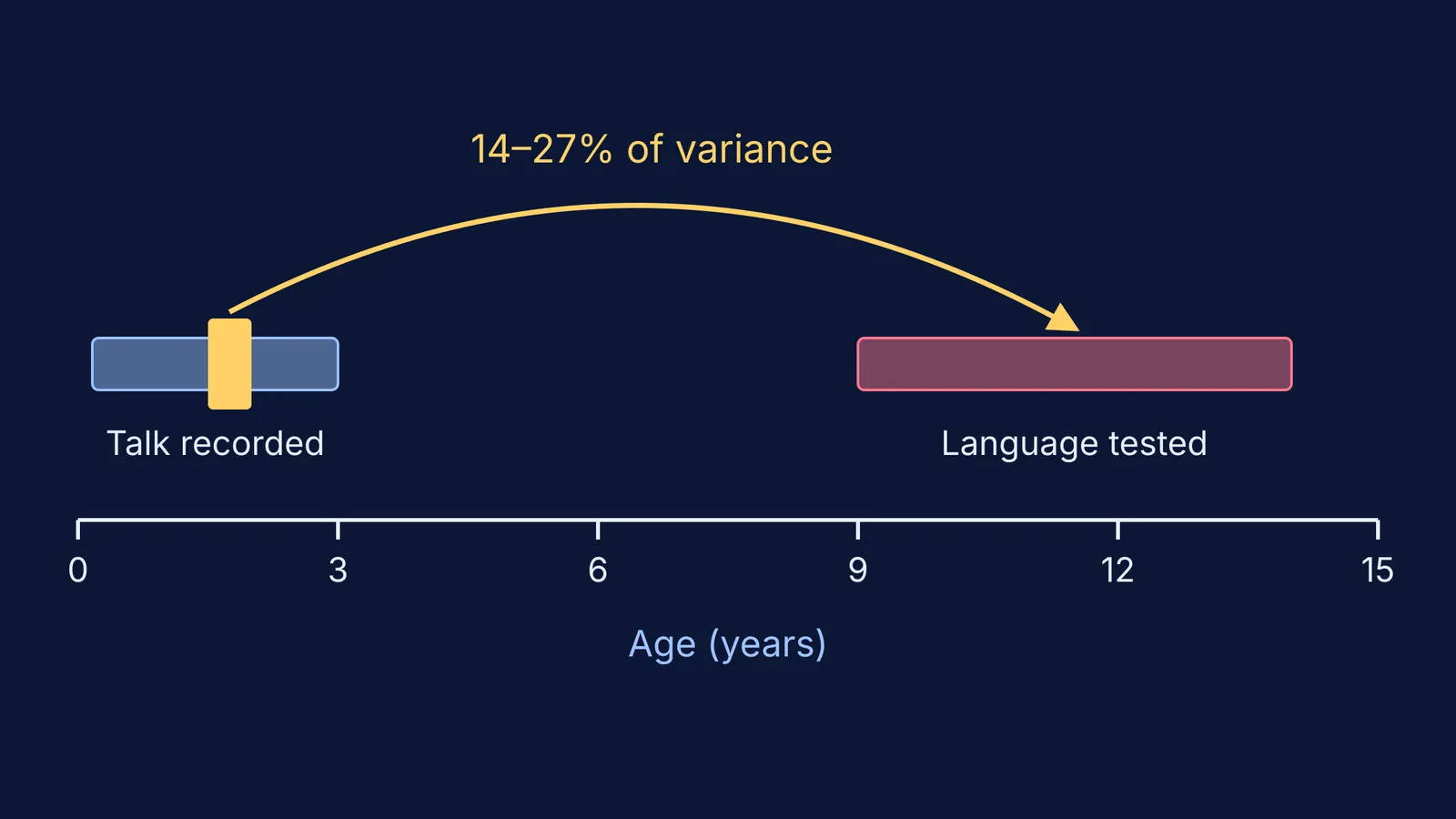
In a 2018 paper in Pediatrics, Jill Gilkerson's team made daylong audio recordings of 146 infants and toddlers and tested them again at 9 to 14 years. Conversational turns at 18 to 24 months accounted for 14% to 27% of the variance in IQ, verbal comprehension and vocabulary scores about ten years later, after controlling for socioeconomic status. This is a correlation, not proof that talk alone caused the difference.
The World Health Organization's guideline on early childhood development recommends that all children have early learning activities with their parents and caregivers in the first 3 years of life. Its glossary counts talking and pointing as stimulation, with or without objects.
How do you tell a story from daily life to a toddler?
Start with something that happened today, keep it short, and leave gaps for your child to fill. Researchers call the habit of adding detail and inviting the child to add more "elaborative reminiscing". In a study in Child Development, Elaine Reese and Rhiannon Newcombe trained mothers in this style when their children were 1.5 to 2.5 years old. At follow-ups at 2.5 and 3.5 years, their children gave richer accounts of past events than children of untrained mothers.
Here is what a market story might sound like:
You: "This morning we went to the sabzi market. Who did we see there?"
Child: "Uncle."
You: "Yes, the tomato uncle with the big basket. What did he give you?"
Child: "Tomato!"
You: "A round, red tomato. Then what happened? Did we walk home or take an auto?"
You set the scene, ask, then repeat your child's word and add one or two new ones (round, red, basket). Bilingual families can tell the story in either language; see why children mix languages and how to support them.
What is a picture walk, and how do you do one without a book?
A picture walk means looking at pictures together and talking about them, with your child doing more of the talking over time. In a 1988 study in Developmental Psychology, G. J. Whitehurst and colleagues ran a one-month home programme that changed how parents read picture books with young children. Children in the programme scored higher on expressive language, used longer utterances and relied less on single words than children in the control group.
You can try the same habits with any picture: the family photo album, a calendar, a biscuit packet or shop signboards:
Point and wait. Let your child name what they see first.
Repeat and stretch: "Dadi. Dadi is wearing a green saree."
Ask one open question: "What is she doing?"
Link it to your child's life: "Where did we go with Dadi?"
Stop while your child is still interested.
Which question prompts grow vocabulary at each stage?
Match the question to what your child can do, then nudge one step up:
Just starting to talk: "Where is the cow?" (your child points), then name it together.
Using single words: "What is this?" and "What colour is it?"
Joining two or three words: "What happened next?" and "Who else was there?"
Speaking in sentences: "Why do you think the dog ran?" and "How did you feel?"
For more ideas, see how to build your child's vocabulary at home.
What does a 10-minute daily storytelling plan look like?
Morning, 2 minutes: narrate getting ready and ask one choice question ("Red shirt or blue shirt?").
Outing, 3 minutes: name five things you pass and ask your child to spot one more.
Mealtime, 2 minutes: tell the story of where the food came from.
Bedtime, 3 minutes: retell the day together, with your child filling the gaps.
If mornings are the hardest part, our guide to keeping a toddler busy without a phone in the morning has more screen-free ideas.
For older students, Fermi's AI tutor also teaches through back-and-forth: it decides whether to explain, ask or show, and checks understanding as it goes. For now, start with tonight's story of your day.


