

On this page
When your teenager asks to study at a classmate's home, the request often triggers immediate parental tension. Parents worry that "studying" will dissolve into video games, social media, and endless snacking, leaving homework untouched. Teens, meanwhile, crave autonomy and the genuine motivation that comes from solving tough problems alongside their friends. Knowing whether to say yes comes down to distinguishing between structured collaborative learning and unstructured social hangouts.
Does studying with friends actually improve marks?
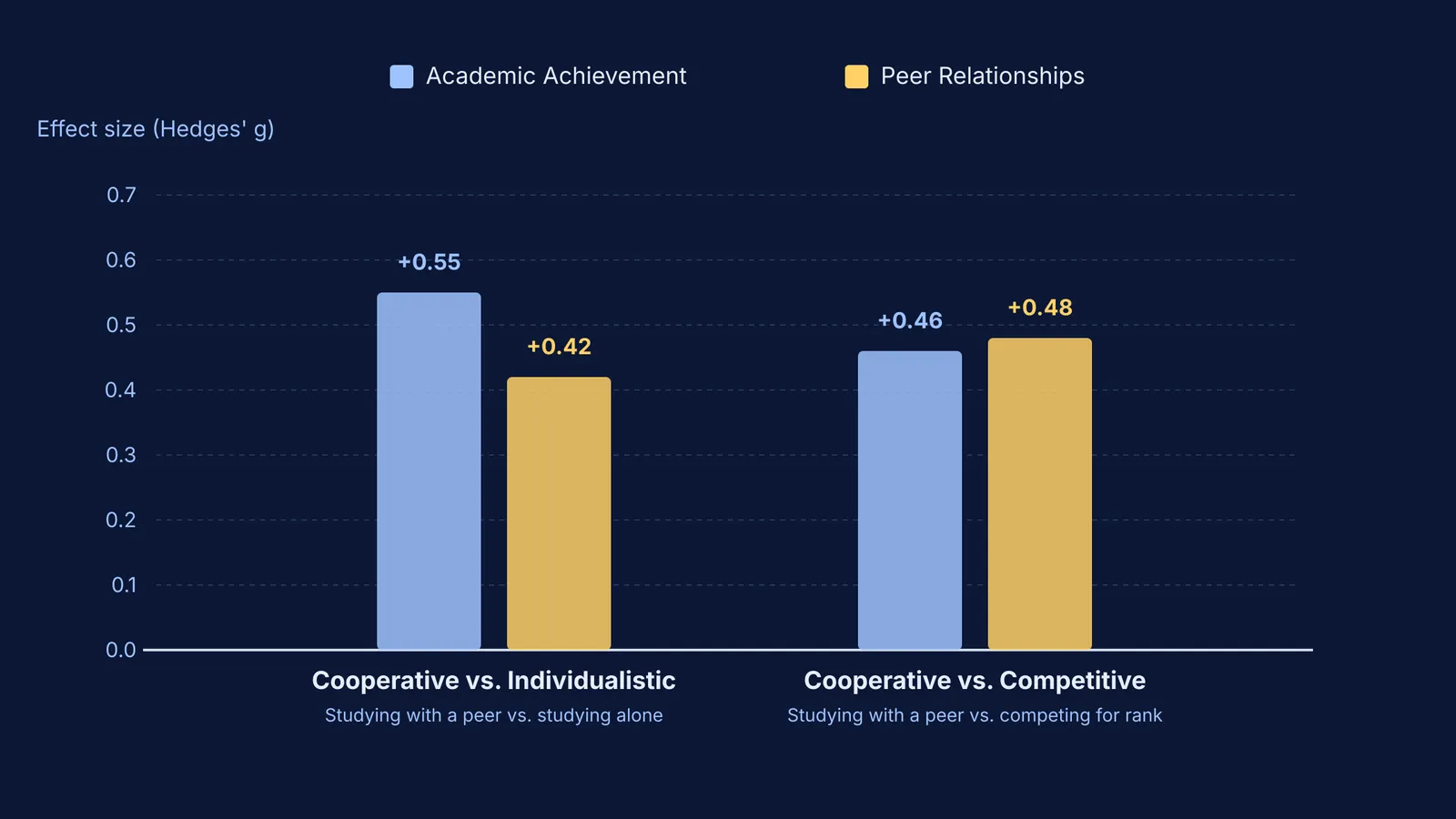
Decades of cognitive science confirm that learning with a peer can be remarkably effective. A landmark meta-analysis of 148 independent studies by Roseth, Johnson, and Johnson (2008) examined more than 17,000 early adolescents aged 12 to 15 across 11 countries. The researchers found that cooperative goal structures produced an academic achievement effect size of d = 0.55 compared to individualistic learning and d = 0.46 compared to competitive learning. Furthermore, cooperative study improved peer relationship quality by effect sizes of d = 0.42 compared to individualistic learning and d = 0.48 compared to competitive learning, with a positive correlation of r = 0.51 between peer relationships and academic achievement.
Collaborative study works primarily through what cognitive psychologists term generative learning. Laboratory experiments by Fiorella and Mayer (2013) demonstrated that students who actively taught and explained concepts to a peer retained significantly more material on a one-week delayed comprehension test than students who only studied alone or expected a test without teaching. Explaining a derivation, balancing a chemical equation, or resolving a difficult geometry problem forces a student to organize concepts into a coherent mental framework.
When does studying at a friend's place backfire?
Peer study fails when there is no structure or individual accountability. In an influential review of cooperative learning research, Slavin (1996) showed that group study fails to raise academic achievement unless it includes two non-negotiable elements: shared group goals and individual accountability. Without individual accountability, group study quickly degenerates into "social loafing" or "dilution," where one student solves the questions while the other copies or drifts into conversation.
Studying at a friend's house also backfires when students lack a dedicated, distraction-free environment. Just as setting up a quiet study space at home is critical for focus, studying at a friend's dining table with televisions running and phones constantly buzzing invites cognitive overload. When students hit an intellectual roadblock where neither understands the method, an unstructured session easily stalls. For challenging STEM topics, students can turn to the Fermi Problem Library for worked problems with a step-by-step solver that explains the reasoning rather than printing an answer, or let Fermi's AI tutor work out what they already know and build a plan for the session.
How should parents agree on check-ins without hovering?
Parental anxiety often leads to micromanagement—calling every thirty minutes or texting demanding questions. Developmental psychology shows that excessive surveillance harms both trust and safety. A seminal study of 703 adolescents aged 14 by Stattin and Kerr (2000) revealed that parental knowledge about a teen's activities comes primarily from spontaneous adolescent disclosure, not from parental tracking, snooping, or persistent interrogation. Excessive interrogation tends to suppress voluntary communication.
Parents succeed when they adopt autonomy-supportive parenting practices that establish predictable boundaries while honouring independence. Instead of unscheduled check-in calls, agree on a simple, predictable communication protocol. This approach allows staying involved during high school without hovering over their afternoon.
A reliable script before they leave might sound like this:
"I am glad you and Rohan are working through the physics problem set together. Let's agree that you will send me a quick text when you arrive at 3:00 PM, and a brief check-in at 5:00 PM when you take a tea break. Before you leave at 6:30 PM, show me the completed exercise set. If you finish your target early, call me so we can plan your pickup."
What should parents and teens agree on before leaving?
Before saying yes to an afternoon of studying elsewhere, run through this practical pre-departure checklist with your teenager:
A defined topic and tangible outcome: Agree on an exact deliverable, such as completing 15 numerical problems from Chapter 4 or drafting a Class 12 lab practical summary, rather than a vague intention to "study chemistry."
Dedicated physical workspace: Confirm where they will sit. A desk or clear table in a quiet room works; sitting side by side on a bed with laptops on their laps invites distraction.
Agreed device boundaries: Agree on phone rules during problem-solving blocks. Putting notifications on silent during active 45-minute study intervals prevents group drift.
Pre-set check-in points: Agree on arrival, midway break, and departure times so neither party feels anxious or scrutinized.
When families agree on clear outcomes and predictable check-ins, studying at a friend's place fosters both rigorous academic mastery and healthy peer collaboration.


