On this page
Most families meet this question the week a friend's child turns up on a scooter. The law's answer is stricter than many parents expect.
When can my teenager get a driving licence in India?
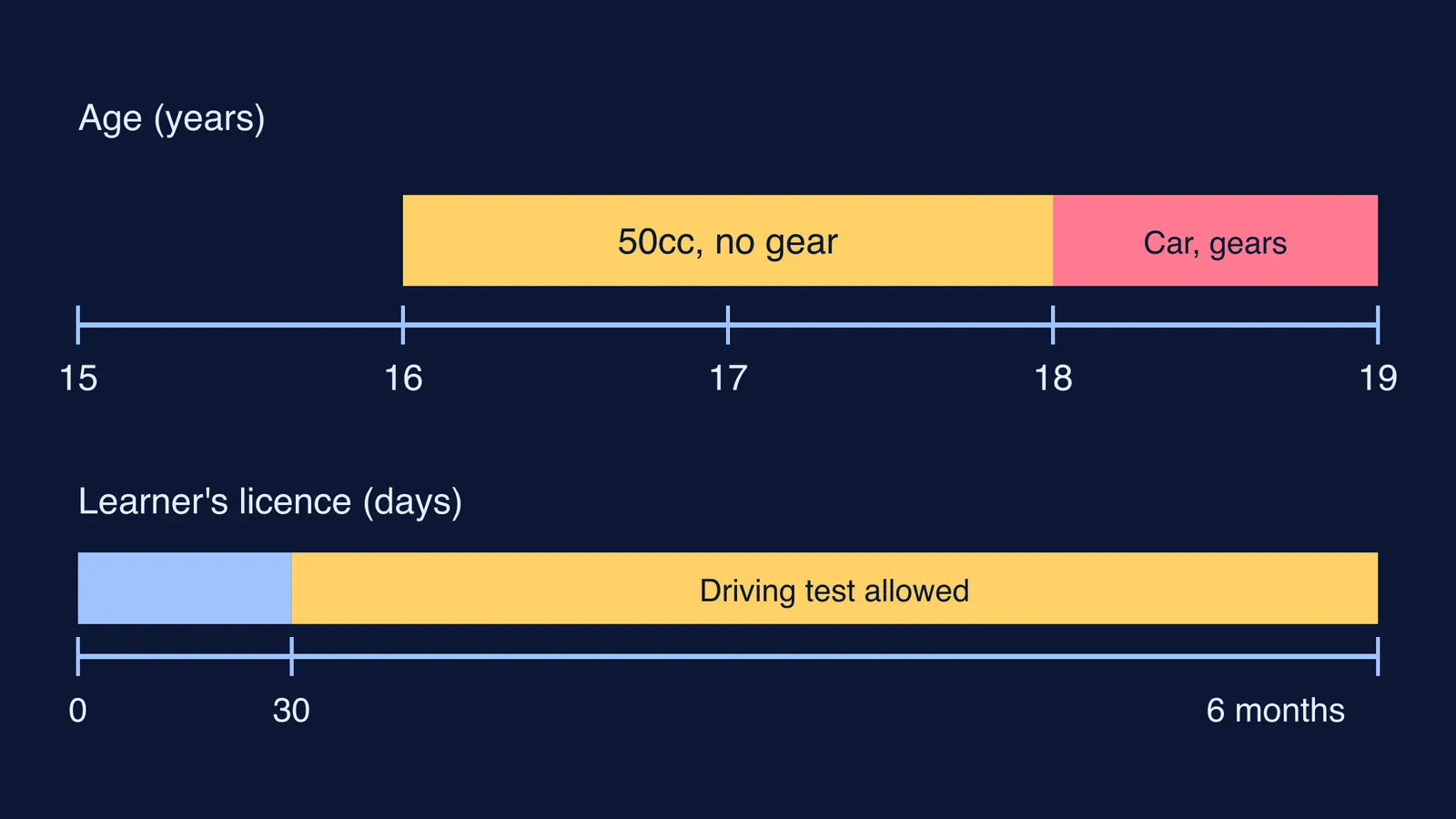
There are two ages to remember. The Delhi Transport Department states that a person who has completed 16 years may get a licence for a motor cycle without gear whose engine capacity does not exceed 50cc, with the consent of a parent or guardian, and that driving a motor vehicle other than a transport vehicle, such as a car, needs the person to have completed 18 years.
This comes from Section 4 of the Motor Vehicles Act, 1988, which says no one under 18 may drive a motor vehicle in a public place, with a motorcycle of 50cc or less as the only exception from 16.
At 16: a gearless two-wheeler of 50cc or less, with a parent's consent.
At 18: cars, geared motorcycles and any two-wheeler above 50cc.
Can a 16-year-old ride a normal scooter?
Only if its engine is 50cc or less. "Gearless" alone is not enough: the limit in Section 4 of the Act is engine capacity. Before you say yes, check the cubic capacity on the vehicle's registration certificate. If it is above 50cc, your 16-year-old cannot legally ride it on a public road.
How does the learner's licence work?
Every licence starts with a learner's licence. Here is the order the Puducherry Transport Department describes:
Apply for a learner's licence for the right vehicle class, online through your state's transport portal or at the licensing office.
If your child is between 16 and 18, you sign your consent in Form 2 before the licensing authority.
Your child takes a short objective test. In Puducherry it has 10 questions, with 6 correct needed to pass; other states may set it differently.
After 30 days with the learner's licence, they can apply for the permanent driving licence and its test.
A learner's licence is temporary and valid for 6 months from the date of issue, according to the Delhi Transport Department. While learning, the vehicle must show the letter "L" in red on a white background at the front and the rear.
What happens if a minor is caught driving?
The 2019 changes to the Act made parents answerable. The government's summary table of the Motor Vehicles (Amendment) Act, 2019 lists the punishment for offences by juveniles: a fine of Rs 25,000, imprisonment of up to 3 years, cancellation of the vehicle's registration for 12 months, and the young driver becoming ineligible for a learner's licence until the age of 25.
Under Section 199A, the guardian or the vehicle's owner is deemed guilty unless they show the offence happened without their knowledge or that they tried to prevent it. It does not apply when the teen held a learner's or driving licence and was driving a vehicle that licence covered.
The law is about more than fines. Road traffic injuries are the leading cause of death for children and young adults aged 5 to 29, according to the WHO road traffic injuries fact sheet. The same fact sheet says correct helmet use can reduce the risk of death in a crash by more than 6 times, and drivers using mobile phones are about 4 times more likely to crash.
A family driving agreement you can sign together
A licence says your teen may drive. A family agreement says how. Write it on one page, both sign it, and review it after the first month.
Vehicle: only the vehicle the licence covers. For a 16-year-old, a gearless two-wheeler of 50cc or less, and nothing borrowed from friends.
Helmet: a fastened helmet on every ride, for the rider and any passenger.
Phone: in the bag, not the hand. Maps are set before starting; calls wait until parked.
Passengers: none at first; add them only when you both agree.
Routes and hours: known routes such as school, coaching and tuition first; no riding after dark until you both agree it is time.
Learner rules: L plates on, and a licensed adult with them when the vehicle class needs it.
If something goes wrong: call home first. No punishment for calling.
Review date: sit down again after the first month and widen the rules if they have been kept.
If your teen pushes back, try this: "I'm not saying no. I'm saying the law sets the vehicle and we set the habits. Keep these for a month and we'll widen them together."
The same staged approach works for other firsts, such as teaching your teen to use the metro and bus alone or a safety plan for a trip with friends.
If your teen is curious about the physics of the road, start with why friction pushes a vehicle forward. The Fermi Simulation Lab has interactive simulations for ideas that are easier to see than read.
Your next step: check your state's learner's licence page tonight, then write the agreement before the first ride.