

On this page
A college fest, a hackathon and a science exhibition all ask the same thing of your teen: build or explain something real against a clock. In the research so far, two things you can check in advance went with a better experience: whether your child chose to go, and whether a knowledgeable adult helped them.
What does a teenager gain from science fests and hackathons?
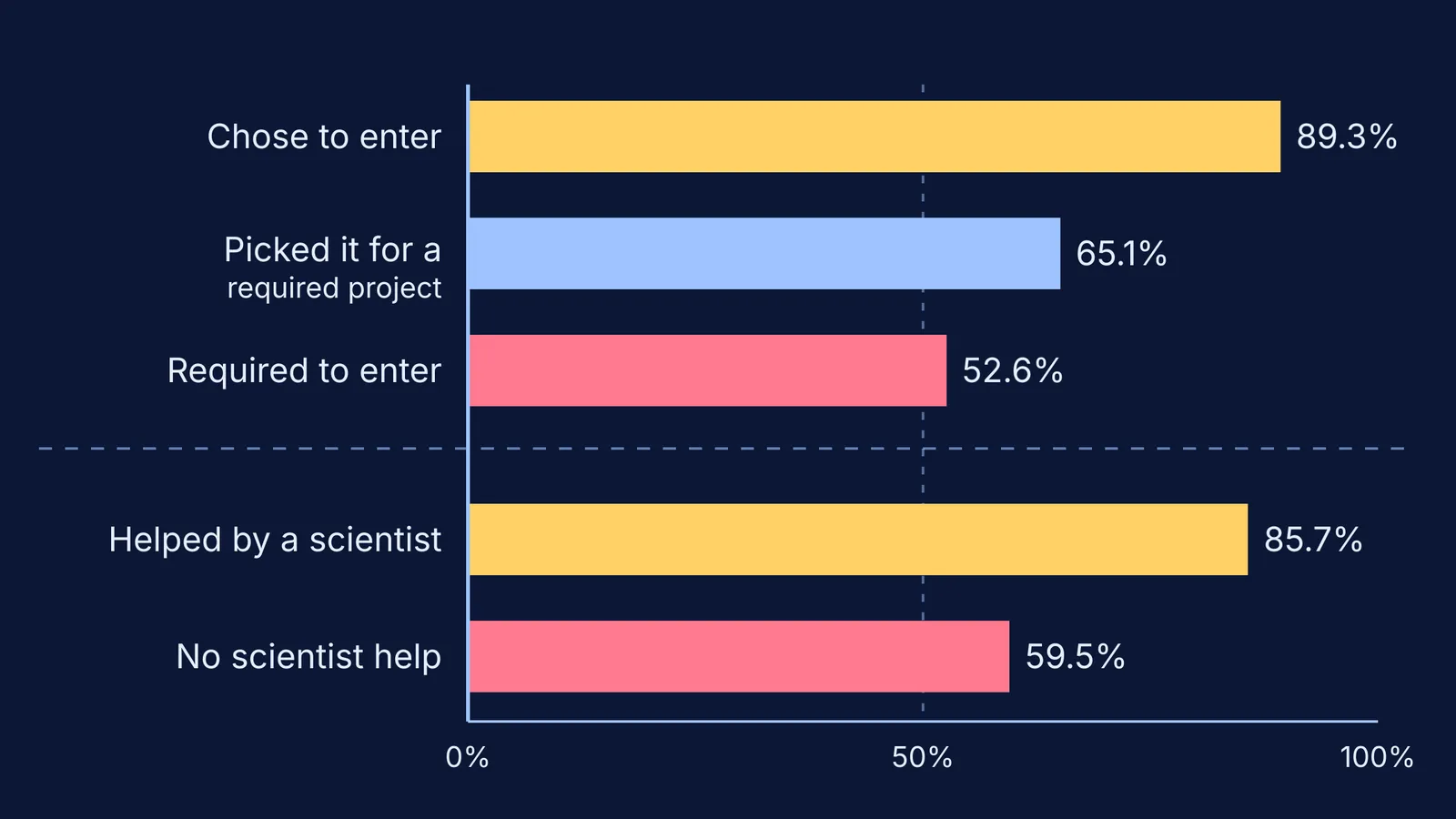
The clearest evidence comes from science fairs. In a 2025 PLOS ONE study by Frederick Grinnell, Simon Dalley and Joan Reisch, 1,191 US high school students explained in their own words why a science and engineering fair did or did not raise their interest in science. The reasons given most often were learning new things, the experience of doing research, enjoying it, and help with a career choice. Students coached or helped by scientists made the most positive comments; students whose only fair was at school level made the most negative ones.
A hackathon is an event where small teams build a working answer to a set challenge in a fixed, short time. In a 2025 study of six youth hackathons in the European Journal of Education, Maciej Rys reported gains in problem-solving and in technical and soft skills, and recommended suitable mentorship and attention to participants' well-being. An earlier survey of 398 hackathon participants by Rys and colleagues found that more hackathon experience went with higher confidence and lower anxiety, and that taking part out of real interest went with less anxiety.
None of these studies shows that a fest raises marks. Treat it as a way to find out whether your teen enjoys building things, not as exam preparation.
Does it matter whether your teen chooses to go?
It appears to. In the 2025 study, 89.3% of students who entered by choice made positive comments, compared with 52.6% of those who were required to take part (Grinnell and colleagues, PLOS ONE). An earlier 2020 study of 363 students found that, in the worst case, about 10% of students who were required to take part and had no interest in a science career engaged in research misconduct, such as plagiarism or making up results.
How do you judge whether an event is worth it?
India's national school science exhibition gives a useful yardstick. The NCERT guidelines for the Rashtriya Bal Vaigyanik Pradarshani 2026 say the tendency to buy ready-made exhibits "must be ruled out", and weight judging as originality and innovation 25%, scientific thought 20%, utility and scalability 20%, low cost and portability 15%, and the write-up 20%. The government's INSPIRE-MANAK scheme takes ideas from students in Classes 6 to 12, and a school can nominate at most two ideas from Class 11 or 12 science students.
Before paying a fee, check:
Mentors: will scientists, engineers or college students sit with teams, or only judge at the end?
Making, not buying: does the event want work your teen did themselves?
Judging criteria: can you read them before you register?
Fee and certificate: if the main thing on sale is a certificate, skip it.
Safety: for overnight or out-of-town hackathons, who is the named adult contact, and how will your teen get home?
How can a Class 11 student fit one in?
Class 11 brings a new syllabus, often alongside JEE or NEET-UG coaching, and its marks can matter for college (see our guide to what Class 11 marks mean for college). One event a term is plenty. Here is a worked plan for a two-day college tech fest:
Three weeks before, check the school and coaching test calendars. If the fest clashes with a test, use our guide to choosing between an exam and a competition.
The week before, finish that week's homework and one revision block early.
At the fest, attend one workshop and one competition, and spend an hour talking to the teams presenting.
The day after, rest and catch up on anything missed.
Within a week, write five lines: what you built or saw, what went wrong, and which physics, chemistry or maths idea you needed.
If a generator or circuit made sense at the stall but not on paper, the Fermi Simulation Lab has interactive simulations for ideas that are easier to see than to read, and the Fermi Concept Library gives each concept its own lesson.
What can a parent say?
Try: "This hackathon looks interesting. Do you want to go? If you do, let's look at your test dates together and work out what you'll finish beforehand." If the answer is no, accept it and ask again next term. Afterwards, ask "What surprised you?" rather than "Did you win?"
If a longer holiday programme seems a better fit, our guide to choosing a science summer camp uses many of the same questions.


