

On this page
When an important school assessment lands on the exact weekend of a state athletics meet, an international debate championship, or a national science olympiad, the immediate household reaction is often panic. Parents worry that missing an exam will ruin a grade card or compromise attendance records, while the student feels devastated at the prospect of forfeiting months of dedicated training.
Choosing between an exam and a competition does not have to be an all-or-nothing crisis. By understanding institutional guidelines, evaluating the true stakes of the event, and engaging the school proactively, families can often negotiate alternatives or make clear-headed decisions.
Does a school exam always take priority over a competition?
In many traditional classrooms, the default assumption is that academic tests strictly override outside activities. However, developmental research indicates that active involvement in structured competitions builds resilience, executive functioning, and long-term academic drive.
In a study of 13,130 high school students published in the *Journal of Youth and Adolescence*, researcher Jennifer A. Fredricks evaluated the over-scheduling hypothesis to test whether extracurricular demands hurt schooling. The study found that students engaged in an average of 2 to 3 extracurricular activities for 5 hours per week, with only 3% to 6% of students exceeding 20 hours per week.
Academic adjustment peaked between 5 and 10 hours per week. While the threshold for diminishing returns appeared around 14 to 17 hours per week, students at the highest participation levels still achieved better academic outcomes than peers with 0 hours of activity. For families weighing outside interests against marks, our guide on extracurricular activities and marks explores this dynamic in depth.
When an activity represents a core pursuit where a child has qualified through rigorous regional stages, giving it up can stifle enthusiasm. Unless the clashing exam carries irreversible consequences, an outside competition often deserves serious consideration.
What do official board rules allow when dates clash?
Many parents assume that missing an exam leads to an automatic zero. In reality, examination boards and school administration frameworks frequently contain specific accommodations for high-level events.
According to policy circulars from the Central Board of Secondary Education, formal mechanisms exist to protect students participating in recognized competitions:
Class 10 Board examinations: Under the two-board system introduced for 2026, students whose participation in recognized national or international events clashes with the first examination cycle in February are permitted to sit for those subjects during the second cycle in May.
Class 12 Board examinations: CBSE conducts special re-examinations for theory papers, typically scheduled within 15 days following the conclusion of the main board examinations.
Qualifying criteria: For board-level rescheduling, sports meets must be recognized by the Sports Authority of India (SAI) or the Board of Control for Cricket in India (BCCI), while science competitions must be international olympiads administered through the Homi Bhabha Centre for Science Education (HBCSE).
Internal school assessments: Schools possess direct discretion to reschedule internal unit tests, term exams, and practicals locally, updating the portal status to "re-scheduled" rather than "absent".
Attendance safeguards: Under CBSE Examination Bye-Laws Rule 13 and Rule 14, students must maintain 75% attendance, but the board allows a condonation of up to 15% (permitting a 60% minimum threshold) for authorized sports representation, with travel and competition days credited as attendance.
If your child is preparing for major competitive academic stages, our guide on supporting your child's olympiad preparation details how to balance high-level contests with day-to-day school commitments.
How do you decide what to choose? A 3-step framework
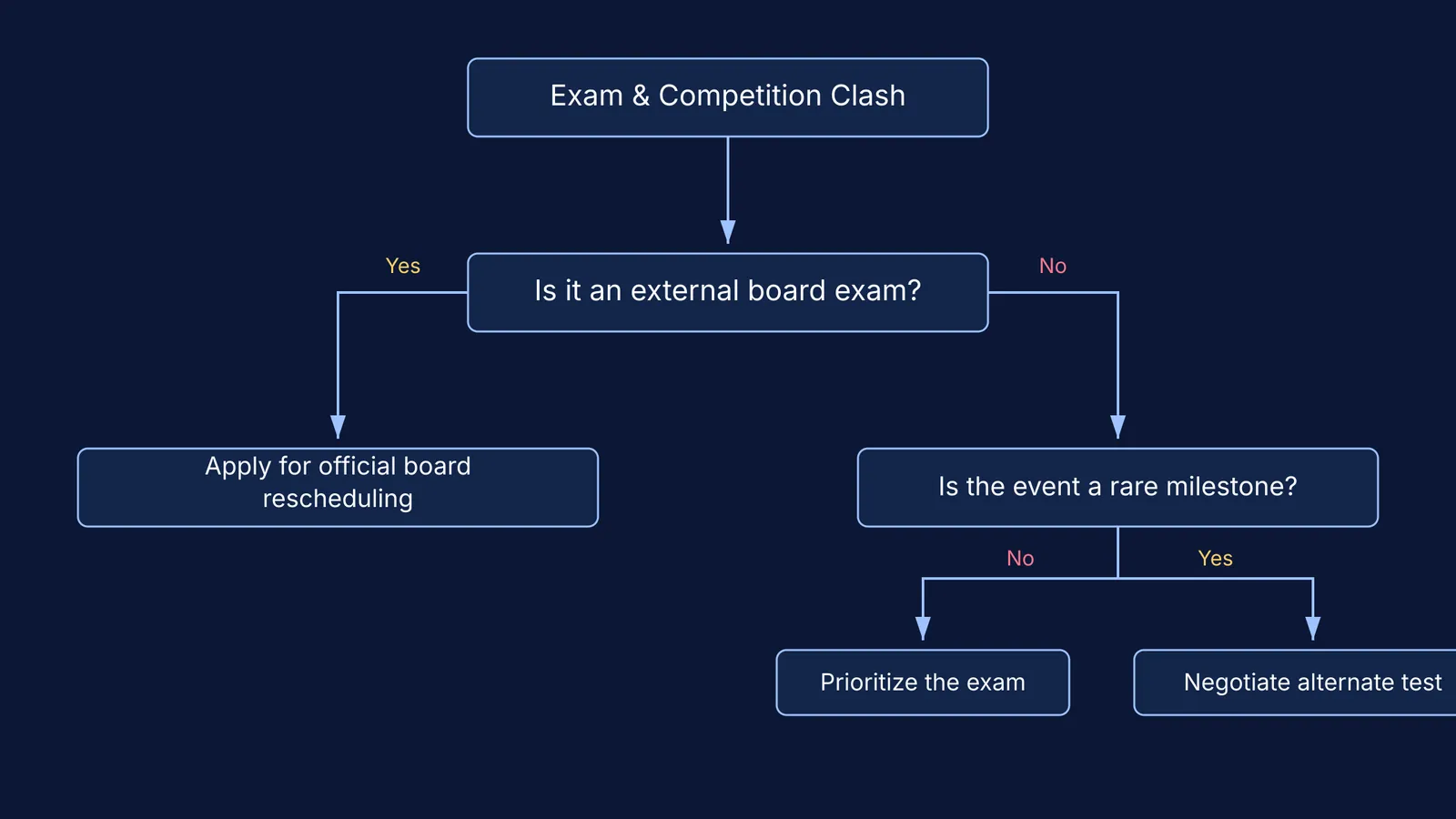
When the conflict involves a local assessment or an event not covered by national board circulars, families can resolve the dilemma with a simple three-step evaluation:
Assess exam irreversibility: Is this an external board exam, a critical promotion hurdle (such as Class 9 or 11 finals), or a periodic unit test? Unit tests and formative assessments carry lower weightage, and schools frequently calculate scores from best-of-two rounds or average term marks.
Assess event uniqueness: Is this competition a once-a-year championship that the student earned through prior qualifying rounds, or is it a recurring monthly inter-school meet? Irreplaceable milestones warrant advocating for flexibility.
Confirm rescheduling options: Approach the subject teacher or academic coordinator immediately. Ask whether the student can sit for an alternate question paper before departure, complete the test immediately upon return, or receive a pro-rata score based on their semester average.
What should you write to the school principal? A practical script
Schools are far more cooperative when parents communicate early, present verified documentation, and demonstrate academic responsibility. A constructive email template can be adapted as follows:
"Dear Principal [Surname],
I am writing regarding my child, [Student Name], of Class [Grade and Section]. [Student Name] has been selected to represent [School/Region/State] at the [Name of Competition], held in [City] from [Start Date] to [End Date].
This travel schedule coincides with the [Subject] examination scheduled for [Exam Date]. We deeply value [Student's] academic standing and request permission to appear for a re-test or an alternate assessment paper at your convenience, either prior to travel or immediately upon return.
Attached please find the official invitation letter and qualification certificate from the organizing body. [Student Name] has collected the syllabus outline from their teachers and will complete all assigned homework during travel downtime.
Thank you for supporting our students in pursuing excellence both inside and outside the classroom."
Open discussions during regular parent-teacher meeting discussions can also help establish mutual expectations before crunch periods occur.
How can a student catch up on academics after the competition?
Returning from an intense tournament or hackathon requires a structured transition back into classroom routines. Competing students often face fatigue alongside a small backlog of unread chapters.
When a student returns from a competition trip and needs to catch up on missed lessons quickly, Fermi's AI tutor can work out what they already know and build a plan for the session. For independent revision on missed topics, students can turn to the Fermi Concept Library, which covers every concept in physics, chemistry, biology, mathematics and computing. A focused two-day catch-up schedule prevents temporary absences from becoming chronic learning gaps.


