

On this page
If every small request ("put the phone away", "start your physics") turns into a debate, you are not alone, and it does not mean the relationship is failing.
Why does my teenager argue about everything?
A meta-analysis by Brett Laursen, Katherine Coy and W. Andrew Collins found that the rate of conflict falls from early to mid-adolescence and again into late adolescence (Child Development, 1998). The same analysis found that conflict affect, meaning how angry or upset the arguments feel, rises from early to mid-adolescence. So at 14 or 15 you may not be arguing more than before, but each argument may feel hotter.
What are the fights about? In a study of 68 sixth, eighth and tenth graders and their parents, Judith Smetana and Pamela Asquith asked both sides who should decide on 24 hypothetical everyday issues (Child Development, 1994). Teens and parents agreed that parents should keep authority over moral issues and social conventions. They disagreed about personal and "mixed" issues: parents saw these as more open to parental authority than teens did, while teens saw them as their own business, and teens claimed more personal choice as they got older. Mixed issues, which have both a rule side and a personal side, came up most often, though moral and conventional conflicts were the most intense.
In plain terms: your teen is not arguing that rules do not matter. They are arguing about where the line between your decisions and theirs now sits.
Laurence Steinberg, reviewing 25 years of research on adolescents and families, concluded that teens benefit from parents who are warm, firm, and accepting of their need for psychological autonomy (Journal of Research on Adolescence, 2001).
Which battles should parents drop?
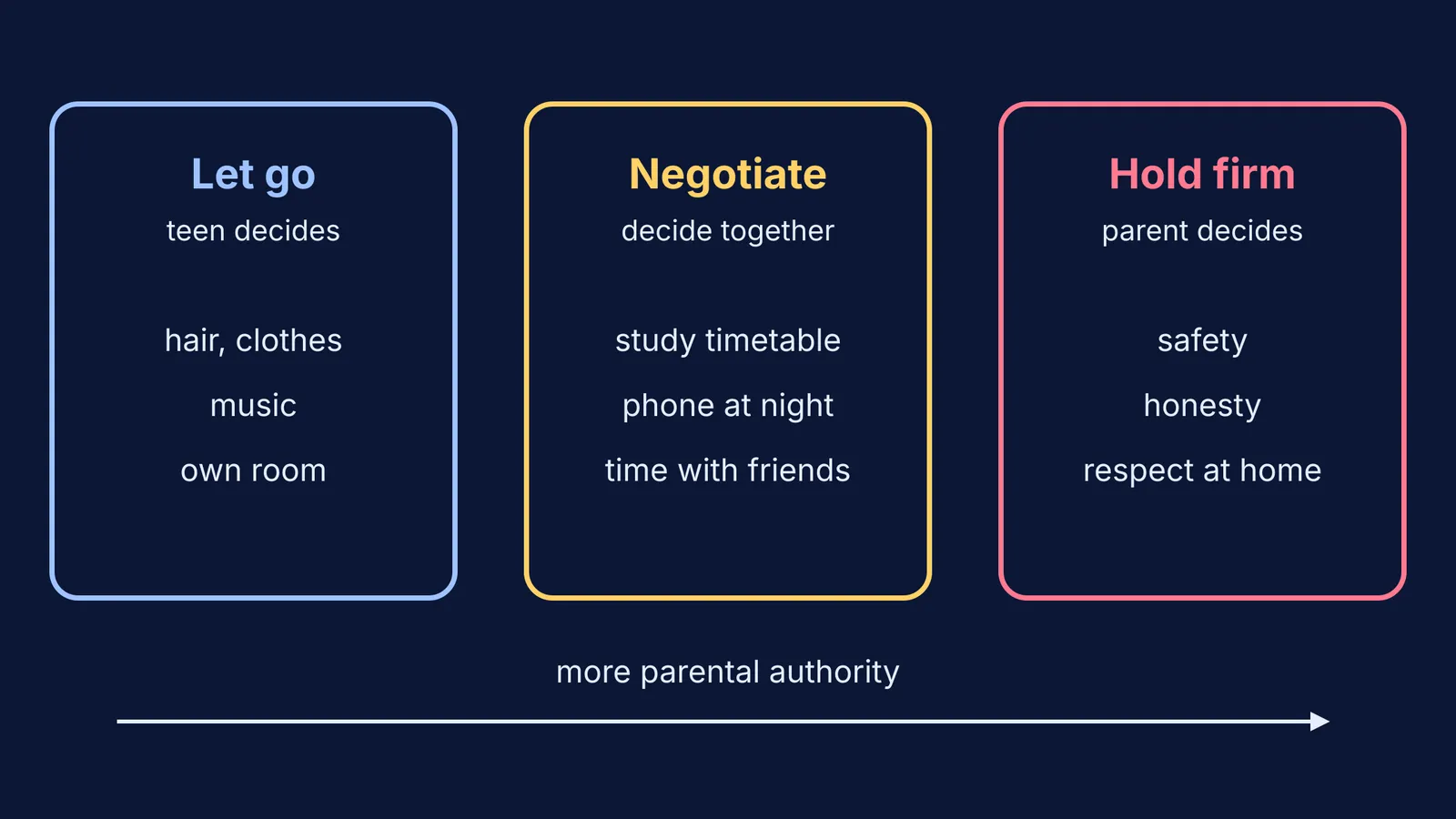
Sort each recurring argument into one of three buckets before you next have it:
Let go (teen decides): hairstyle, clothes, music, how their own room looks. These are personal issues.
Negotiate (decide together): study timetable, phone at night, time with friends, coaching load. These are mixed issues, the ones that come up most, so agree on the goal and let your teen propose the method.
Hold firm (you decide): safety, honesty, and basic respect at home. Explain your reasons once, calmly, and do not reopen them.
Letting your teen win some arguments is not weakness. In a study that followed 157 young teens (average age about 13) into mid-adolescence, those who showed less autonomy in observed earlier discussions with their mothers were more likely to shift their own substance use towards a close friend's level (Allen and colleagues, Child Development, 2012). A teen who practises calm disagreement at home may find it easier to hold their own with friends.
How do I respond when my teen argues?
Use this five-step script for anything in the "negotiate" bucket. Example: your Class 11 child wants to study late at night with the phone nearby; you want them done by 10 pm.
Pause the heat. "I want to sort this out properly. Can we talk after dinner instead of now?"
Say their position back. "So you focus better at night, and the phone is for doubts on the class group?"
Name the goal, not the method. "What I care about is enough sleep and finishing the week's chapters. How you get there is open."
Ask for their plan. "What would you suggest that covers both?" Write down what they say.
Agree a trial and a review date. "Let's try your plan for two weeks, then look at the chapter list together on Sunday."
If it goes badly and you shout, repair it the next day. Our guide on how to apologise to your child after losing your temper has the words.
What if every argument is about studying?
Study fights are usually mixed issues: the goal (learning, marks) is shared, and the method (when, where, how long) feels personal. Agree on targets you can both check, such as chapters finished or problems attempted, and leave the hour-by-hour plan to your teen. See also how many hours your child should study by class. If the argument is really about dropping out of coaching, read what to do when your teen wants to quit JEE coaching.
Sometimes "I'll do it later" means "I don't know where to start". Fermi's AI tutor can work out what your teen already knows and build a plan for the session, so the evening starts with a clear first step instead of a fight.
When is it more than ordinary arguing?
Talk to the school counsellor or a doctor if the anger comes with other changes that last for weeks: pulling away from friends, sleeping or eating very differently, falling marks across subjects, or talk of hopelessness. Tele MANAS is a free, 24x7 national mental-health helpline launched by the Ministry of Health and Family Welfare, on 14416 or 1800-891-4416 (IIT Kanpur counselling service).


