

On this page
A sudden red-ink remark in your child's school diary can bring a rush of anxiety. You might feel defensive, worried about their academics, or frustrated by a sudden discipline issue. However, treating the diary as a bridge rather than a complaint book can change how your child experiences school.
A study in the *Economics of Education Review* by Kraft and Rogers (2015) found that regular, specific teacher-to-parent communication reduced the course failure rate by 41% [[1]](https://doi.org/10.1016/j.econedurev.2015.04.001). A single note is an opportunity to join that conversation and help your child correct their course.
Why did the teacher write a remark in the diary?
Teachers usually resort to a written note when informal verbal warnings in class have not worked. It is a formal way to bring you into the loop. Common reasons include:
Incomplete work: Failing to bring textbooks, submit assignments, or do homework.
Discipline issues: Talking out of turn, disrupting the class, or, as schools increasingly deal with, inappropriate screen time. (What to do when the school says your child misbehaved online offers more guidance on the latter).
Academic struggles: Consistently performing poorly in class tests or showing a lack of understanding. If a teacher says your child is a slow learner, you should know what to ask next.
Whatever the reason, the remark is a signal that the teacher cannot solve the problem alone.
How to respond to a teacher remark in diary?
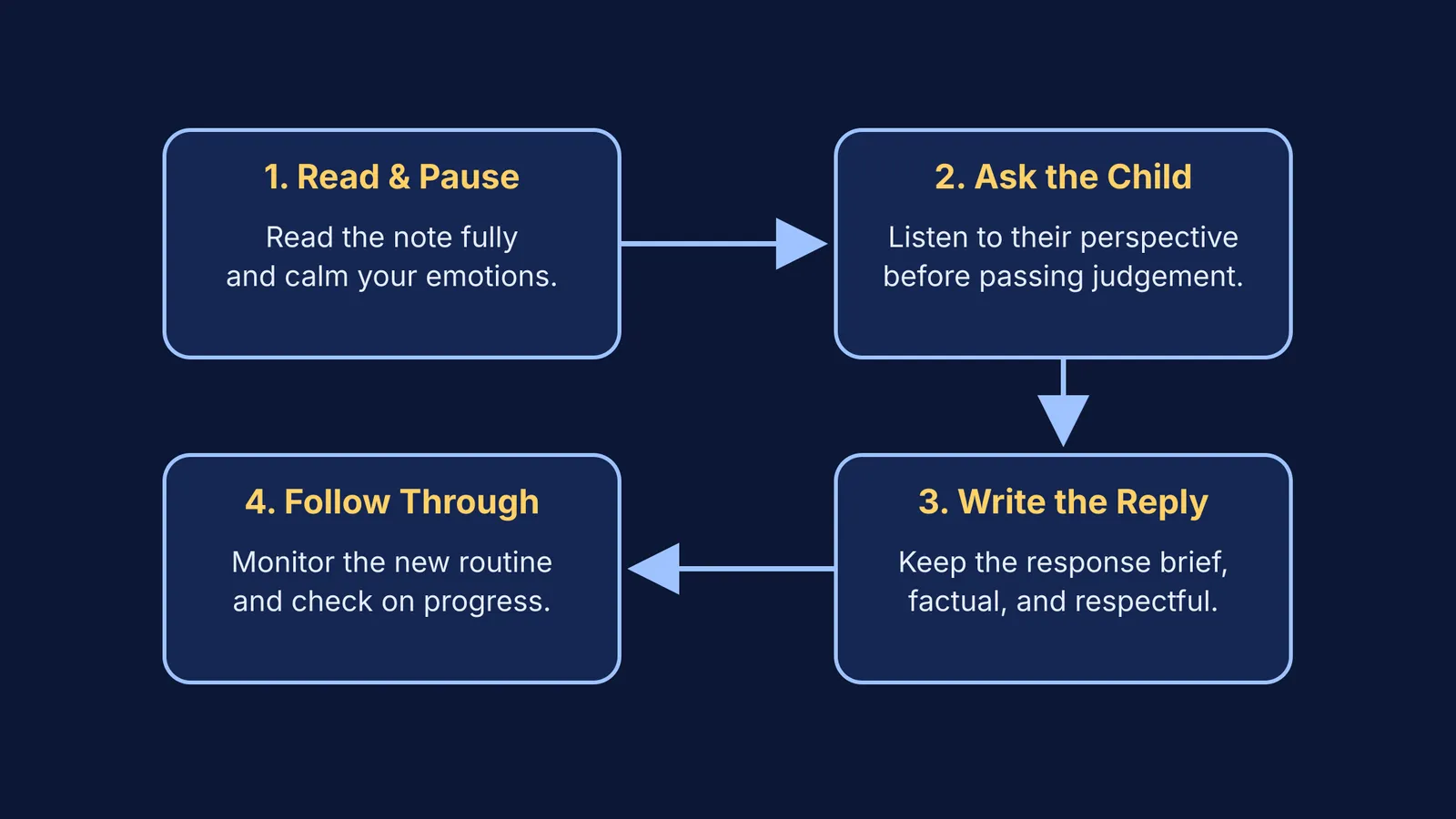
Your immediate reaction sets the tone for your child. Do not react the moment you see the note.
Read and pause: Take 10 minutes to process the note. Acknowledge your frustration, but do not vent it on your child immediately.
Talk to your child first: Before writing anything, hear their side of the story.
Draft a short reply: Acknowledging the teacher's note formally is required, but you do not need to write an essay.
Follow through at home: A note solved with a signature means nothing if the underlying habit does not change.
What should I say to my child first?
Sit down with your child when both of you are calm. Show them the diary and ask an open-ended question.
"I saw the note from your science teacher today. Can you tell me what happened?"
Listen without interrupting. Children often have a context the teacher missed. They might say, "I forgot my book because I packed my bag in a hurry," or "I was talking because the person next to me took my pen."
Do not dismiss the teacher's view, but validate your child's feelings. You can say, "I understand why that made you angry, but talking back in class is not the way to handle it. What can we do differently tomorrow?"
If the remark points out that your child is struggling to start maths or physics problems, they might need a way to practise without just reading the solution. The Fermi Problem Library has a step-by-step solver that explains the reasoning rather than printing an answer, helping them build confidence at home.
What should I write in my diary reply?
When writing your response, keep it brief, polite, and action-oriented. Address the teacher respectfully.
For incomplete work: "Dear [Teacher's Name], noted. I have spoken to [Child's Name] about this. We will check the school bag together every evening to ensure all books are packed. Thank you for letting me know."
For a discipline issue: "Dear [Teacher's Name], noted with concern. We have discussed classroom behaviour at home. Please let me know if this happens again."
For a drop in performance: "Dear [Teacher's Name], noted. We are working on a new revision schedule at home. I would appreciate a brief meeting next week to understand how to help [Child's Name] better."
Always sign and date your response.
How should I follow up with the school?
A diary note is a starting point, not the end. If the problem persists for more than a week, request a parent-teacher meeting. Speaking in person reduces misunderstandings and shows the teacher you are actively involved.
If you feel disconnected from the school's general expectations, consider joining the school Parent-Teacher Association (PTA). Being involved helps you understand the classroom environment and makes the next diary note, if it ever comes, much easier to handle.
By responding calmly, you show your child that mistakes are correctable, and you show the teacher that you are a reliable partner in the student's education.


