

On this page
Sequencing means putting events in the order they happened and saying how one led to the next. For a three- to six-year-old, it is the difference between "Park, ice cream, the dog!" and "First we went to the park, next a dog ran up to us, and last we had ice cream." You do not need worksheets: family photos, a few picture cards and your daily routines are enough.
Why does telling a story in order help with reading later?
A small study of 32 children recorded each child telling stories and explaining things at age 5, then tested their reading and writing at age 8 (Griffin, Hemphill, Camp and Wolf, First Language, 2004). Children who, at 5, could show why the events in their story mattered had stronger reading comprehension at 8. Children whose spoken stories and explanations at 5 were better organised overall tended to write better stories at 8.
That fits what speech and language specialists use in practice. A 2020 tutorial for school clinicians describes telling and retelling stories as a way to teach story grammar, vocabulary, inferencing and complex language (Spencer and Petersen, 2020). A simple "first, next, last" frame gives your child somewhere to hang a story, and may help when they follow stories other people tell.
The 2004 study was small and shows a link, not proof that games cause better reading. Still, the games below are cheap and fun.
How do I play sequencing games with photos and picture cards?
Start with three steps. When your child gets three right without help, move to four or five.
Photos of your own day. Take three photos on your phone while you make chai, pack the school bag or water a plant. Later, show them jumbled and ask, "Which happened first?"
Kitchen cards. Draw three simple pictures: dough in a bowl, a rolled-out roti, a roti puffing on the tawa. Shuffle them, then sort them together.
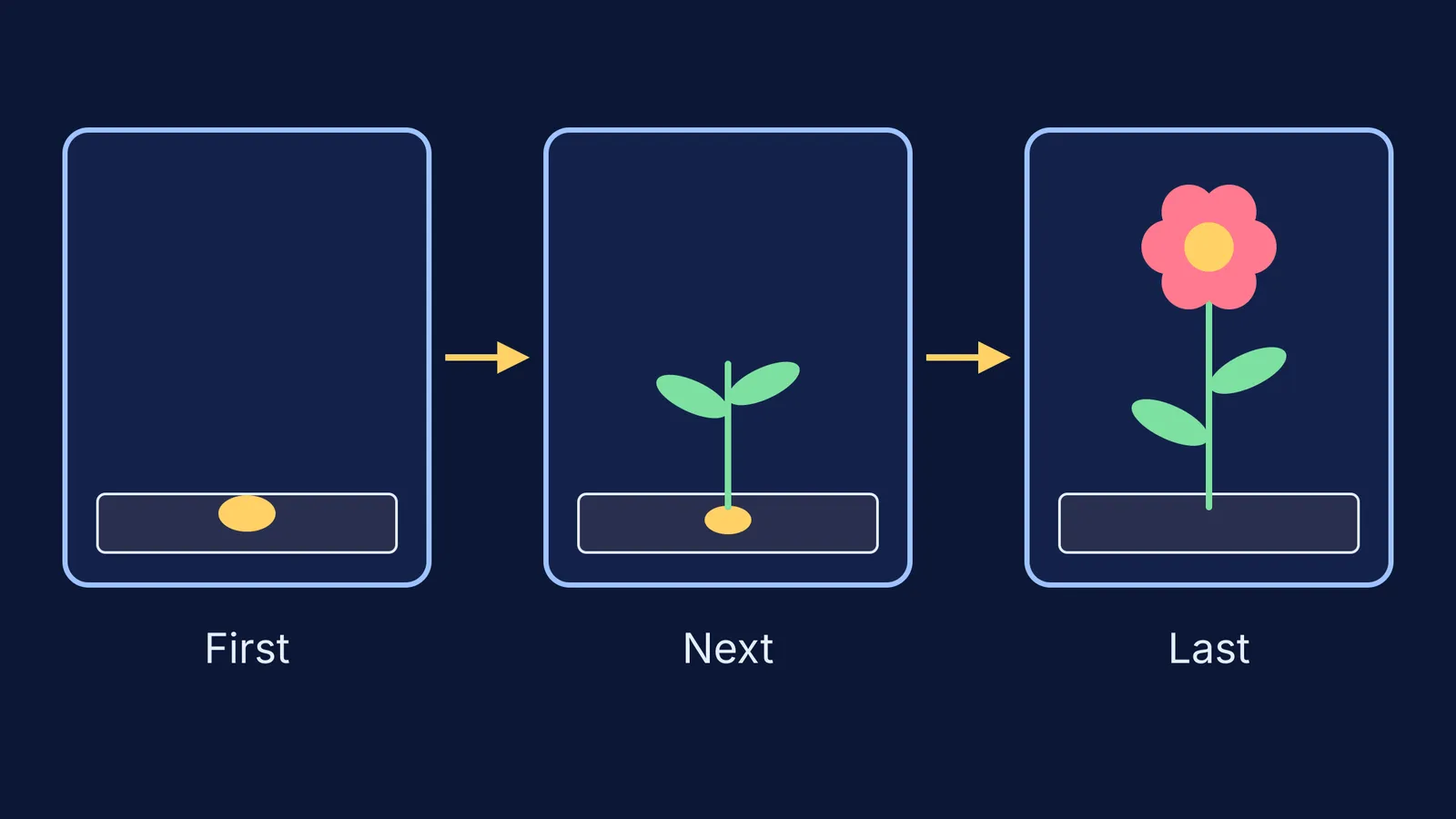
Growing things. A seed, a sprout, a plant with a flower. If you can, sow a few methi or mustard seeds and photograph them every few days, so the cards come from something your child watched.
Book retell. After a picture book, photograph three pages, close the book and ask your child to lay out the pictures and tell the story back.
The silly mix-up. Tell a familiar story in the wrong order ("The thirsty crow drank the water, then he found the pot...") and let your child fix it.
If mornings are busy, the photo game fits into the gaps; there are more ideas in our guide to keeping a toddler busy without a phone in the morning.
What should I say during a first-next-last game?
Here is a worked example with three photos from making dosa.
You: "I have three pictures from this morning. Which one came first?"
Your child points to the batter bowl.
You: "Yes. First we poured the batter. What happened next?"
Your child picks the dosa on the tawa.
You: "Next it cooked on the tawa. And last?"
Your child: "We ate it!"
You: "Can you tell the whole story to Nani, using first, next and last?"
If your child puts a card in the wrong place, do not say "wrong". Ask a checking question instead: "Could we eat the dosa before it went on the tawa?" Let them move the card themselves.
Once the order is easy, add "why" and "how did it feel" questions, because showing why events matter is the part the 2004 study linked to later reading comprehension. Try "Why did we wait before flipping it?" or "How did you feel when it was ready?" Our post on building your child's vocabulary at home has ways to grow the new words that come up.
Retelling in order helps older children too: see why your child cannot tell you what was taught today.
Does putting things in order help with maths too?
Order matters in numbers as well as stories. In a study of 1,391 children in grades 1 to 6, knowing the order of number symbols became a steadily stronger predictor of arithmetic skill and, by grade 6, outweighed the other seven number skills tested (Lyons, Price, Vaessen, Blomert and Ansari, Developmental Science, 2014). That study looked at numbers, not stories, so it does not show that picture cards raise maths marks. But the question "what comes before, what comes after?" is the same one.
You can carry the talk across:
Line up toys and ask who is first, second and third in the queue.
Lay out number cards from 1 to 10 out of order and fix them together.
Ask "What number comes after 7? What comes before it?" on the stairs or in the lift.
Turn a recipe or the bedtime routine into numbered steps your child can follow.
Years later, doing steps in the right order matters again in multi-step maths and science problems. When your child reaches that stage, the Fermi Problem Library has worked problems with a step-by-step solver that explains the reasoning rather than printing an answer.
Tonight, pick three photos from today and ask your child which one came first.


