

On this page
If your five-year-old holds up the wrong hand every time you say "right", nothing is wrong with them. Left and right are hard because, unlike up and down, they depend on which way you are facing. Short games and a hand trick help.
At what age do children learn left and right?
In a 1968 study of children aged 3 to 11, psychologist Akira Katsui of Shizuoka University found that children judged above and below correctly at ages 3 to 4, front and behind at 5 to 6, and left and right only at 7 to 8. The same study found that judging left and right from the point of view of a person facing them came about two years after judging it on one's own body.
JSTOR Daily's summary of a 1963 Child Development study of 148 children by Lillian Belmont and Herbert Birch reports that only 70 percent of five-year-olds answered seven questions about left and right on their own bodies correctly, while by age 10 all of them did.
Even grown-ups slip. In a study in the Quarterly Journal of Experimental Psychology, whose questionnaire went to more than 400 Dutch volunteers, 14.6% rated their own ability to tell left from right as insufficient. So treat this as a skill your child is growing into, not a test they are failing.
How do I teach my child the left hand trick?
Using the hands is a strategy many adults rely on: the Quarterly Journal of Experimental Psychology study found that 42.9% of people use a hand-related strategy to tell left from right. Here is a version that suits young children.
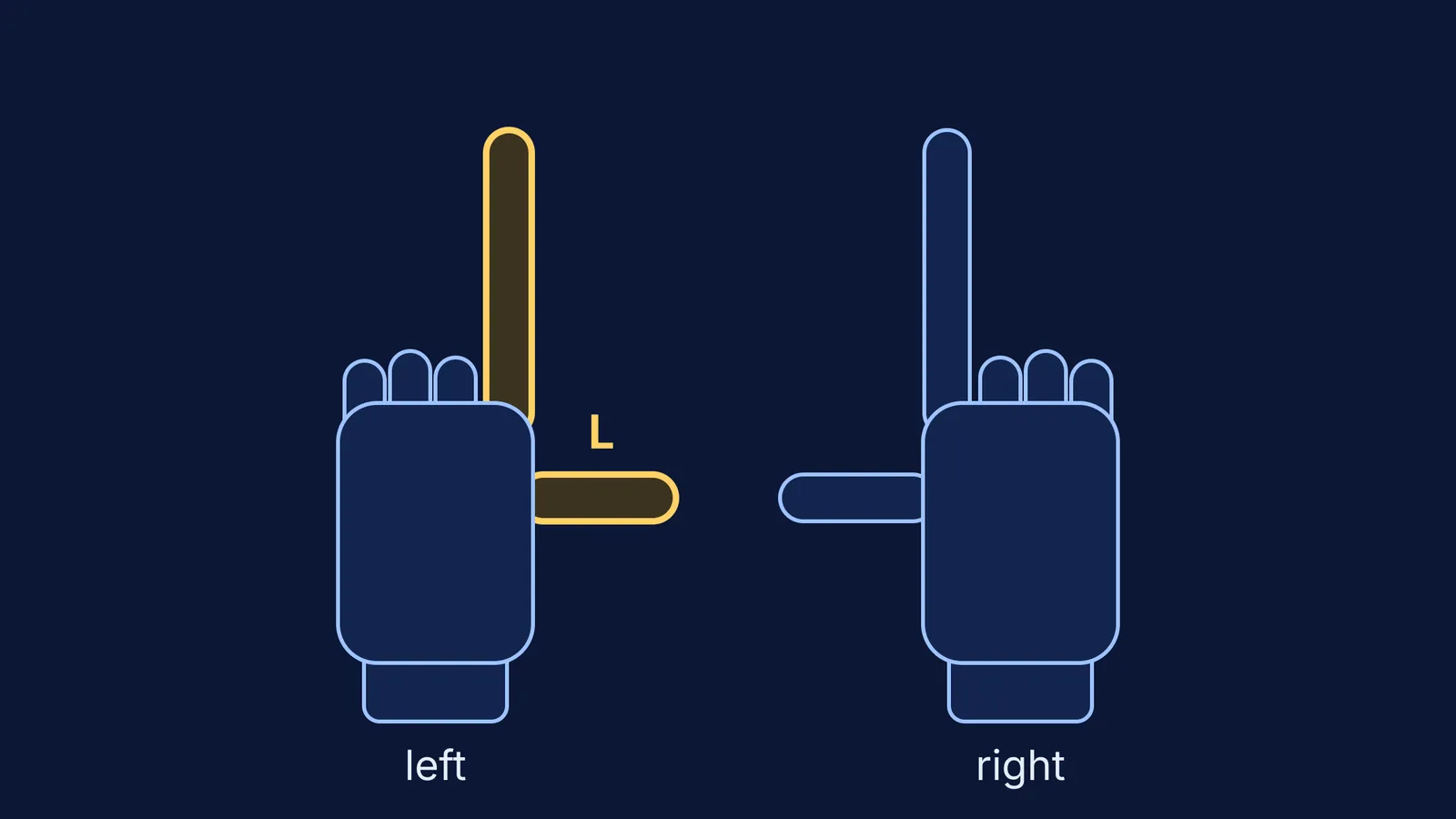
Hold both hands out in front of you, palms facing away, fingers pointing up.
Stick out the thumb and the first finger on each hand, keeping the other fingers folded.
Look: one hand makes a proper capital L. That is your left hand. The other makes a back-to-front L.
Say it together: "L for left."
If your child does not yet know the letter L, use a marker instead: a thread, hair band or small sticker on the same wrist every day. Avoid "the hand you write with" until you know which hand that is, because the rule flips for a left-handed child.
When they get it wrong, skip "No, the other one!" Try this instead: "Hmm, check your L." Let them find the answer, then say, "Yes, that's your left." The point is that they learn how to check, not that they guess right first time.
Which movement games help children learn left and right?
Children remember what their bodies do. Keep each game to about five minutes and stop while it is still fun.
Raja bole. Like Simon says: "Raja bole touch your left ear." Use only "left" commands for the first few days.
Newspaper stepping stones. Lay sheets on the floor and call "left foot" or "right foot" for each step.
Parade march. Put a sticker on the left shoe and march to "left, right, left", stamping a little harder on left.
Picture orders. On paper, ask for a sun on the left side and a tree on the right side.
How do I use left and right in everyday life?
The words stick when they come up many times a day, without any quiz attached. Try:
Dressing: "Right arm in first. Now left."
Shoes: cut a small sticker in half and put one half inside each shoe, so the picture is whole only when the shoes are on the correct feet.
Walks and auto rides: "We turn left at the temple. Which side is the vegetable shop on?"
Meals: "Put the glass on the right side of your plate."
A four-week plan
Week 1: name the left side only, using the hand trick or wrist marker, in two daily routines.
Week 2: add one five-minute movement game each day.
Week 3: start asking your child to direct you on walks.
Week 4: play a game where you stand side by side and they tell you which hand you raised.
When should I worry about left-right confusion?
Mixing up left and right between 4 and 7 is expected on its own, and many children of that age also reverse letters; our guide to why children mix up b and d explains why. If your child is still very unsure at 8 or 9 and also finds reading, copying from the board or coordination hard, mention it to their class teacher and your paediatrician, who can tell you whether an assessment would help.
Older siblings sometimes get a puzzle out of this too: try why mirrors seem to swap left and right but not up and down. For ideas that are easier to see than to read, the Fermi Simulation Lab has interactive simulations they can explore.
Start tonight with one thing: hold up your hands together and find the L.


