

On this page
Why do mirrors swap left and right but not up and down?
It is a classic physics riddle. When you raise your right hand, your reflection raises its left hand. Your shirt's text reads backwards. It seems obvious that the mirror has flipped you horizontally.
But think about the geometry. If a mirror flips things horizontally, why doesn't it flip them vertically? Why is your head still at the top and your feet at the bottom? The truth is that a mirror does neither. A plane mirror only reverses the axis perpendicular to its surface, as discussed in a 2000 paper.
What does a mirror really reverse?
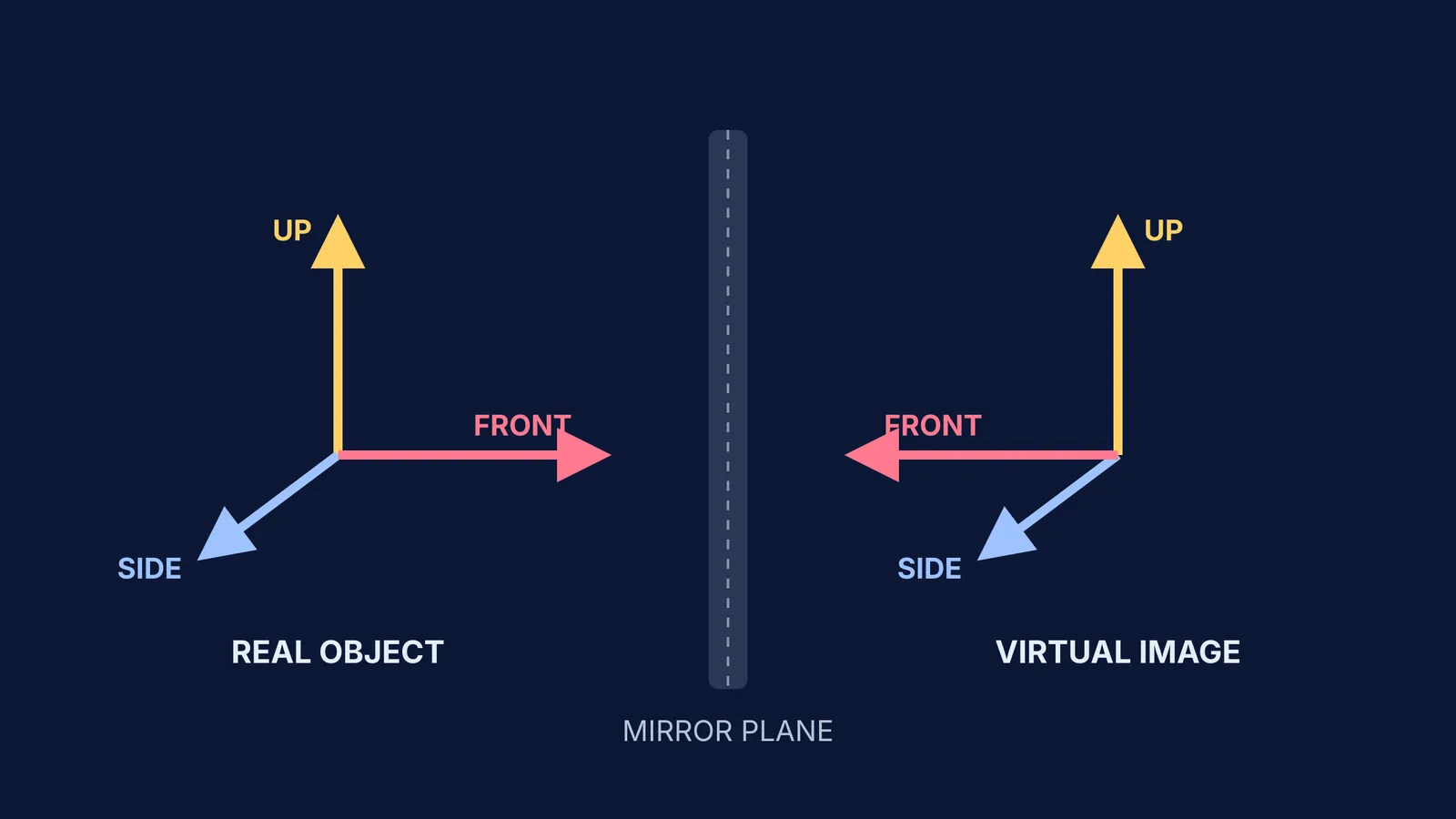
Imagine pointing three arrows while standing in front of a mirror: one pointing up, one pointing to your side, and one pointing directly at the mirror.
Up and Down: Your up arrow points to the ceiling. The reflection's arrow also points to the ceiling. There is no vertical reversal.
Left and Right: Your sideways arrow points to the East wall of the room. The reflection's arrow also points to the East wall. There is no horizontal reversal.
Front and Back: You point the third arrow straight forward, touching the glass. The reflection points its arrow straight back at you.
This is the only true reversal. The mirror image is not a rotated version of you; it is an inside-out version of you, pulled through the glass along the depth axis. If you were to hold a right-hand glove to the mirror, its reflection would perfectly fit a left hand. This happens because pulling an asymmetric, or chiral, object through the depth axis creates its enantiomer—its mirror-image counterpart that cannot be superimposed on the original. This concept is crucial in chemistry, where left- and right-handed molecules behave completely differently in the body.
The mental rotation trick
If the mirror only reverses depth, why do we see a left-right swap?
The answer lies in psychology and human biology. We are bilaterally symmetrical—our left and right sides look roughly the same from the outside. When you see your reflection facing you, your brain automatically assumes it is seeing another person who has walked around to face you. We are so used to encountering other people by walking around them that our brains apply the same rule to the mirror. This is a built-in mental shortcut that usually serves us well in the physical world.
To imagine yourself in the reflection's shoes, your brain performs a mental rotation of 180 degrees around your vertical axis, an illusion detailed in the Corballis study. If you actually turned around to face out from the mirror, your right hand would be on the other side. Because the mirror reversed your depth but not your left/right, the reflection's body does not match the result of your mental rotation. Your brain registers this mismatch as a "left-right swap".
If you are struggling to picture 3D reflections, the Fermi Simulation Lab lets you freely rotate and inspect optical systems, helping you build an intuition for the geometry of light.
Overcoming spatial reasoning hurdles
Spatial puzzles like mirror reflections often trap students because they rely on mental gymnastics rather than concrete rules. If you cannot visualise the depth reversal, drawing the axes out explicitly breaks the illusion. This is why physicists use coordinate systems instead of relying on gut feeling when dealing with transformations in three dimensions.
We see this same hurdle in optics problems across all levels of physics. Whether you are finding the minimum mirror height to see your full image or predicting what happens when rotating a plane mirror by θ, drawing the actual rays prevents your intuition from tricking you. The human brain is not built to intuitively trace multiple reflections or refractions, but it is excellent at following a geometric diagram step by step. When the rules of physics contradict our daily experience, drawing the system accurately is the only way forward.
Fermi's AI tutor works alongside you on these drawings. If it notices you repeatedly swapping signs in a mirror formula, it will not just correct the math. It draws the coordinate system on the board, runs the simulation, and asks you to trace the depth axis until you see why the image forms where it does. By making the abstract concrete, it helps you build a reliable framework for solving optics problems.


