

On this page
To an eight-year-old, a dictionary feels slow. Teach the skills underneath it one at a time: alphabetical order, guide words, and turning a definition into a meaning they understand. A personal word book then makes it a habit.
When should a child start using a dictionary?
NCERT's answer is Class 4. Its Learning Outcomes at the Elementary Stage lists, for Class IV English, that the learner "uses dictionary to find out spelling and meaning". The same list says the learner "infers the meaning of unfamiliar words by reading them in context", so the dictionary sits alongside guessing from the sentence, not in place of it. For Class V, the suggested classroom activities include chances to "refer to the dictionary, for spelling, meaning and to find out synonyms and antonyms".
Schools elsewhere start at a similar age. Researchers George Miller and Patricia Gildea wrote in Scientific American in 1987 that "in about the fourth grade" most schools begin to teach dictionary skills such as spelling, alphabetising and pronunciation. So Class 2 and Class 3 are a sensible time for the groundwork.
How do you teach alphabetical order as a game?
Keep games short; move on only when the last one feels easy.
Family line-up: write everyone's name on a slip (Amma, Dadi, Rohan, Zoya) and put the slips in ABC order.
Spice shelf: sort jars by name (haldi, jeera, methi, rai), then slot hing into the right place.
Second-letter sort: give words that share a first letter (bat, bed, big, box, bus), then words that share two (beach, bead, beak, bean). This step is often harder, and it is exactly the skill a dictionary needs.
Front, middle or back: before opening the dictionary, your child guesses where "tiger", "egg" and "monkey" will be, then checks.
What are guide words in a dictionary?
Guide words are words printed at the top (or sometimes the bottom) of a dictionary page to help readers find a specific entry (Wiktionary). In most children's dictionaries the left one is the first entry on the page and the right one is the last.
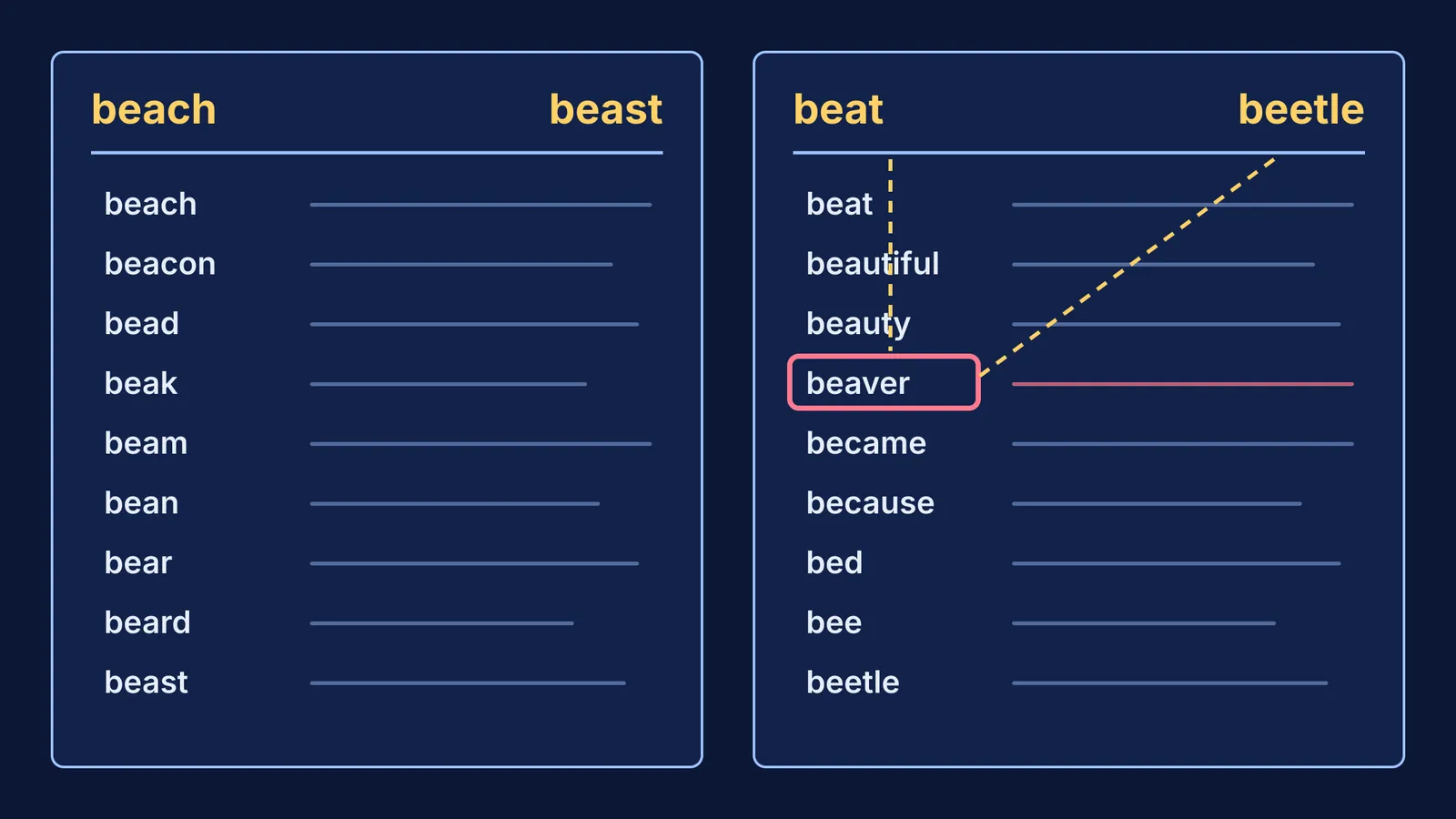
Here is a worked example to do together. Your child wants "beaver".
Open to the B section. One page shows the guide words beach and beast.
Compare letter by letter: b-e-a-v and b-e-a-s. V comes after S, so "beaver" is later than "beast". Turn the page.
The next page shows beat and beetle. "Beaver" comes after "beat" (V after T) and before "beetle" (A before E). It must be on this page, so scan down it.
Then say: "Is it after the first guide word? Is it before the last one? Then it lives on this page."
Why does the dictionary meaning confuse children?
Miller and Gildea studied several thousand sentences written by children in the fifth and sixth grades who had been asked to look up a word and use it in a sentence. Children often picked a familiar phrase out of the definition and swapped the new word in. A fifth-grader who looked up "erode" found "eat out" in the definition and wrote "Our family erodes a lot." In the same article, fourth-graders asked to choose between just two meanings of a word did little better than chance.
Plainer definitions help. In a 1993 study in Reading Research Quarterly, Margaret McKeown compared ordinary dictionary definitions with definitions revised to fix their common problems. The revised ones led to significantly more sentences showing a typical, correct use of the word (ERIC summary). So choose a children's or learner's dictionary, and read the example sentence aloud before the definition.
How do you make a personal word book?
Use a thin notebook with A to Z tabs, so every entry is more alphabetical-order practice. Each entry gets five lines:
The word, and where it was found (book, signboard, science chapter).
The guide words on its dictionary page.
The meaning, in their own words.
Their own sentence, checked with you for the swap mistake.
A small drawing, if it helps.
A simple plan for the year before Class 4:
First month: alphabet games, three times a week.
Second month: guide-word hunts. You call out a word and they find its page.
From the third month: two words a week from their own reading go into the word book. On Sunday they read the week's entries back to you.
The habit has formed when your child reaches for the dictionary unasked. Our weekly spelling plan for home fits alongside the word book, and how to build your child's vocabulary at home has more word games. For the other half of this plan, see building a reading habit in a 10-year-old.
Later, many hard words come from science and maths: photosynthesis, perimeter, friction. When a definition alone does not make one clear, the Fermi Concept Library has a lesson for every concept in physics, chemistry, biology, mathematics and computing.
Start tonight with the family line-up game; it needs only paper and a pencil.


